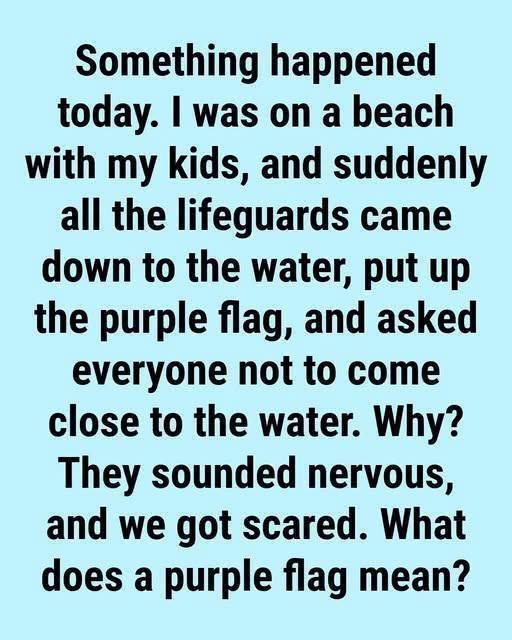
A perfect beach day can turn dangerous in seconds.
The sun is shining, the water looks calm, and families are laughing along the shoreline. Children run toward the waves while adults relax nearby, convinced that there is nothing to worry about.
Then you notice a small purple flag.
For many people, it barely registers.
They keep swimming. They let their children wade into the shallows. They assume the flag is simply another warning that can be ignored, especially when the ocean looks completely peaceful.
But that small purple flag can be telling you something important.
Something may be drifting beneath the surface.
Jellyfish. Stingrays. Portuguese man o’ war. Other marine creatures capable of painful or dangerous stings may be present in the water. They can be difficult to see, especially when waves are moving, sunlight reflects off the surface, or the water is cloudy.
The ocean can look perfectly safe while hiding something you cannot see.
That is what makes the purple flag so important.
It is not necessarily telling you to panic or stay away from the beach entirely. Instead, it is a signal that conditions in the water have changed and that you should pay closer attention to what is happening around you.
Marine life can be carried toward shore by currents, tides, wind, and changing water conditions. Something that was far from the beach earlier in the day can suddenly appear close to swimmers.
And unlike a large wave or strong current, a jellyfish or other stinging creature may provide almost no visible warning.
You might see nothing.
You might step into the water believing everything is normal.
Then, suddenly, you feel a sharp sting.
For children, the risk can be even harder to recognize. Young swimmers may not understand what the flag means, and they may be too distracted by the excitement of being in the ocean to notice unusual creatures in the water.
That is why parents and guardians should pay particular attention when a purple flag is flying.
Keeping children close, watching where they step, and listening to lifeguards can make a major difference.
In shallow water, one useful precaution around potential stingrays is to shuffle your feet rather than taking large steps. This can help reduce the chance of accidentally stepping directly on a ray.
It is also wise to avoid touching marine animals, even if they appear harmless or have washed onto the beach.
A creature that looks lifeless may still be capable of causing injury.
The same principle applies to jellyfish and other unfamiliar organisms. Do not assume that something is safe simply because it is small, transparent, or motionless.
The safest response is to give marine life plenty of space.
Another important step is talking to lifeguards.
They are often the people most aware of what has been happening in the water that day. They may know whether jellyfish have recently been spotted, whether stingrays are common in a particular area, or whether changing conditions have brought marine life closer to shore.
A few seconds spent asking a question can be far more useful than simply guessing.
The purple flag is therefore less about fear and more about awareness.
The ocean does not have to be dangerous for you to respect it.
In fact, most beach days are perfectly enjoyable. People swim, surf, paddle, and play in the water without encountering anything serious. But the conditions of the ocean can change quickly, and responsible swimmers understand that calm water does not always mean completely risk-free water.
The surface can be beautiful.
Beneath it, conditions can be very different.
Warm currents can transport marine organisms toward shore. Tides can change where animals are found. Wind and waves can move floating creatures into areas where swimmers were previously comfortable.
That is why beach safety is not simply about watching the waves.
It is also about noticing the signals around you.
Flags.
Warning signs.
Lifeguard instructions.
Changes in water conditions.
And even reports from other swimmers.
Ignoring these warnings because the water looks calm can create unnecessary risk.
A purple flag is especially easy to overlook because it does not have the same immediate visual impact as a dangerous surf warning. There may be no giant waves, no dramatic current, and no obvious sign that something is wrong.
But the warning exists for a reason.
If you see one, slow down and pay attention.
Look around before entering the water.
Keep children within close reach.
Avoid areas where marine life has been reported.
Ask the lifeguard what has been spotted.
And if conditions seem uncertain, consider staying closer to shore or waiting until the warning has changed.
None of this means you have to fear the ocean.
It simply means respecting what you cannot see.
The sea has always carried an element of uncertainty. That is part of its beauty, but it is also why swimmers need to understand its signals.
A small purple flag may seem insignificant compared with the enormous ocean surrounding it.
But sometimes, the smallest warning deserves the most attention.
Because the difference between a beautiful beach memory and a painful emergency can come down to one simple decision:
Notice the flag.
And take it seriously.