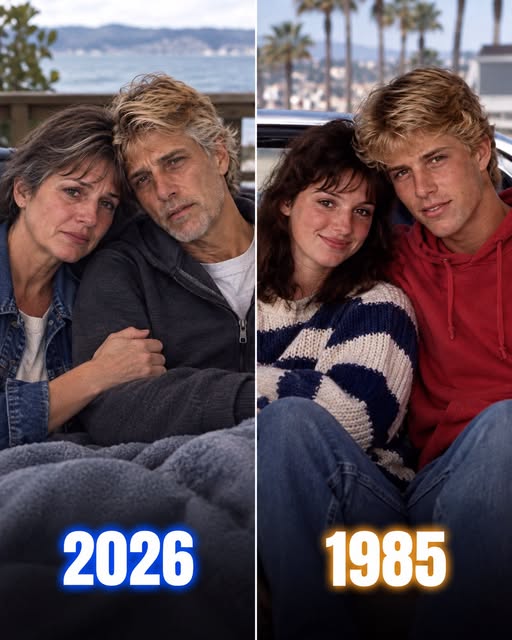
For forty-one years, I believed the cruelest thing Jeffrey could ever do was ask me to disappear. I had spent most of my adult life carrying those words with me, even after I convinced myself I had stopped caring. Then, unexpectedly, I found myself standing outside his hospital room, one hand frozen against the door, staring at a number that seemed impossible to connect with the person I had once known so intimately. Behind that door was the man whose final letter had taught me to stop hoping. The man I had once imagined growing old beside. The man who had eventually asked me to become a stranger.
For a moment, I could not make myself move.
The hospital corridor was quiet, almost painfully ordinary. Nurses passed by with practiced efficiency. Machines sounded somewhere beyond the walls. Doors opened and closed. People whispered to one another as if the building itself demanded silence. Yet for me, the hallway had become a place where forty-one years seemed to collapse into a single breath.
I had imagined seeing Jeffrey again countless times over the years, usually in ways that had nothing to do with reality. Sometimes I imagined running into him unexpectedly in a grocery store or across a crowded street. Sometimes I imagined him calling. Sometimes, during particularly lonely moments, I wondered what I would say if he ever appeared at my door and asked me to forgive him.
But I had never imagined this.
A hospital room.
A final illness.
A door I was terrified to open.
Jeffrey’s goodbye had arrived in writing. There had been no dramatic confrontation, no opportunity to argue, and no conversation in which I could persuade him to reconsider. His words had been painfully clear, along with a request that left almost no room for interpretation: no more contact.
So I respected it.
That may have been the hardest thing I had ever done.
There were nights when I wanted to write to him anyway. I would sit with a blank page or an unsent message and wonder whether one sentence could somehow change everything. I would think about the memories we shared, the promises we once made, and the future we had once spoken about as though it were guaranteed.
But I never sent anything.
I told myself that respecting his wishes was another form of love. If he needed me gone, then I would stay gone. If disappearing from his life was what allowed him to move forward, I would accept the pain and let him have that freedom.
Through the years that followed, I tried to understand something I had never wanted to learn: loving someone does not guarantee a place in their life.
That truth took years to accept.
At first, I waited.
Then I hoped less.
Eventually, I stopped waiting altogether.
Life continued because it always does. Seasons changed. People came and went. Responsibilities filled the spaces where longing had once lived. I learned how to build routines that did not include him. I learned how to answer questions about my past without saying his name. I learned how to remember without allowing the memories to control my present.
Most importantly, I eventually stopped imagining a future with Jeffrey.
Or at least, I convinced myself I had.
Because standing at the far end of that hospital corridor, I suddenly understood something I had spent decades refusing to acknowledge: I had stopped imagining the future, but I had never completely forgotten the one I had once wanted.
I remembered it all.
Not perfectly. Memory is never perfect after four decades. But I remembered enough.
The way he used to look at me when he thought I wasn’t watching. The conversations that seemed endless because neither of us wanted them to end. The ordinary plans that felt extraordinary simply because we were making them together. The small promises people make when they believe they have years ahead of them.
We had once thought time belonged to us.
Forty-one years proved otherwise.
I stared at the hospital door and wondered what had brought me there. Was it forgiveness? Guilt? Curiosity? Love? Closure? Maybe it was none of those things. Maybe some part of me simply needed to know whether the person I had carried in my memory still existed somewhere beneath all those years.
My hand remained against the door.
I almost turned around.
There would have been something strangely safe about leaving. I had already survived his goodbye once. I could survive walking away from this door too. I could tell myself that some stories are better left unfinished.
Then I heard movement inside.
My heart began beating faster.
I opened the door.
And there he was.
Older, weaker, changed by time in ways that were impossible to ignore.
For a second, neither of us spoke.
I had spent forty-one years imagining what his face might look like, but none of those imagined versions prepared me for the reality. Time had touched him. It had touched me too. We were no longer the people who had once stood together believing the future would unfold exactly as we wanted.
I stood there wondering whether he even recognized me.
Then his voice came.
Quietly.
Almost uncertainly.
He said my name.
Everything I had buried over those decades began to unravel.
Not because those two words magically repaired what had happened. They didn’t. His voice could not erase the letter. It could not explain forty-one years of silence. It could not give back the time we had lost or undo the pain I had learned to live with.
But hearing my name from him changed something.
It brought me back to the present.
For years, Jeffrey had existed in my mind as a memory frozen in time. A person connected to another version of my life. But suddenly he was no longer only someone I remembered. He was sitting in front of me, breathing, speaking, looking at me.
And I was listening.
There was no simple way to measure the distance between that letter and this doorway. Forty-one years had passed between the moment he asked me to disappear and the moment he said my name again. We had lived through entire lives in the space between those two moments.
There had been birthdays.
Losses.
Celebrations.
Regrets.
Ordinary mornings.
Long nights.
People we had loved.
People we had lost.
Versions of ourselves that no longer existed.
I wanted to ask him everything at once.
Why?
Why did you leave?
Why didn’t you call?
Did you ever think about me?
Did you regret it?
Did you ever wonder where I was?
But some questions are too large to ask all at once. Some answers require more courage than a single conversation can contain.
So I stayed.
I listened.
For the first time in decades, there was no letter standing between us. No envelope carrying words that could not be challenged. No silence that had to be interpreted from a distance.
There was simply a room.
Two people.
And a conversation that had somehow survived forty-one years of silence.
Hearing Jeffrey say my name did not make the past disappear. It did not transform what happened into something beautiful. It did not guarantee forgiveness, reconciliation, or even another meeting.
But it gave me something I had not expected.
A beginning.
Not the beginning I had once imagined when we were young. Not the future we had once believed would be ours. Something completely different.
A chance to finally hear what had been left unsaid.
And perhaps, after forty-one years, that was enough to make me open the door.