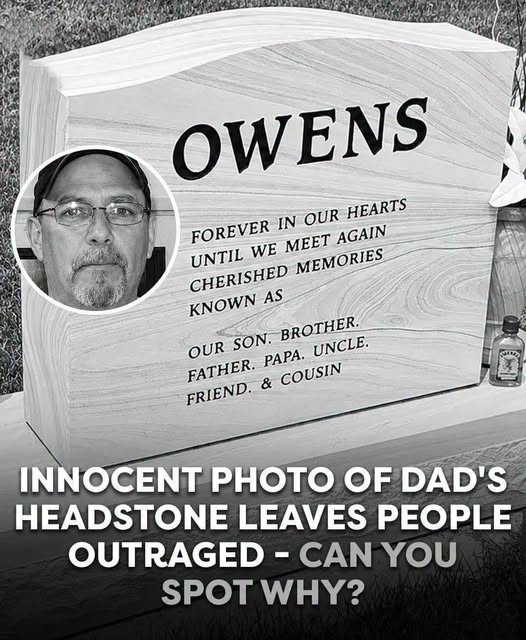
One family’s final goodbye became an unexpected battle over a hidden profanity, turning a deeply personal memorial into a public controversy. Steven Paul Owens’ loved ones wanted his headstone to reflect the man they knew, remembered, and loved, including the humor and irreverence that had made him unforgettable to those closest to him. But what the family considered a fitting tribute soon attracted objections from cemetery officials, who wanted the inscription changed. As the disagreement spread beyond the cemetery, strangers began debating decency, respect, and the limits of personal expression in a place reserved for remembrance. What should have remained a private farewell became a much larger discussion about who has the authority to decide how someone should be remembered after death.
The controversy centered on a message concealed in plain sight. The first letters of the lines in Owens’ epitaph, when read vertically, spelled out a profanity. The arrangement was intentional, according to his family, who viewed the hidden message as an inside joke that captured an essential part of his personality. Rather than seeing the inscription as an attempt to disrespect the dead, they considered it a final expression of the humor that had defined their relationship with him. For those who knew Owens personally, the wording carried a meaning that outsiders might not immediately understand. It was not simply a collection of words carved into stone; it was a private reference transformed into a lasting memorial.
However, once the inscription began circulating online, its meaning became the subject of widespread public discussion. People who had never met Owens began offering opinions about whether such language belonged in a cemetery. Some viewed the hidden profanity as inappropriate, arguing that burial grounds should remain places of solemnity and respect. Others defended the family’s decision, suggesting that a memorial should reflect the individual being remembered rather than conform entirely to conventional expectations. The disagreement revealed how differently people understand the purpose of a headstone. For some, it is a formal statement of remembrance. For others, it is an opportunity to preserve a loved one’s personality, including the qualities that might not fit traditional ideas of decorum.
Cemetery officials sought a revision to the inscription, raising concerns about the standards expected in a shared public setting. Their position reflected the responsibility of maintaining an environment where people from different backgrounds can visit graves, mourn relatives, and remember loved ones without encountering language they consider offensive. Cemeteries are often shared by several generations, including children, and officials may have rules governing the wording or appearance of memorials. From that perspective, even a message hidden within an otherwise ordinary epitaph can raise questions about whether a monument meets the standards established for the site.
For Owens’ family, however, the request to change the inscription presented a different kind of problem. Altering the wording would mean changing something they had deliberately chosen to preserve his character. The hidden message was reportedly more than an attempt to provoke strangers or attract attention. It represented a familiar kind of humor, one that made sense within the relationships and memories shared by those who loved him. To the family, removing it risked turning a personal tribute into something more conventional but less authentic. They believed that remembering Owens honestly meant allowing his personality to remain visible, even if some people found that personality unconventional.
The dispute highlighted the complicated relationship between grief and public expectations. Losing someone can make even the smallest details of a memorial feel deeply significant. The words chosen for a headstone may become one of the few permanent expressions of a family’s relationship with the person who has died. A phrase that appears unusual or inappropriate to an outsider can hold an entirely different meaning for those who understand its history. Inside jokes, familiar expressions, and playful references can carry memories that cannot easily be explained to strangers. When those details are challenged, grieving relatives may feel that the objection extends beyond the wording itself and becomes a judgment about the person they are trying to honor.
At the same time, the cemetery’s position raised questions that could not simply be dismissed. A cemetery is not always a completely private space, even when an individual grave represents a deeply personal relationship. Other families visit the same grounds to mourn their own losses, and cemetery operators may have to balance different expectations about appropriate language and conduct. What one family sees as affectionate humor may be interpreted differently by another visitor. Establishing standards for a shared environment can therefore involve difficult decisions, particularly when a memorial’s intended meaning conflicts with the expectations of other people using the same space.
The internet added another layer to the disagreement. Before the inscription attracted wider attention, its significance belonged primarily to Owens’ family and the people who understood his humor. Once images and descriptions circulated online, the headstone became a symbol in a debate that extended far beyond the people directly affected. Online discussions often reduce complicated personal situations to opposing positions, encouraging people to decide quickly whether something is right or wrong. In this case, the central question was not merely whether a profanity was acceptable. It was whether strangers should have the power to determine which aspects of a deceased person’s personality are appropriate to preserve in a permanent memorial.
Supporters of the family argued that respect does not always have to look solemn. Some people are remembered through formal inscriptions and traditional expressions of affection, while others are remembered through jokes, unconventional gestures, and stories that make their loved ones smile even in the middle of grief. A memorial that reflects a person’s irreverence may be just as meaningful to a family as one that uses conventional language. From this point of view, the hidden message represented a refusal to separate the person Owens had been in life from the person his family was mourning in death.
Critics, meanwhile, emphasized that intention does not automatically determine how a message affects others. Even when a family means no harm, a public inscription can be encountered by people who do not share the same background or sense of humor. Their concerns were rooted in the idea that a cemetery should provide a respectful atmosphere for everyone, rather than allowing each memorial to operate entirely according to individual preferences. The disagreement therefore involved two understandable but competing principles: the freedom to express personal grief and the responsibility to respect the expectations of a shared setting.
The situation also raised questions about the authority cemetery officials have over memorial inscriptions. The answer can depend on the cemetery’s ownership, applicable regulations, contractual terms, and established rules for headstones. A family may choose the wording of a memorial, but that choice can still be subject to restrictions governing the property. Without specific details about the applicable rules and the final outcome of this particular dispute, it would be difficult to determine whether the requested revision was legally enforceable or how the disagreement would ultimately be resolved.
Beneath the arguments about language and public standards, the family’s position reflected something deeply human: the desire to remember a loved one as a real person rather than as an idealized image. People are complicated. They can be kind and difficult, serious and playful, respectful in some situations and irreverent in others. When someone dies, the people left behind often search for ways to preserve those distinctive qualities. For Owens’ family, the hidden message offered a way to keep his humor alive, even in a place where humor is not usually expected.
Ultimately, the controversy surrounding Steven Paul Owens’ headstone revealed how difficult it can be to balance individual expression with shared standards of respect. Cemetery officials sought to maintain the dignity of a common space, while his loved ones wanted a memorial that reflected the personality they knew and cherished. Neither side approached the question from exactly the same understanding of what a headstone should represent. One emphasized the experience of everyone visiting the cemetery; the other emphasized the intimate memories of the family saying goodbye.
The dispute leaves behind a question that reaches beyond a single inscription: should a