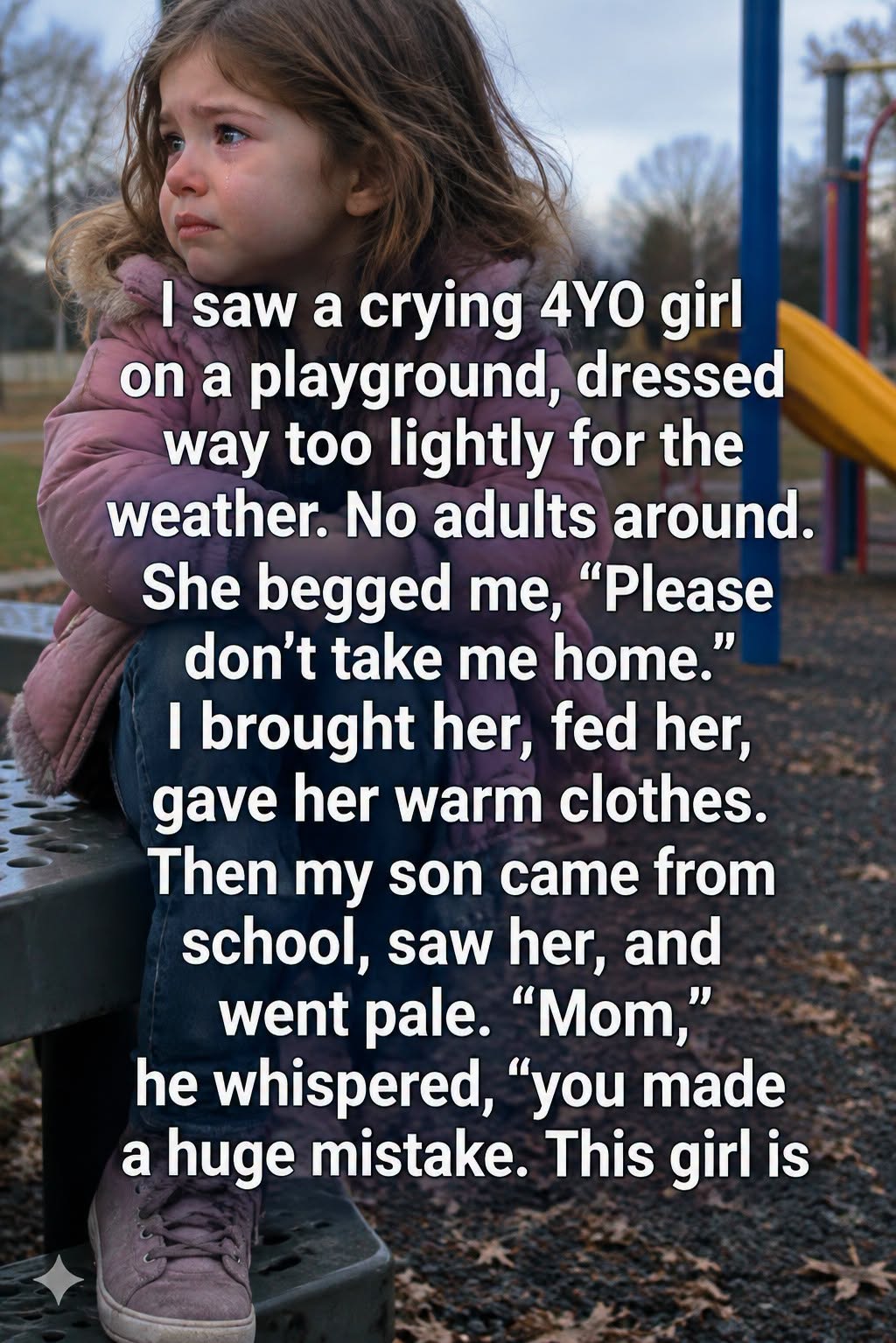
I didn’t know her name when I first wrapped her in my son’s old hoodie.
All I knew was that she was cold.
She sat quietly, shoulders pulled inward, flinching whenever a door closed or someone moved too quickly nearby. There was something about the way she looked around the room that made it seem as though she was constantly waiting for something bad to happen.
When I offered her food, she ate quickly.
Not like a hungry child who had simply missed a meal, but like someone who believed the plate might disappear if she didn’t finish fast enough.
I remember watching her and wondering how long a child had to live with fear before fear became part of her normal life.
She barely spoke.
She kept her eyes lowered.
And every unfamiliar sound seemed to make her body tense.
I didn’t know her story yet.
I didn’t know where she had come from or why she had ended up there.
Then my son walked through the door.
He dropped his backpack, looked across the room, and suddenly stopped.
His expression changed.
He whispered just one thing.
“That’s Emma.”
And somehow, those two words opened the door to a story that would change all of us.
Emma had already experienced more loss than any child should have to understand.
Her parents were gone.
For a while, she had still had her grandmother—a person who loved her, cared for her, and gave her something that every child needs: the feeling that someone would be there tomorrow.
But that stability eventually disappeared too.
Emma was placed in an orphanage.
In theory, it was supposed to be a place of safety.
A place where she would be cared for until another permanent solution could be found.
But to Emma, it felt less like shelter and more like exile.
She had already lost the people she loved.
Now she had lost the place she called home.
When I heard the story, I found myself thinking about how easily adults use words like “placement,” “facility,” and “care” without understanding what those words can mean to a frightened child.
For us, it was a system.
For Emma, it was her entire world.
Returning her there felt wrong.
But keeping her without knowing whether I had the legal right to do so felt wrong too.
I was caught between two fears.
I was afraid of abandoning her.
And I was afraid of taking something that wasn’t mine to take.
So I did the only thing I knew I could live with.
I made her a promise.
I told her I would come back.
I didn’t know how long it would take.
I didn’t know how complicated the process would become.
I didn’t know how many doors I would have to knock on or how many forms I would have to fill out.
But I knew I would return.
And then the system began.
There were forms.
There were interviews.
There were inspections.
There were questions about my home, my finances, my history, my parenting, and almost every part of my personal life.
Every question was understandable in isolation.
Children need protection.
Adults who want to take responsibility for a child need to be evaluated.
The system has a duty to make sure that a placement is safe.
But knowing that did not make the waiting easier.
Because while adults were filling out paperwork and checking boxes, Emma was still waiting.
Her future was suspended between decisions made by people she barely knew.
Every day mattered to her.
Every delay felt enormous.
I kept wondering what she thought.
Did she believe I would actually come back?
Or had she already learned not to trust promises made by adults?
That was the part that frightened me most.
Children who have experienced repeated loss can learn to protect themselves by expecting disappointment.
Hope becomes dangerous because hope can hurt.
So I kept showing up.
I answered questions.
I completed paperwork.
I opened my home to inspections.
I sat through interviews where strangers tried to determine whether I was capable of giving Emma the stability she needed.
Sometimes it felt as though my entire past was being placed under a microscope.
But I reminded myself why I was doing it.
This wasn’t about proving something to myself.
It was about proving that Emma could finally have a place where she would not have to wonder whether someone was coming back.
Eventually, the day arrived when the judge signed the papers.
There was no dramatic movie scene.
Emma didn’t run across the room and throw herself into my arms.
She didn’t suddenly become a different child.
Instead, she simply exhaled.
It was a tiny sound, almost too quiet to notice.
But I noticed it.
It sounded like someone who had been holding her breath for years.
Maybe she didn’t fully understand what the papers meant.
Maybe she was still afraid that another adult would change their mind.
Maybe she had learned that good news should always be treated carefully.
Whatever she was thinking, she was finally staying.
The days that followed were not perfect.
There were still difficult mornings.
There were moments when she became frightened for reasons I didn’t understand.
Sometimes she needed reassurance about things that seemed ordinary to everyone else.
Sometimes she checked the locks.
Sometimes she woke during the night.
Sometimes she watched the adults around her as though trying to determine whether we were really going to be there in the morning.
So we stopped expecting her to heal according to a schedule.
We gave her time.
We let her ask questions.
We let her be quiet.
And slowly, ordinary things began to happen.
She started laughing with my son.
At first, the laughter seemed almost surprising, as though she was discovering the sound herself.
Then it became normal.
She began leaving drawings on the refrigerator.
She started arguing over small things like which movie to watch.
She became comfortable enough to complain when dinner wasn’t what she wanted.
Those little moments meant more than any dramatic declaration of love could have.
Because they meant she was beginning to feel safe enough to simply be a child.
She still checks the locks before bed.
But now she checks them only once.
Then she walks away.
She still has moments when the past catches up with her.
We know there are memories that may never disappear completely.
There may always be parts of her story that hurt.
But she is no longer facing those memories alone.
She still calls me by my first name.
And honestly, that’s enough.
I’ve learned that love doesn’t always arrive with the words people expect.
Sometimes a child doesn’t immediately call you “Mom” or “Dad.”
Sometimes love doesn’t come wrapped in a perfect family story.
Sometimes it begins much more quietly.
It begins with a frightened child sitting on a cold swing.
It begins with an old hoodie wrapped around small shoulders.
It begins with a plate of food and the realization that someone is eating as though they expect it to disappear.
And sometimes it begins with one adult making a promise.
Not a promise that everything will suddenly become easy.
Not a promise that the past can be erased.
Just a promise that says:
I will come back.
And then the hardest part is keeping that promise.
Emma taught me that family is not always created in the way we imagine.
Sometimes it is created through patience.
Through paperwork.
Through difficult conversations.
Through showing up again and again.
Through proving, slowly, that tomorrow will still contain the same people who were there today.
The most important thing I could give her was not a perfect life.
It was consistency.
A door that stayed open.
A room that remained hers.
A family that didn’t disappear when things became difficult.
And the freedom to decide, in her own time, what I would eventually mean to her.
Maybe one day she’ll call me something different.
Maybe she won’t.
I don’t need to force it.
Because love isn’t measured by the title a child gives you.
Sometimes love is simply knowing that when the world once taught a child that people leave, one person decided to stay.
And sometimes, that is enough to begin rebuilding an entire life.