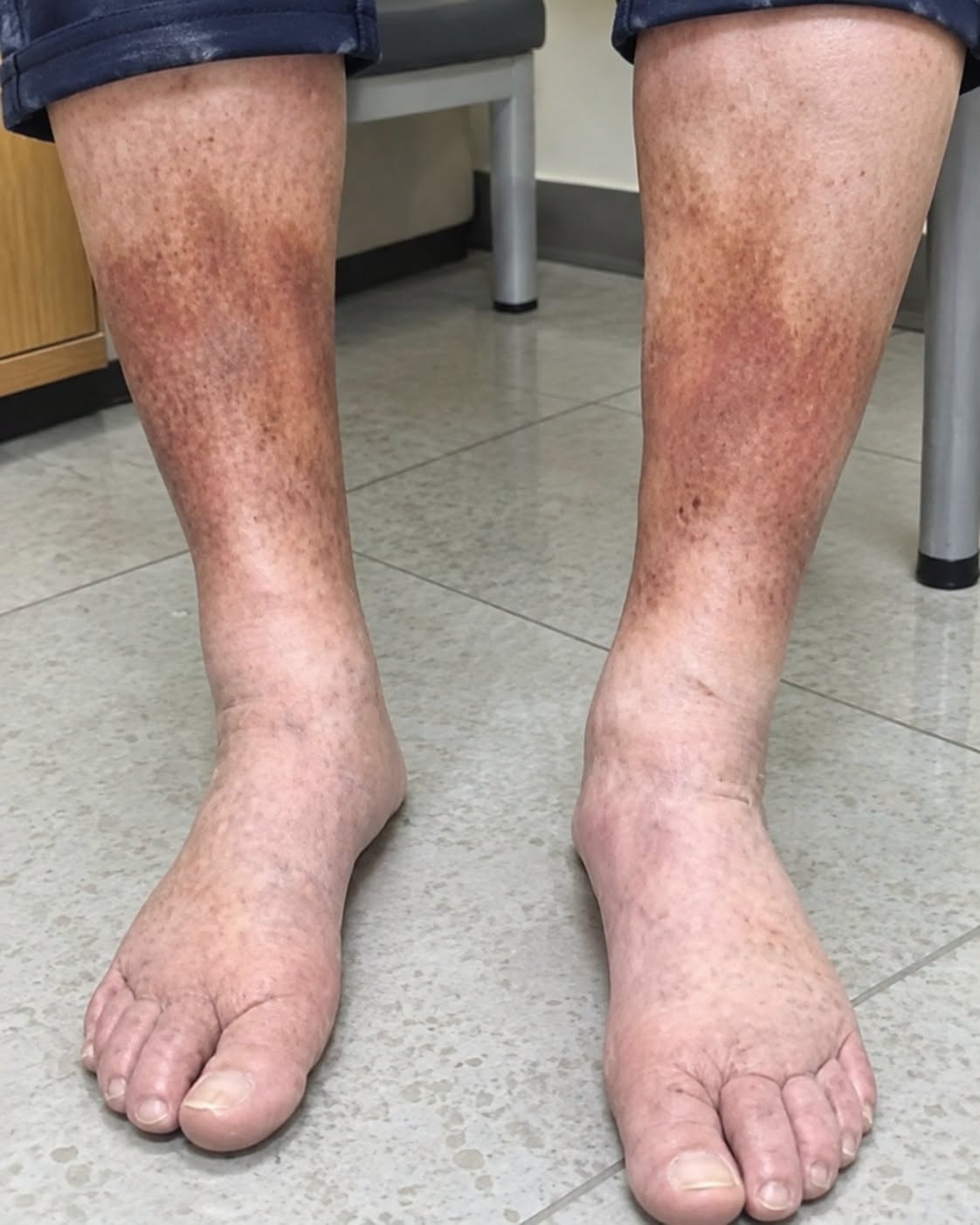
Swollen feet often begin as a quiet inconvenience, the kind of symptom that is easy to ignore because there is usually an ordinary explanation for it. You may have spent an entire day standing, sat behind a desk for hours, traveled for a long time without moving much, eaten a particularly salty meal, or simply spent the day in unusually hot weather. By evening, your shoes may feel tighter, your ankles may look slightly larger, and the skin can feel stretched or uncomfortable.
In many cases, this kind of swelling really is temporary.
Gravity naturally pulls fluid toward the lower parts of the body, especially when we remain standing or sitting in one position for extended periods. When circulation slows, some fluid can collect in the tissues around the feet and ankles. Heat can make the problem more noticeable, while excess sodium can cause the body to retain additional water.
After moving around, changing position, elevating the legs, and returning to normal hydration and activity, the swelling may gradually disappear.
For many people, it is simply an uncomfortable reminder that the body has been under strain.
The next morning, the shoes fit normally again.
The ankles look familiar.
The discomfort is gone.
And the episode becomes something easy to forget.
But not every swollen foot has such a harmless explanation.
When swelling happens repeatedly, lasts longer than expected, becomes increasingly uncomfortable, or appears without an obvious reason, it can be an important signal that something else is happening inside the body.
That is when the symptom deserves more attention.
The body constantly works to maintain the right balance of fluids. The heart helps circulate blood throughout the body, while the kidneys and liver play important roles in managing fluids and removing waste. The veins also have to return blood from the legs back toward the heart.
When one of these systems is not working properly, fluid can begin accumulating in the tissues.
That accumulation may first become noticeable around the ankles and feet.
In some cases, persistent swelling can be associated with heart problems, particularly when the heart is struggling to pump blood effectively. When circulation becomes less efficient, fluid can build up in the lower parts of the body.
Kidney problems can also affect the body’s ability to maintain the proper fluid balance. The kidneys play a central role in regulating water and salt, so problems with their function can contribute to swelling.
The liver can also be involved because serious liver disease can affect the body’s fluid balance and contribute to edema.
There are other possible causes as well, including certain medications, vein problems, hormonal changes, and other medical conditions.
That is why swelling should not automatically be interpreted as evidence of one particular disease.
The important point is the pattern.
Is the swelling new?
Does it keep coming back?
Does it continue even after resting?
Is it getting worse?
Does it affect one leg or both?
Are there other symptoms happening at the same time?
These details can help a healthcare professional determine whether the swelling is likely to be temporary or whether further evaluation is needed.
One-sided swelling deserves particular attention, especially when it appears suddenly.
If one leg becomes noticeably swollen, painful, warm, or red, a blood clot is one possible concern. A clot in a deep vein can interfere with normal blood flow and can become dangerous if part of it travels to the lungs.
That is why sudden swelling accompanied by pain, warmth, redness, or tenderness should not simply be dismissed as tired feet.
There are also symptoms that make the situation more urgent.
Swelling accompanied by shortness of breath can be particularly concerning.
So can chest pain, difficulty breathing, fainting, sudden weakness, or an unexplained and significant decline in energy.
These symptoms can indicate a potentially serious problem that requires prompt medical attention.
The temptation, however, is to explain everything away.
It was a long day.
It was hot outside.
I ate too much salt.
I didn’t drink enough water.
My shoes were uncomfortable.
Sometimes those explanations are correct.
But when the same symptom keeps returning, relying on the simplest explanation without considering other possibilities can delay appropriate care.
That does not mean every swollen ankle is an emergency.
It means the body deserves attention when a symptom changes its usual pattern.
For mild swelling after prolonged sitting or standing, simple measures such as moving regularly, avoiding long periods in one position, and elevating the legs may help. Staying appropriately hydrated and following a balanced diet can also support normal fluid regulation.
But these measures should not replace medical evaluation when swelling is persistent, severe, unexplained, or accompanied by concerning symptoms.
One of the most important things to remember is that symptoms do not always arrive dramatically.
Sometimes the body gives a warning quietly.
A little swelling at the end of the day.
A ring that suddenly feels tighter.
Shoes that seem unusually uncomfortable.
A sock leaving a deeper indentation around the ankle.
None of these signs automatically means something is seriously wrong.
But when they become frequent or occur alongside other changes, they can be worth discussing with a healthcare professional.
Listening to your body does not mean assuming the worst.
It means noticing patterns.
It means recognizing when something that used to disappear is no longer disappearing.
And it means understanding that early medical advice can sometimes identify a problem before it becomes much more difficult to treat.
Swollen feet may be nothing more than the result of gravity, heat, inactivity, or temporary fluid retention.
But persistent or unexplained swelling can also be a clue that deserves investigation.
The difference is not always visible from the outside.
That is why the safest approach is not to panic—but also not to ignore a recurring warning.
If your feet suddenly swell and the swelling is accompanied by redness, warmth, significant pain, shortness of breath, chest pain, fainting, or other severe symptoms, seek urgent medical attention.
And if the swelling keeps returning without an obvious explanation, make an appointment with a healthcare professional rather than simply waiting for it to disappear again.
Sometimes the body whispers before it shouts.
Learning to notice that whisper can be one of the simplest ways to take your health seriously.