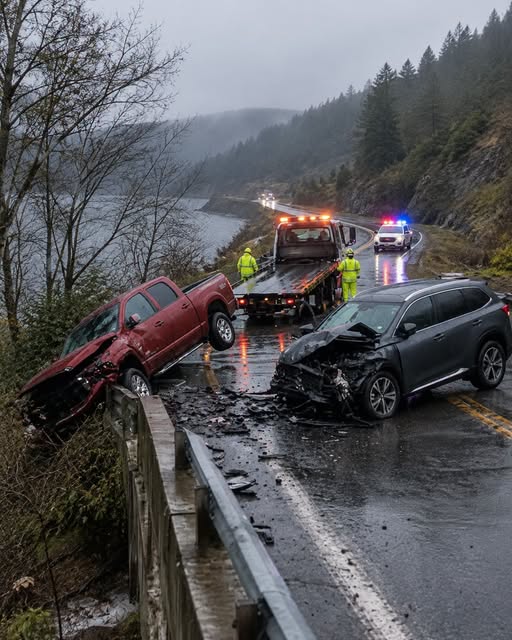
The silence after the crash was unbearable. Sirens came late, answers came even later, and in the ravine below BR-251, nine lives were gone. Among those who would never return home was a singer whose voice had once filled bars, churches, community gatherings, and crowded town squares. For the families waiting beside their phones, the hours seemed endless. Every unanswered call carried another possibility. Every new message brought another wave of fear. They prayed that their loved one’s name would not appear on the fatal list. Then the names began to emerge, and a night of uncertainty became a national tragedy.
In the darkness of that September night near Grão Mogol, what should have been a simple journey home became a brutal full stop. A van carrying exhausted workers and a truck traveling along the highway met in a single, unforgiving moment. There was no time to understand what was happening. Metal folded under the force of the collision. Glass shattered across the darkness. The vehicles were thrown toward a ravine, turning a stretch of road into a scene that rescuers would struggle to reach.
For the people inside those vehicles, the journey ended in seconds. For the families waiting at home, however, the tragedy would continue for much longer. They had expected phone calls announcing that their loved ones were on their way. They expected doors to open. They expected tired workers to return from another difficult day. Instead, they found themselves waiting for confirmation that no family should ever have to receive.
The location itself made the rescue operation even more difficult. The crash occurred below the roadway, in terrain that was difficult to access in the darkness. Rescuers had to work under challenging conditions as they attempted to reach the wreckage and determine whether anyone could still be saved. Every minute mattered, while families hundreds of miles away waited without knowing what had happened to the people they loved.
By the time the full scale of the disaster became clear, nine stories had already ended.
Nine families had lost someone whose absence would immediately change everything. Nine groups of relatives, friends, coworkers, and communities were suddenly forced to imagine a future without someone who had been part of their everyday lives.
In Ceará and Minas Gerais, grief took different forms but carried the same weight. Some families had pinned their hopes on distant jobs and the promise that hard work would provide a better future. Others were waiting for someone to return after another trip on the road. Instead of hearing a familiar voice at the door, they were confronted with the unbearable reality of preparing for a funeral.
For some families, the journey had represented sacrifice. Work had taken people away from home, sometimes for long periods, because earning a living often requires difficult choices. People leave their families in the morning expecting to come back. They travel highways because they have somewhere to be, someone depending on them, or a job waiting at the end of the road.
No one begins such a journey imagining that it could be their final one.
That is what makes tragedies like this so difficult to process. The people involved were not seeking danger. They were traveling, working, returning home, and living ordinary lives. Yet one moment on a highway was enough to divide everything into a before and an after.
Among the victims was a singer whose voice had become part of the cultural life of the communities where he performed. His music had been heard in places filled with people celebrating, praying, gathering with friends, and marking important moments. A microphone that had once carried his voice across crowded rooms now stood silent.
For those who knew him through music, the silence was almost impossible to comprehend.
A performer can become woven into the memories of an entire community without realizing it. People remember the songs they heard at celebrations. They remember the voice coming through speakers at a local gathering. They remember standing in a crowd while someone they loved performed on stage.
After a death, those memories suddenly become something different.
A song that once sounded joyful can become painful. A stage can feel strangely empty. A microphone can become a symbol of someone who will never hold it again.
Flowers begin appearing where music once filled the air.
People gather not because there is a celebration, but because there is grief.
And the same communities that once gathered to listen now gather to remember.
For the families, however, the public attention is only one part of the tragedy. Their loss is deeply personal. Behind every name on an official list is a home that will feel different, a phone number that will never again light up in quite the same way, and a chair that will remain empty.
There are belongings that will never be collected.
Messages that will never receive a response.
Plans that will never happen.
And ordinary routines that suddenly become reminders of the person who is missing.
As investigators begin examining the circumstances surrounding the collision, questions naturally emerge. What happened in the moments before impact? Were there mechanical problems? What were the road conditions? How long had the vehicles been traveling? Were brakes, tires, visibility, speed, or fatigue factors that need to be examined?
These questions matter because understanding how a disaster happened can help prevent another one.
But investigation takes time. Evidence must be collected. Vehicle conditions must be examined. Records and travel information may need to be reviewed. Investigators must separate facts from assumptions and determine what can actually be established.
For grieving families, that waiting can be incredibly difficult.
They want answers because answers cannot bring someone back, but they can sometimes explain how a normal journey became a catastrophe. They can provide accountability where appropriate and, perhaps most importantly, offer information that could help prevent another family from experiencing the same kind of loss.
The highway itself becomes part of the conversation.
Roads connect cities, states, families, workplaces, and entire communities. Millions of people depend on them every day. Trucks travel long distances carrying goods. Workers travel to jobs. Families drive to visit relatives. Musicians travel to performances. Every journey represents someone trying to reach somewhere else.
Yet every journey also depends on safety systems working as they should.
Vehicles must be maintained. Drivers must be able to operate safely. Roads must be properly designed and maintained. Emergency services must be able to reach crash sites. And when something goes wrong, the difference between a close call and a tragedy can sometimes be measured in seconds.
That is why the wreckage left behind on BR-251 cannot simply become another photograph that disappears from the news cycle.
The people who died were more than numbers.
They were parents, children, spouses, siblings, friends, coworkers, neighbors, and members of communities that will feel their absence for years.
One person may have been the person everyone called when they needed help.
Another may have been the one who made everyone laugh.
Another may have been working far from home to provide for a family.
And another may have been a singer whose voice brought people together.
Their lives cannot be reduced to the moment when the vehicles collided.
That is perhaps the hardest part of understanding a mass-casualty crash. The news reports the collision in seconds, but the lives lost in those seconds were built over decades.
Every victim had a history before the crash.
Every family had memories before the phone call.
Every community had a future that included these people.
Then, suddenly, everything changed.
As the investigation continues, the country is left with questions about road safety, working conditions, long-distance travel, vehicle maintenance, emergency response, and the circumstances that led two vehicles to meet on that stretch of highway.
But there is also a simpler truth beneath all those questions.
People should be able to leave home for work and expect to return.
They should be able to travel across the country without treating every highway journey as a gamble.
They should be able to earn a living without their families constantly fearing the phone call that says something went wrong.
And when tragedies happen, the memory of those who died should not disappear when the headlines do.
That is why mourning can become something more than grief.
It can become a demand for answers.
It can become pressure for safer roads, stronger safety practices, better enforcement, improved emergency access, and greater attention to the risks faced by people who spend their lives traveling for work.
For the families in Ceará and Minas, however, none of those changes can replace the people they lost.
A safer road cannot bring back a parent.
A new regulation cannot restore a sibling.
A better emergency response cannot recreate a voice that once filled a crowded room.
The only thing left is memory—and the hope that memory can lead to action.
The stages where the singer once performed may eventually become active again. People will return to those spaces. Music will play. Crowds will gather. But for those who knew him, there will always be an absence that cannot be filled.
And somewhere along the road, families will continue to remember the people who never made it home.
The crash lasted only a moment.
The grief will last much longer.
That is the part of the story that statistics cannot capture.
Nine people were lost, but the consequences extend far beyond the number nine. They live in the empty homes, the unanswered phones, the photographs placed beside flowers, the silent stages, and the memories carried by everyone who loved them.
As Brazil searches for answers about what happened on that September night, the most important question may ultimately be what happens afterward.
Will the investigation simply explain the crash?
Or will the lessons become changes that make another tragedy less likely?
The people who died cannot be brought back.
But their stories can still matter.
Their names can still be remembered.
And their final journey can become a reason to demand that fewer families ever have to experience the same silence again.