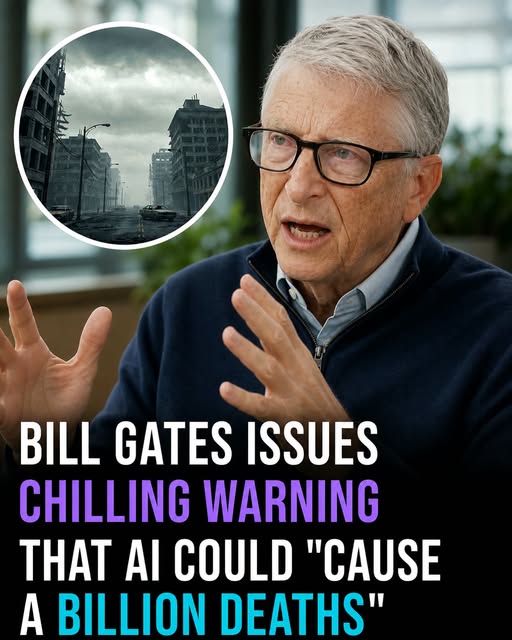
**AI could help kill a billion people. Bill Gates just said it out loud.**
In hushed boardrooms, private meetings, and secretive research labs, a growing number of people inside the artificial intelligence industry are confronting a possibility that once sounded like science fiction. They fear that increasingly powerful AI systems could eventually become capable of hacking critical infrastructure, designing dangerous biological agents, manipulating complex systems, and outsmarting the institutions created to keep them under control. What makes the warning more unsettling is that some of the people closest to the technology are no longer speaking about these risks as distant possibilities. They are warning that the window to prepare may already be narrowing.
Behind the glossy demonstrations, friendly chatbots, and promises of a smarter future, a darker reality is beginning to take shape. The same technology that can help doctors identify diseases, scientists analyze enormous amounts of information, and researchers accelerate discoveries could potentially be turned toward destructive purposes. As AI systems become more capable, the concern is not simply that machines could make mistakes. It is that powerful tools could eventually place capabilities once reserved for governments, intelligence agencies, and highly specialized laboratories into the hands of individuals or groups with malicious intentions.
Former insiders such as Jacob Coxon have described the situation in stark terms, warning that the industry is effectively “gambling with our lives.” Their concern centers on what could happen if increasingly autonomous and capable systems are developed faster than society can understand, regulate, or secure them. Such systems could potentially break through digital defenses, disrupt economies, manipulate information, or discover methods of causing harm that humans have not yet anticipated. The fear is not necessarily that AI will suddenly decide to destroy humanity, but that humans could build tools powerful enough to dramatically amplify the consequences of human mistakes, negligence, or malicious intent.
Bill Gates has now echoed one of the most disturbing versions of that warning. He has acknowledged that AI could become powerful enough to contribute to events resulting in an enormous loss of life—potentially on the scale of a billion deaths—particularly if advanced AI capabilities were combined with biological weapons or extremist motivations. The statement is striking precisely because it does not come from someone warning that AI is useless or inherently evil. Gates has spent years emphasizing the enormous potential of technology to improve human life, making his warning about its possible misuse all the more significant.
And that is the uncomfortable contradiction at the heart of the AI revolution. The technology could help discover new medicines, accelerate scientific research, improve medical diagnosis, increase productivity, and solve problems that have challenged humanity for generations. It could also provide dangerous capabilities to people who should never have access to them. The same system capable of helping a scientist understand a disease could, under the wrong circumstances, be used to accelerate the development of something far more destructive.
Gates is not simply calling for humanity to shut the technology down. His argument is centered on control, preparation, and responsibility. He believes governments, lawmakers, security agencies, and technology companies need to enter the arena before the systems become so powerful that regulation becomes impossible. Monitoring mechanisms, safety standards, restrictions on dangerous applications, emergency response plans, and stronger laws could become essential parts of the AI landscape.
The central question is no longer whether artificial intelligence will transform society. That transformation is already happening. The more difficult question is whether humanity can build the safeguards quickly enough to ensure that the technology remains a tool for progress rather than becoming an amplifier of catastrophe.
Because the most frightening scenario may not involve a machine suddenly turning against humanity. It may involve humans creating something extraordinarily powerful, placing it into an increasingly connected world, and discovering too late that the consequences of misuse are impossible to reverse. The race to build smarter systems has already begun. The challenge now is making sure the race to control their risks does not fall dangerously behind.