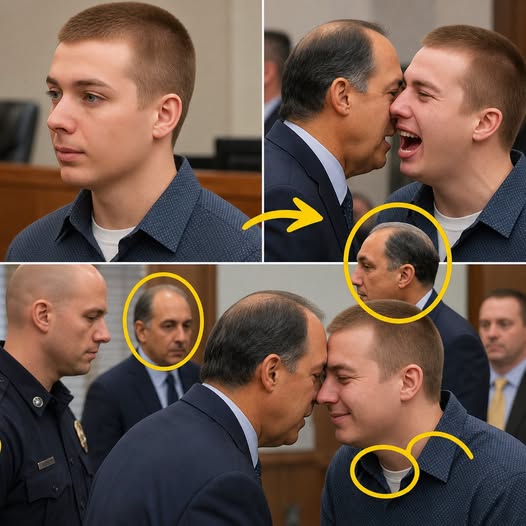
The number was never meant for a human life. It sounded like a curse, not a sentence—a figure so enormous that it seemed almost impossible to connect it with the limited span of a single lifetime. A teenager vanished into centuries of punishment, transformed from a complicated, unfinished person into a symbol in a single headline. Outrage collided with grief. Law met neuroscience. Victims demanded permanence, while advocates quietly spoke about redemption and the possibility of change. Somewhere between those absolutes, a quieter question began to tremble: what does justice mean when the person being sentenced is still becoming?
A sentence measured in centuries does more than confine a body; it communicates a belief about whether a person can ever truly change. The number itself becomes a message, extending far beyond the courtroom and into the lives of everyone affected. When that person is young, the sentence can begin to feel like a verdict not only on what happened, but on time itself—on whether the future is allowed to matter after an irreversible act.
For families who have experienced devastating violence, however, the meaning of a sentence can be very different. The law may speak in statutes, procedures, precedents, and carefully defined terms, but families often hear something more personal. They hear a promise that what was done to them will not be minimized, forgotten, or quietly pushed into the past. They may see a lengthy sentence as the only form of permanence available in a world where so much else has been permanently taken away.
For many victims and their families, the loss cannot be measured simply in years. A life has been changed forever, relationships have been shattered, and ordinary moments may become reminders of what can never be recovered. In that reality, the desire for a punishment that reflects the permanence of the harm is understandable. The sentence can become more than a legal consequence; it can represent recognition that something happened that can never be undone.
Yet youth unsettles that certainty. A teenager is not a finished version of an adult. Neuroscience, lived experience, and common sense all point toward the fact that adolescence is a period of extraordinary development, when judgment, impulse control, identity, and the ability to understand long-term consequences are still evolving. None of that erases the seriousness of a crime or the suffering of victims. But it complicates the question of what punishment should mean when the person receiving it has not yet reached psychological or emotional maturity.
That creates one of the most difficult questions a justice system can face: can society hold two truths at the same time? Can it acknowledge that some harms are permanent and irreparable while also recognizing that some people, even those who have caused terrible harm, may change profoundly over the course of their lives?
The answer is difficult because neither truth cancels out the other. A person’s capacity to change does not undo what happened to a victim. At the same time, the permanence of a victim’s suffering does not necessarily prove that a young offender’s identity, character, or capacity for change must remain frozen forever at the moment of the crime.
This tension becomes even harder when emotions enter the courtroom. Anger, grief, fear, and the desire for accountability are not abstract concepts for families who have suffered. They are lived realities. Asking those families to think about rehabilitation or redemption can sometimes feel like asking them to accept something that contradicts the permanence of their loss.
But justice also carries a responsibility to look beyond the immediate moment. It must consider accountability while confronting questions about development, rehabilitation, public safety, proportionality, and the possibility that human beings can change. These considerations do not require society to forget victims. They require society to acknowledge the complexity of human behavior and the difficulty of predicting who a young person will become decades into the future.
A careful society therefore resists turning either pain or possibility into a slogan. It does not pretend that every young offender will change, nor does it assume that no young offender can. It does not diminish the suffering of victims in the name of compassion, and it does not eliminate the possibility of rehabilitation simply because the harm was devastating.
Justice may ultimately live in that uncomfortable space between absolutes—a place where accountability and mercy are not treated as simple opposites, where victims are not forgotten, and where a teenager is not automatically reduced to the worst thing they have ever done.
The number may still sound impossible. The grief may remain permanent. The questions may never have perfectly satisfying answers. But perhaps the deepest challenge of justice is not finding a number large enough to express our outrage. It is deciding how to respond to irreversible harm while remembering that human beings, especially young ones, are capable of becoming different people with time.