# My Son Sold My Buick for $4,200 on My 76th Birthday “For My Own Good”—So I Bought a $389 Three-Wheeled Bicycle and Rode It to His Office
I turned seventy-six on a Thursday.
I remember because the garbage truck came early that morning, rattling down our street at 6:15, and because my son, Michael, had promised to take me to breakfast before he went to work.
He arrived at eight carrying a grocery-store cake with blue frosting and a card that said, Happy Birthday, Dad\! You’re the best.
I should have known something was wrong when he hugged me before I had even opened the door.
Michael had always been affectionate in that slightly hurried way of his, as though every embrace were another item on a checklist. He was forty-eight, a regional manager at a medical supply company, and the sort of man who answered emails during dinner and described vacations as opportunities to catch up on work.
Still, he was my only child. His mother and I had raised him to be responsible, hardworking, and considerate of others.
His mother had been gone for six years.
Since then, the house had become quieter, but I had managed. I tended my garden, met my old friend Walter for coffee on Wednesdays, and drove my blue 2008 Buick Lucerne wherever I pleased.
That Buick wasn’t fancy. The passenger-side window sometimes needed a second press before it closed, and the air conditioner made a faint clicking sound whenever I turned it to its highest setting.
But it was mine.
I had bought it with money I saved from thirty-one years working as a high school history teacher. I had driven my wife to her last doctor’s appointments in it. I had taken Michael to visit colleges in it. And after my wife died, I would sometimes drive out to the lake where we used to spend our anniversaries, park beneath the old cottonwood trees, and sit quietly until I felt ready to return home.
That car carried more than my groceries.
It carried my life.
So when Michael handed me the birthday card and said, “Dad, we need to talk about your driving,” I felt something inside me tighten.
“What about it?” I asked.
He glanced toward the driveway.
“Well, that’s actually why I’m here.”
I followed his eyes.
The driveway was empty.
For a moment, I genuinely thought I had forgotten where I parked.
Then I looked at him.
“Where’s my Buick?”
Michael took a slow breath, the kind people take when they’ve rehearsed a difficult conversation and are pleased to have finally reached their opening line.
“I sold it, Dad.”
I stared at him.
“You did what?”
“I sold the Buick. Four thousand two hundred dollars. A dealer offered a fair price, and I took care of everything.”
He said it as casually as if he had picked up my dry cleaning.
I felt the blood drain from my face.
“You sold my car?”
“Listen, Dad. Before you get upset, just hear me out.”
I was already upset.
He explained that he had noticed me driving more slowly. He said I had complained about glare from headlights. He reminded me of the time I had scraped the trash cans while backing out of the garage.
The trash cans had been placed behind the car by a delivery driver. I had apologized to the neighbors and replaced the cans.
Michael treated the incident as if I had narrowly escaped a catastrophe.
“You live alone,” he continued. “You’re getting older. It’s only a matter of time before something happens. I couldn’t just sit around and wait for it.”
I looked at him, waiting for the punch line.
There wasn’t one.
“You sold my car without asking me?”
“I did it for your own good.”
Those five words landed harder than anything else he said that morning.
For your own good.
I had heard them before, usually from people who wanted to make a decision for someone else and didn’t want to be questioned about it.
I thought of my wife in her final months, when strangers sometimes spoke to her rather than to me because they assumed she couldn’t understand. I remembered the frustration in her eyes when someone would take her hand and explain what was best for her without asking what she wanted.
I had promised myself I would never let age become a reason to stop treating someone like a person.
And now my own son had done exactly that to me.
“What if I wanted to keep driving?” I asked.
Michael sighed.
“That’s precisely the problem. You don’t recognize your limitations.”
He told me he would arrange grocery deliveries. He had already downloaded a transportation app onto my phone. If I needed to visit a doctor, he would help coordinate it.
He spoke about my future as if I had already surrendered it to him.
Then he patted my shoulder.
“Someday you’ll thank me.”
I didn’t answer.
He stayed for another twenty minutes, cut me a slice of birthday cake, and left to go to work.
I stood in the kitchen long after his car disappeared around the corner.
There was a candle on the cake. I hadn’t lit it.
I wasn’t sure why, but I couldn’t bring myself to blow it out.
That afternoon, I called Walter.
He listened while I explained everything, including the part where Michael had sold my Buick for $4,200 without my permission.
When I finished, Walter was silent for a moment.
Then he asked, “Do you still have your driver’s license?”
“Of course.”
“And did you sign anything authorizing him to sell the car?”
“No.”
“Then I think you have a bigger problem than transportation.”
I knew he was right.
But I wasn’t ready to call a lawyer, accuse my son of taking advantage of me, or turn my birthday into a family war.
What I wanted was something much simpler.
I wanted to go where I pleased.
I wanted to buy my own groceries, visit the lake, and decide for myself whether I was too old to drive.
Most of all, I wanted Michael to understand that being seventy-six did not mean I had become a piece of furniture he could rearrange.
The next morning, I did something I hadn’t done in years.
I went shopping.
Not for a car.
For a bicycle.
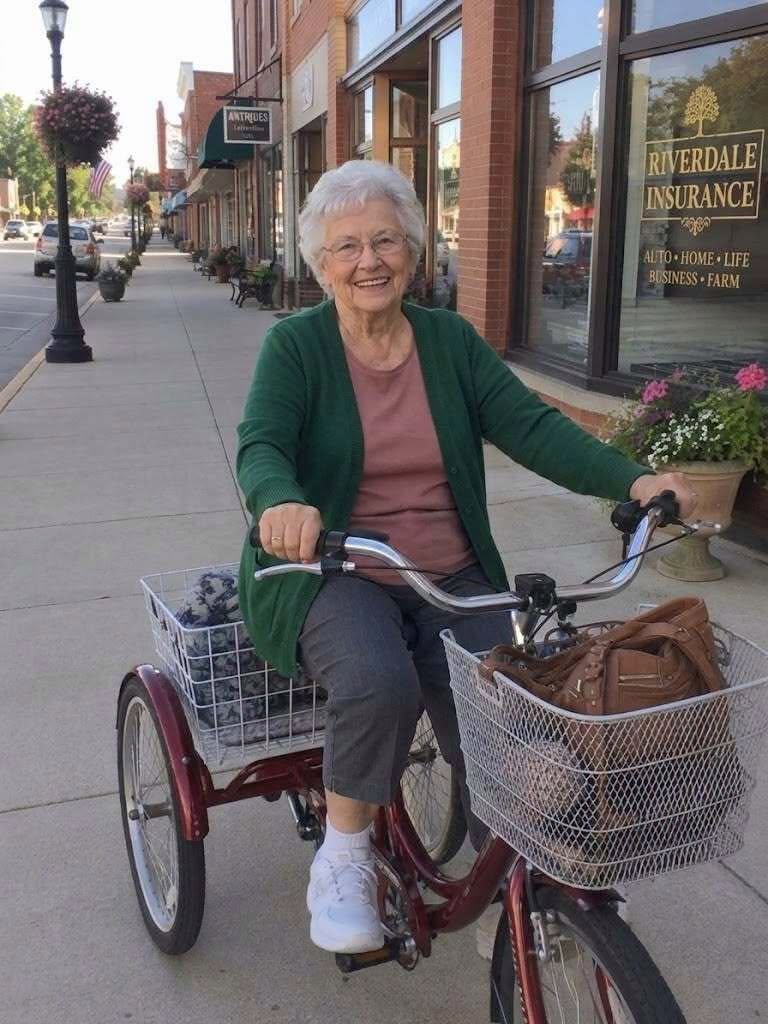
I’d seen them around town: sturdy three-wheeled bicycles with large seats, upright handlebars, and baskets big enough to carry a bag of groceries. They were designed for stability rather than speed.
At a local shop, I found one advertised for $389.
The salesman asked what had brought me in.
“My son sold my car,” I said.
He looked uncomfortable.
“Sorry to hear that.”
“So I need a new way to get around.”
He showed me the bicycle, explained the brakes, adjusted the seat, and let me take it for a short ride in the parking lot.
I was wobbly for the first few yards.
Then I found my balance.
I circled the lot once, twice, and a third time.
For the first time since my birthday, I smiled.
I paid in cash.
The bicycle was dark red, with a black seat, a sturdy rear basket, and a small bell that sounded cheerfully ridiculous when I pressed it.
I rode it home.
It took me nearly forty minutes, and my legs complained for the first ten. But the morning air was cool, the sky was clear, and I found myself noticing things I had ignored while driving for years: the roses outside the bakery, a little boy feeding pigeons, the smell of fresh bread drifting from an open window.
When I reached my house, I parked the bicycle in the garage.
Then I looked at the empty space where my Buick had stood.
I had an idea.
Michael’s office was about seven miles away.
The following Monday, I woke before sunrise, made myself two eggs and a piece of toast, packed a bottle of water, and put on the cleanest pair of trousers I owned.
I checked the bicycle tires.
I tested the brakes.
I placed a small envelope in the rear basket.
Inside it was a copy of the Buick’s registration, the bill of sale I had obtained from the dealer, and a handwritten letter.
I didn’t know exactly what I would say when I arrived at Michael’s office.
But I knew I needed to say it in person.
At seven thirty, I pushed the bicycle out of the garage and started pedaling.
The first mile was easy.
The second was less comfortable.
By the third, I had begun to question the wisdom of my plan. My knees ached, my hands were cold, and I stopped twice to drink water.
But I kept going.
I wasn’t trying to prove that I could ride faster than a younger man. I wasn’t trying to show that I could do everything I had done at forty.
I was trying to show that I still had the right to decide what I could do at seventy-six.
When I reached Michael’s office building, I was tired, sweaty, and more than a little proud of myself.
I parked the bicycle near the entrance, locked it to the rack, and walked inside.
The receptionist looked up.
“Good morning. Can I help you?”
“I’m here to see Michael Harris.”
“Do you have an appointment?”
“No,” I said. “But I’m his father.”
She made a phone call.
Five minutes later, Michael appeared in the lobby, wearing his usual navy suit and an expression of complete bewilderment.
“Dad? What are you doing here?”
I gestured toward the glass doors.
“I rode my bicycle.”
He stared at me.
“You rode that thing all the way here?”
“Seven miles. Give or take.”
His face turned red.
“Dad, this isn’t funny.”
“I didn’t come here to be funny.”
People were beginning to glance in our direction.
Michael lowered his voice.
“Can we please talk about this somewhere private?”
“Certainly.”
He led me into a small conference room and closed the door.
For a few seconds, we sat opposite each other without speaking.
Then he leaned forward.
“Look, I know you’re upset about the car. But this is exactly what I’m talking about. You shouldn’t be riding around on busy roads. What if you get hurt?”
I placed the envelope on the table.
“What if I get hurt because you decided my life for me?”
He opened his mouth, then closed it.
I continued.
“You sold my property without asking. You made a decision about my independence without speaking to me. And then you told me I would thank you for it.”
“Dad, I was worried about you.”
“I believe that.”
He looked surprised.
“I believe you were worried,” I repeated. “But being worried doesn’t give you the right to take over my life.”
For the first time that morning, he stopped interrupting.
I told him I understood that my driving deserved an honest assessment. I told him I was willing to take a professional driving evaluation, listen to a doctor’s advice if there were genuine medical concerns, and make reasonable changes if necessary.
“But those decisions have to be made with me,” I said. “Not behind my back.”
I pushed the envelope toward him.
Inside was a letter explaining what I expected next.
I wanted a full accounting of the sale. I wanted copies of the documents he had used. And I wanted him to understand that any money belonging to me had to be handled with my permission.
If he had acted without legal authority, I would seek independent legal advice about my options.
Michael read the letter without speaking.
When he reached the end, his shoulders slumped.
“I thought I was helping,” he said.
“Maybe you thought you were.”
He looked up at me.
“Are you really going to make this a legal matter?”
“I hope I won’t have to.”
For the first time in years, I saw my son not as the confident man who always seemed to have an answer, but as someone who had made a serious mistake and wasn’t sure how to admit it.
“I didn’t think you’d feel this way,” he said quietly.
I almost laughed.
“You sold my car, Michael. What did you think I’d feel?”
He rubbed his forehead.
“I thought you’d be angry for a while. I thought you’d get used to it.”
That hurt more than I expected.
Because it meant he hadn’t simply acted without asking me. He had assumed that if he made my world smaller, I would eventually accept the size he had chosen.
I stood.
“I’m going home now.”
He followed me to the entrance.
“Dad, let me drive you.”
I looked at the bicycle.
“No, thank you.”
He hesitated.
Then he asked, “Can I at least ride with you for a little while?”
I considered the question.
“On your own bicycle?”
He gave a small, embarrassed smile.
“I suppose I could buy one.”
“Then we’ll talk.”
I rode home slowly, stopping once at the bakery for a coffee and a pastry. My legs ached, and I was exhausted by the time I reached my street.
But I felt lighter than I had in days.
I didn’t know whether Michael would apologize properly. I didn’t know whether I would recover the money from the sale or whether I would ever buy another car.
Those questions would take time, and I would deal with them one at a time.
What I did know was that I had spent seventy-six years building a life of my own.
I wasn’t going to surrender it simply because someone else had decided that my age made me incapable of choosing.
That evening, Michael called.
He apologized—not for worrying about me, but for making the decision without me.
It wasn’t a perfect conversation. We still had a great deal to work through, and I made it clear that an apology did not erase the practical questions surrounding the sale.
But it was a beginning.
A week later, he showed up at my house with a bicycle of his own.
It was black, slightly more expensive than mine, and equipped with a basket he claimed was “purely practical.”
We rode together to the lake.
I took the familiar route beneath the cottonwood trees, and for a while neither of us said much.
Then Michael looked over at me.
“Mom would have liked this,” he said.
I nodded.
“She would have liked that we were talking.”
He was quiet for a moment.
Then he said, “I’m sorry, Dad. I really am.”
This time, I believed him.
We sat by the water until the sun began to set.
My Buick was still gone. The problem wasn’t magically solved, and I still had decisions to make about transportation, money, and the boundaries between a father’s independence and a son’s concern.
But something had changed.
My son had finally begun to understand that helping someone isn’t the same as controlling them.
And I had learned that standing up for yourself doesn’t always require shouting, fighting, or walking away from the people you love.
Sometimes, it requires a $389 three-wheeled bicycle, seven miles of determination, and the courage to show up at your son’s office and remind him who you are.
I’m seventy-six years old.
I have wrinkles, stiff knees, and a growing collection of stories that begin with the words, “Back when I was younger.”
But I still have a voice.
I still have choices.
And as long as I can safely make them, I intend to keep making them myself.
Because growing older should mean receiving more understanding, not less respect.
And no one—not even the child you raised—should get to decide that your life belongs to them.