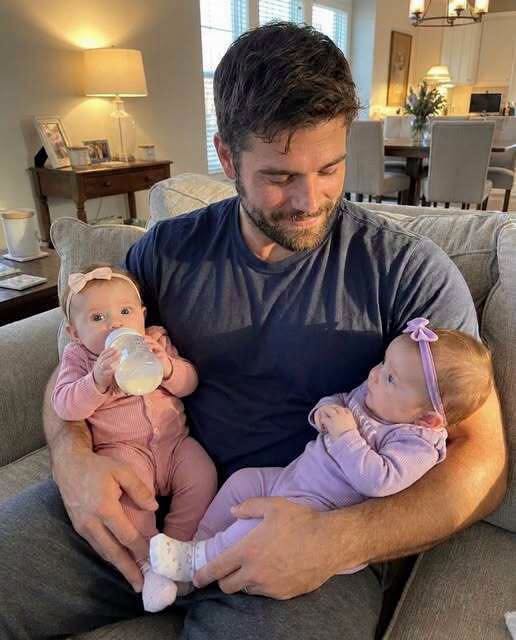
My wife died bringing our twin daughters into the world, and for a long time, I believed her mother blamed me for surviving when her daughter did not. For ninety days, the silence between us became another burden I struggled to carry. While I learned how to feed, comfort, and care for two newborn girls on my own, I was also fighting a guilt that seemed impossible to escape. Every time I looked at June and Ellie, I saw the beautiful gift Mary had left behind, but I also remembered the woman who should have been there to hold them. I wondered whether Joan looked at me and saw the man who had come home from the hospital without her daughter. Then, one quiet afternoon, she appeared at my doorstep holding an envelope with Mary’s handwriting on it. What she revealed would change everything I thought I understood about my wife, her mother, and the painful silence that had separated us.
For ninety days, I had replayed those final hours in my mind, searching for something I could have done differently. I remembered the doctors moving quickly, the unfamiliar sounds of the hospital room, and the moment my world changed forever. I had gone into that hospital expecting to bring my wife home with our daughters. Instead, I returned carrying two tiny lives and a grief so enormous that even breathing sometimes felt like work. Friends told me to be strong for the girls, but nobody explained how a person could be strong while feeling as though half of his heart had been buried. At night, when the twins finally slept, I sat beside their bassinets and whispered stories about their mother, hoping that somehow my words could keep her close.
Joan never called to ask how the girls were doing. She never knocked on my door or offered to help me through the sleepless nights. When I sent her pictures of June and Ellie, she did not respond. At first, I told myself she needed time to grieve. After all, she had lost her only daughter, and I could not pretend to understand the depth of that pain. But as the days became weeks, her silence began to feel personal. I convinced myself that she blamed me for surviving, for bringing the girls home when Mary could not come with us. That belief settled into my mind until I started feeling guilty for things I could not control. I was alive, my daughters were alive, and Mary was gone. Somehow, I began to feel as though my survival was something I needed to apologize for.
Raising newborn twins alone left little room for the kind of grief people imagine when they hear about loss. There were bottles to prepare, diapers to change, laundry to wash, and endless nights when one baby cried just as the other finally fell asleep. I learned to hold one daughter against my chest while rocking the other with my foot. I learned to recognize their different cries and to move through the house in the darkness without turning on a light. Some mornings, I stood in the kitchen with cold coffee in my hand, wondering how I would make it through another day. Yet every time June wrapped her tiny fingers around mine, or Ellie settled against my shoulder, I found a reason to keep going. They needed their father, even on the days when I barely recognized the man I had become.
Then, on the ninetieth day after Mary’s death, someone knocked on the door.
When I opened it, Joan stood outside looking older and more exhausted than I remembered. Her eyes were swollen, and her hands trembled slightly as she held a small cream-colored envelope. For a moment, neither of us spoke. I wanted to ask why she had stayed away for so long, why she had left me to struggle alone, and whether she had any idea how much her silence had hurt. But before I could say anything, she looked past me toward the living room, where the twins were sleeping in their bassinets.
“Can I come in?” she asked quietly.
I stepped aside.
Joan sat at the kitchen table and placed the envelope between us. She explained that she had found it among Mary’s belongings and had needed time before she could bring herself to read it. Inside was a letter my wife had written before the delivery, a letter she had apparently intended for me and her mother. Joan said she had read it more than once, but each time she reached the final lines, she had to stop. Her voice broke as she pushed the envelope toward me.
“I need you to understand something,” she whispered. “My silence was never because I blamed you. I was afraid.”
I looked at her, confused by the words.
Then she told me the truth about the pain she had been carrying long before Mary died.
Years earlier, after losing her husband, Joan had withdrawn from the people who loved her most. Grief had made her quiet, distant, and unable to explain what she was feeling. Without realizing how deeply it affected her daughter, she had gradually pushed Mary away. Calls went unanswered, visits became less frequent, and conversations that once brought comfort turned into uncomfortable silences. Joan had believed she was protecting herself from further pain, but Mary had experienced that distance as rejection. She had spent years wondering why her own mother seemed unable to be there for her.
Now, after losing Mary, Joan feared she had repeated the same mistake in another way. She was terrified that her grief would prevent her from becoming the grandmother June and Ellie deserved. She worried that she would look at them and see everything she had lost, and that her pain would make her distant from the two little girls who needed her love. Rather than admit that fear, she had stayed away. She had mistaken isolation for protection, just as she had years before.
Listening to her, I realized that I had misunderstood her silence, even though the hurt it caused me was real. I had believed she was judging me, while she had been struggling to face a world in which her daughter no longer existed. We had both been grieving the same woman, but we had allowed our pain to build a wall between us.
With trembling hands, I opened Mary’s letter.
Her handwriting was unmistakable. I could almost hear her voice in the gentle curves of the words, the way she always seemed to make even the simplest sentence feel full of love. She had written about the future she imagined for our daughters, the little traditions she wanted us to create, and the stories she hoped we would tell them as they grew older. She had written about their names, their personalities, and all the ordinary moments she had been dreaming of sharing with them.
Then I reached the words that changed everything.
Mary had written that if something went wrong during delivery, she did not want me to spend the rest of my life believing I had failed her. She knew how deeply I loved her, and she knew that grief might convince me to search endlessly for someone to blame, even myself. She wanted me to understand that loving her did not mean refusing to live after losing her. She wanted me to keep laughing, to keep making plans, and to raise our daughters in a home where her memory brought warmth instead of guilt.
She had also written about Joan. Mary understood her mother’s wounds better than anyone. She knew that Joan’s distance had come from unresolved grief, even though it had hurt her deeply. She hoped that one day her mother would find the courage to return, not because she had forgotten the past, but because love deserved another chance.
And then I read the sentence I would carry with me for the rest of my life: she trusted me to miss her deeply while loving June and Ellie without regret.
I lowered the letter, unable to speak.
For ninety days, I had treated my survival as a debt I could never repay. I had believed that being happy with my daughters somehow meant leaving Mary behind. I had wondered whether every smile, every peaceful night, and every small moment of joy was a betrayal of the woman I had lost. But Mary had understood something I could not yet accept: our love did not end when her life did, and my daughters were not reminders that I had failed her. They were part of the life we had created together.
Her words did not erase the grief. They did not make the empty side of the bed feel less empty or bring her voice back into the house. But they loosened the blame I had carried home from the hospital. For the first time, I allowed myself to believe that I could be devastated by Mary’s absence and still be a good father. I could miss her every day without punishing myself for being alive.
Across the table, Joan was crying quietly. I could see the pain in her face, but I could also see something I had not seen in months: a willingness to stop hiding from it.
“Could I hold them?” she asked, glancing toward the living room.
I hesitated. Not because I wanted to punish her, but because I knew how much those first ninety days had changed me. I had learned to protect my daughters with every part of myself, and letting someone back into our lives meant trusting them with the most precious things Mary had left behind. But I also remembered the letter, and I understood that the girls deserved the chance to know their grandmother.
I walked into the living room and carefully lifted June from her bassinet. Joan reached out with shaking arms, and I placed my daughter gently against her chest. She stared down at the tiny face, brushing one finger