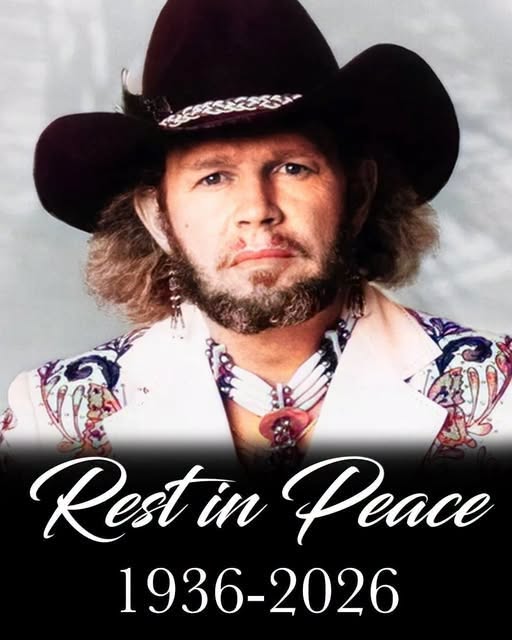
Country music just lost one of its most controversial and unpredictable voices. David Allan Coe is gone at 86, and the silence left behind feels strange, almost unsettling. There is no simple explanation that can make sense of a life like his, no easy way to summarize a man who spent decades challenging the boundaries of country music and the expectations of the people who listened to it. His story was never neat or comfortable. It was filled with contradictions, painful memories, defiance, and moments of brilliance that could leave audiences deeply moved one minute and deeply offended the next. How do you mourn a man whose music could make you cry, then make you question whether you should have been listening in the first place? How do you separate the songs from the man who created them, especially when the same rebellious spirit that made him compelling also made him impossible for many people to accept?
David Allan Coe was never the kind of artist who fit comfortably into the polished world of mainstream country music. He came from the margins and carried that outsider identity with him even after the spotlight finally found him. His life was shaped by hardship, trouble, and years spent moving through a world that seemed determined to keep him on the outside. The brutality of his childhood, his experiences in prison, the years of drifting, and his refusal to conform were not simply details in a biography. They became part of the foundation of his music, giving his songs a roughness that could not easily be manufactured. When Coe sang about loneliness, anger, regret, or a man who had reached the end of his patience, listeners often felt that they were hearing something drawn from real experience rather than something written to satisfy a record label.
That sense of lived-in honesty became one of his greatest strengths. His best songs could feel like confessions whispered in a nearly empty bar after midnight, when the lights were low, the drinks had stopped tasting good, and the truth was finally beginning to emerge. Other times, his words sounded like curses thrown at a world that had never offered him much kindness. There was often a wounded quality beneath the toughness, a feeling that the anger came from somewhere deeper than simple rebellion. He could make the outsider feel understood, the lonely feel less alone, and the person who had made too many mistakes believe that there might still be a place for him somewhere in the world.
For many fans, that was the heart of his appeal. Coe represented a version of country music that refused to dress up every painful truth in pretty language. His songs could be rough, uncomfortable, and emotionally direct, reflecting the lives of people who rarely saw themselves represented in the carefully constructed images of mainstream entertainment. He sang from the perspective of people who had been rejected, judged, forgotten, or pushed aside. His outlaw image was not simply a costume designed for publicity; it became an identity that followed him throughout his career, shaping the way audiences interpreted both his music and his public persona. To those who admired him, he was a symbol of independence, a man who refused to apologize for being different or ask permission to exist on his own terms.
But the story was never that simple. The same defiance that attracted devoted fans also created serious divisions. Coe’s most offensive material crossed lines that many listeners considered impossible to ignore, and his reputation could not be separated from the controversy surrounding it. Some people saw his willingness to provoke as part of his artistic freedom, while others believed that certain things should never be excused simply because they came from a musician with a difficult past. For those listeners, the pain of his childhood or the struggles of his early life did not erase the consequences of his words. They could acknowledge his influence on country music while rejecting parts of his catalog, and they could recognize his talent without feeling obligated to admire the man behind it.
That tension is precisely what makes his legacy so difficult to discuss. Coe was not an artist who offered audiences a comfortable moral lesson or a clean distinction between right and wrong. He left behind a body of work that forces people to confront their own boundaries. Can a song still matter if the person who wrote it behaved in ways you cannot accept? Can a powerful performance be appreciated without becoming an endorsement of everything the performer stood for? And when an artist’s most celebrated qualities—his defiance, his refusal to conform, his willingness to shock—are closely connected to the qualities that make him controversial, where exactly should the line be drawn?
His death does not answer those questions. If anything, it makes them more difficult. When an artist is alive, there is always the possibility of another interview, another performance, another controversy, or another chance to reconsider what we thought we knew. Death removes that possibility. The public figure becomes fixed in memory, and every listener begins constructing a final version of the person they believed they understood. Some will remember the songs that carried them through difficult years. Others will remember the lyrics that disturbed them, the controversies that followed him, and the reasons they could never fully embrace his music. Many will remember both, struggling to reconcile admiration with disappointment.
The records remain, along with the bootlegs, the live performances, the barroom memories, and the stories passed between generations of country music fans. Somewhere, a familiar song will come on a jukebox, and someone will recognize the voice before they even look toward the speakers. The rough edges, the unmistakable delivery, and the sense that the singer was never interested in sounding like anyone else will still be there. For a few minutes, the years will seem to disappear, and the person listening may remember exactly where they were when they first heard the song, who was sitting beside them, or what they were trying to forget at the time.
That is one of the strange powers of music. A song can survive long after the circumstances that created it have disappeared. It can become part of someone’s personal history, attached to a heartbreak, a long drive, a lost friendship, or a night when the world felt too heavy to carry. Listeners may disagree about the artist, question his choices, or reject parts of his legacy, yet still find themselves unexpectedly moved by a melody or a line that reaches somewhere words rarely can. Music does not always ask for permission before stirring an emotion, and it does not always follow the moral boundaries we would prefer it to respect.
Coe’s place in country music will therefore remain complicated. He will be remembered as a distinctive voice in the outlaw country tradition, an artist who resisted conventional expectations and built a reputation around independence and confrontation. He will also be remembered as a deeply divisive figure whose work challenged the limits of what audiences were willing to tolerate. Neither side of that history disappears simply because his life has ended. His supporters will continue to defend the music that spoke to them, while his critics will continue to point out the parts of his legacy that deserve scrutiny. Both conversations will remain part of the story.
Perhaps the most honest way to remember David Allan Coe is to resist the temptation to turn him into either a flawless legend or a figure whose entire career can be dismissed with a single judgment. Real lives rarely fit into such convenient categories, and his certainly did not. His story contains pain and creativity, independence and controversy, emotional honesty and deeply uncomfortable contradictions. Recognizing those contradictions does not require anyone to forgive what they cannot forgive, nor does appreciating a song require anyone to abandon their principles. It simply means acknowledging that the history of music is often made by people who are far more complicated than the stories told about them.
In the end, his death leaves the listener with the same uneasy choice that his music presented for decades: what can be appreciated, what must be questioned, and what cannot be separated from the person who created it? There may never be a single answer that satisfies everyone. Perhaps that is why his voice will continue to provoke such strong reactions long after the final headlines fade. His songs will still be played in trucks, in bars, in quiet rooms, and on late-night drives through empty roads. Some people will turn up the volume. Others will change the station. And some will listen with a mixture of fascination, discomfort, and nostalgia, unable to ignore either the music or the arguments surrounding it.
In that uneasy space between admiration and recoil, between the freedom of an outlaw spirit and the consequences of living without boundaries, David Allan Coe’s legacy will continue to haunt the jukebox. Not because everyone agreed with him, and not because every song deserves unquestioned praise, but because his career left behind questions that cannot be settled by silence alone. His voice may no longer fill a room, yet the debates surrounding it will continue every time someone presses play and decides, for themselves, what the music means.