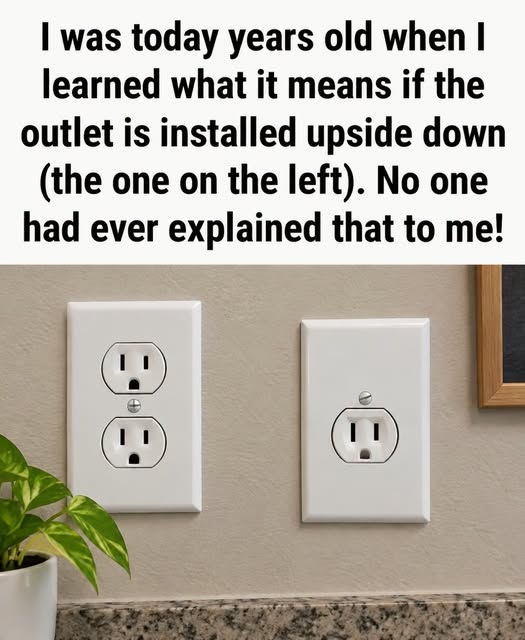
That strange upside-down outlet on your wall might not be a mistake. It might be a warning. A clue. A quiet signal from an electrician you’ve never met that this particular outlet doesn’t play by the usual rules. While most electrical outlets are installed in the familiar orientation, some are deliberately mounted upside down for a very practical reason. One half may be connected to a wall switch while the other remains permanently powered, creating a setup that can look completely ordinary until you actually try using it.
In many homes, especially older houses, wall switches were originally designed to control lamps rather than overhead light fixtures. Before modern lighting became standard in every room, it was common for a lamp plugged into the wall to serve as the primary source of light. Electricians developed different ways of making these arrangements convenient, including wiring only one portion of a duplex receptacle to a nearby wall switch. This allowed a homeowner to turn a lamp on or off from across the room without cutting power to the other half of the outlet.
That means a single outlet could have two completely different functions. The upper or lower receptacle might be controlled by the wall switch, while the other remains live at all times. You could plug a lamp into one side and control it with the switch, while keeping a phone charger, television, or another appliance running continuously from the other. From the outside, however, there might be almost nothing to tell you that the outlet has been wired differently.
To make these switched receptacles easier to identify, some electricians began installing them upside down. The unusual orientation could serve as a subtle visual cue that the outlet was not wired in the standard way. It wasn’t necessarily intended as a warning of danger, but rather as a practical reminder for anyone working on the electrical system—or for future homeowners—that something about the receptacle might be different.
However, there is an important detail many people don’t realize: the National Electrical Code does not universally require outlets to be installed one particular direction. An upside-down receptacle is therefore not automatically evidence that it is connected to a switch. It could simply be the personal preference of the electrician who installed it, a convention commonly used in a particular area, or a choice made for another practical reason.
That’s why you shouldn’t assume that every upside-down outlet has a hidden electrical function. Two homes can have identical-looking upside-down outlets for completely different reasons. In one house, it might indicate a switched receptacle. In another, it could simply be how the electrician preferred to install every outlet. In some cases, the orientation may even have been changed during a renovation without anyone considering its original purpose.
The easiest way to find out what your outlet actually does is surprisingly simple. Plug a lamp or another suitable device into the receptacle and try the nearby wall switches. If the device turns off when a particular switch is flipped, you’ve discovered that the receptacle—or at least that portion of it—is controlled by the switch. If nothing happens, the upside-down orientation may have nothing to do with the wiring at all.
So the next time you notice an outlet that appears to have been installed upside down, don’t immediately assume someone made a mistake. It may be a small piece of information left behind by an electrician, reflecting an older way of designing homes around lamps and switched receptacles. Or it may simply be a matter of installation preference.
What looks like an error can actually be a thoughtful choice—one designed to provide convenience, flexibility, or a subtle visual distinction in the way electricity is used throughout a home. That little outlet on the wall may be telling you more about your house than you realized.