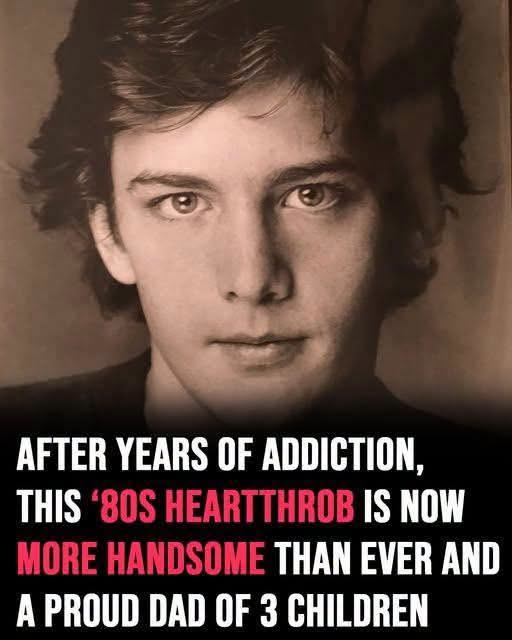
He was the kind of star who defined an entire generation. During the 1980s, his face seemed to be everywhere—on movie posters, magazine covers, and the walls of countless teenagers who admired his effortless charm. With dark, tousled hair, a warm smile, and a quiet screen presence, he became one of Hollywood’s most beloved young actors. To fans, he looked like someone destined for stardom. But behind the polished photographs and growing fame, a far more complicated story was taking shape.
Long before the bright lights of Hollywood, he was simply a boy growing up in Westfield, New Jersey. Born in 1962 as the third of four brothers, he came from a hardworking family far removed from the entertainment industry. His mother worked for a newspaper, while his father was involved in investments and finance. Fame, celebrity, and movie premieres were not part of the world he knew. In fact, he would later admit that he was completely unprepared for the level of success that arrived so quickly.
“I didn’t know anyone who lived that kind of life,” he once reflected. “And honestly, attention made me uncomfortable.” Unlike many aspiring stars, he wasn’t naturally drawn to the spotlight. Even as a teenager, he often felt disconnected from the people around him. School was a lonely experience, and he struggled with a persistent feeling that he simply didn’t belong.
Despite those challenges, he discovered a passion for acting. After high school, he enrolled at New York University to study drama. However, college life never truly suited him. His attendance was inconsistent, and after two years he was expelled. At the time, it seemed like a setback. Instead, it became the unexpected beginning of his career.
Only weeks after leaving school, he responded to an open casting call for a new film called Class. Hundreds of young hopefuls showed up, all chasing the same opportunity. Somehow, he stood out. One week he was a struggling student, and the next he found himself acting alongside actress Jacqueline Bisset in a major motion picture. The sudden shift felt surreal.
His role in Class immediately attracted attention. Audiences noticed the young actor’s natural screen presence, and industry insiders began predicting a bright future. When NYU later suggested he return and use the film as independent study credit, he famously declined. By then, he had already stepped onto a path that would take him far beyond the classroom.
A few years later came the project that would define an era. In 1985, he starred in St. Elmo’s Fire, joining a cast that included several of Hollywood’s most recognizable young performers. Critics were divided, but audiences embraced the film. It became a major commercial success and cemented his place among the rising stars of the decade.
Unfortunately, fame brought complications. He became associated with the so-called “Brat Pack,” a label attached to a group of young actors who dominated teen films during the 1980s. While the nickname generated publicity, it also carried negative stereotypes. Many of the actors involved disliked the label, feeling it reduced their individual work to a media-created image.
Then came Pretty in Pink in 1986. Starring opposite Molly Ringwald, he delivered a performance that resonated deeply with audiences. His understated style, emotional sensitivity, and quiet charisma helped transform him into one of the decade’s biggest teen idols. Fans admired him not because he was loud or flashy, but because he seemed authentic.
The actor, of course, was Andrew McCarthy.
As his popularity exploded, life behind the scenes became increasingly complicated. Hollywood opened doors to glamorous parties, luxury hotels, and exclusive social circles. In his memoir, Brat: An 80s Story, McCarthy described a whirlwind existence filled with celebrity encounters and excess. What many people didn’t realize was that he was slowly developing a serious alcohol problem.
At first, drinking seemed harmless. It eased anxiety and helped him feel more comfortable in social situations. Over time, however, it became something much darker. McCarthy later admitted that alcohol gave him a temporary sense of confidence and control that he struggled to find elsewhere. While audiences saw a talented young actor on screen, he was often battling exhaustion, hangovers, and self-doubt behind the camera.
Looking back on films like Pretty in Pink, he has openly discussed how frequently he worked while feeling miserable. Viewers interpreted his performances as thoughtful and sensitive, while internally he was simply trying to survive another day. The contrast between public perception and private reality became increasingly difficult to manage.
By 1989, he recognized that his relationship with alcohol had become destructive. He stopped drinking before filming Weekend at Bernie’s and deliberately withdrew from many social activities. As an introvert, isolation did not feel particularly difficult. In many ways, being alone felt safer than continuing down the path he was on.
Yet recovery was not immediate. Temptation remained close. During another film project, a seemingly innocent offer of a beer triggered an intense physical reaction that reminded him how fragile his progress truly was. The following years became some of the most painful of his life. He later described them as lost years marked by addiction, regret, and emotional turmoil.
There were also experiments with drugs during the 1980s. McCarthy has admitted that cocaine occasionally entered the picture, though he maintained that alcohol remained the central problem. Eventually, the consequences became impossible to ignore. One morning, overwhelmed by the physical and emotional toll of addiction, he found himself collapsed on a bathroom floor, confronting the reality of where his choices had led him.
Everything changed when he entered rehabilitation at age twenty-nine. Detoxification, therapy, and a commitment to sobriety marked the beginning of a completely new chapter. For the first time in years, he focused not on maintaining a celebrity image but on rebuilding his life from the ground up.
The transformation extended beyond his personal health. As the years passed, he expanded his career into directing and writing. He found success behind the camera, directing acclaimed television projects including Orange Is the New Black and Gossip Girl. At the same time, he developed a passion for travel journalism, earning recognition for his writing and contributing to respected publications.
For McCarthy, storytelling remained the common thread connecting every stage of his career. Whether acting, directing, or writing about distant places, he viewed each endeavor as a different way of exploring human experience and sharing meaningful stories.
His personal life also evolved. After reconnecting with college sweetheart Carol Schneider, the pair married in 1999 and welcomed a son, Sam. Although the marriage eventually ended, they shared important years together. Later, he married Irish writer and director Dolores Rice, with whom he has two additional children, Willow and Rowan.
Today, Andrew McCarthy’s legacy extends far beyond his status as an 80s heartthrob. He is remembered not only for the iconic films that defined a generation, but also for the honesty with which he confronted addiction and rebuilt his life. While he rarely indulges in nostalgia, fans continue to celebrate the impact his work had on them.
Nearly four decades after his breakthrough, McCarthy has become something more enduring than a teen idol. He is a survivor, a storyteller, a father, and a creative force who transformed personal struggles into a life defined by growth and resilience. His journey stands as proof that true success is not measured by fame alone, but by the courage to confront adversity and emerge stronger on the other side.