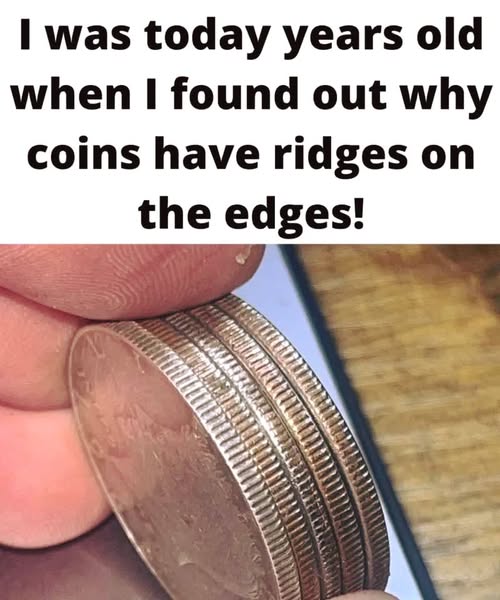
Most people never stop to think about it.
You buy a coffee, receive a few coins in change, slip them into your pocket, and move on with your day. But hidden in that tiny piece of metal is a story far stranger than most imagine — a story filled with theft, collapsing trust, economic panic, and one of history’s greatest scientific minds trying to stop an invisible form of crime. Those small ridges running along the edge of many coins may look decorative, but they were once part of a desperate battle to save entire economies from quiet ruin.
Long before modern paper money and digital banking existed, coins were made from precious metals like silver and gold. Their value didn’t just come from the number stamped onto them; it came from the actual metal inside. A gold coin was valuable because it contained real gold. A silver coin carried real silver. That system worked only as long as people trusted that every coin still contained its full amount of precious metal.
But criminals quickly discovered a nearly invisible way to steal from everyone.
Instead of counterfeiting coins outright, thieves began carefully shaving tiny slivers of metal from the edges of real coins. The process, known as “coin clipping,” was slow and difficult to detect at first. A criminal could trim microscopic amounts from hundreds or thousands of coins without attracting attention. Each individual coin still looked almost normal, so people continued using them in everyday trade. Meanwhile, the stolen silver and gold shavings quietly accumulated into valuable piles of precious metal.
Over time, the damage became enormous.
As more clipped coins spread through markets, trust in money itself began to weaken. Merchants started weighing coins instead of accepting them at face value. Customers argued over whether payments were genuine or altered. Governments watched helplessly as their currency system slowly deteriorated, not through dramatic robbery, but through millions of nearly invisible cuts happening one edge at a time.
The economy entered a dangerous cycle. Once people realized coins might contain less metal than promised, fear spread quickly. Some hoarded full-value coins and refused damaged ones. Others melted coins down completely for profit. The more trust disappeared, the more unstable commerce became. Entire financial systems were threatened by something as small as shaved metal dust.
The solution eventually came through an idea so simple it seemed almost obvious in hindsight: change the edges.
Instead of leaving coins smooth, mints began carving distinctive ridges, grooves, or lettering around the outer rim. These patterned edges made clipping instantly visible. The moment someone shaved even a tiny amount of metal away, the damage became obvious because the ridges would disappear or appear uneven. Suddenly, the edge itself became a security feature.
One of the most important figures connected to this transformation was Isaac Newton. While most people remember him for gravity and physics, Newton also served as Master of the Royal Mint in England. During a period of severe counterfeiting and coin clipping, he helped oversee major reforms to stabilize British currency. Under his supervision, improved minting techniques and reeded coin edges played a major role in restoring public confidence in money.
What makes the story remarkable is how long that tiny invention survived.
Today, most coins are no longer made from precious silver or gold, meaning clipping them would be practically worthless. Yet the ridges remain. Modern vending machines and coin counters still use them to identify coins accurately. Blind and visually impaired people often rely on edge textures to distinguish between denominations without seeing them. Even now, centuries after the original crisis faded, the old anti-theft design continues serving practical purposes in daily life.
And perhaps that’s what makes those little ridges so fascinating. They are not random decoration. They are fossils from an economic war most people have forgotten ever happened. Every groove represents a time when governments feared financial collapse, merchants distrusted every transaction, and criminals discovered that stealing a fraction from everyone could eventually destabilize entire nations.
So the next time a coin passes through your hand, look closely at the edge. Those tiny ridges are more than metal patterns. They are a surviving reminder that even the smallest details in ordinary objects often exist because, somewhere in history, someone found a clever way to cheat the system — and someone else had to find an even cleverer way to stop them.