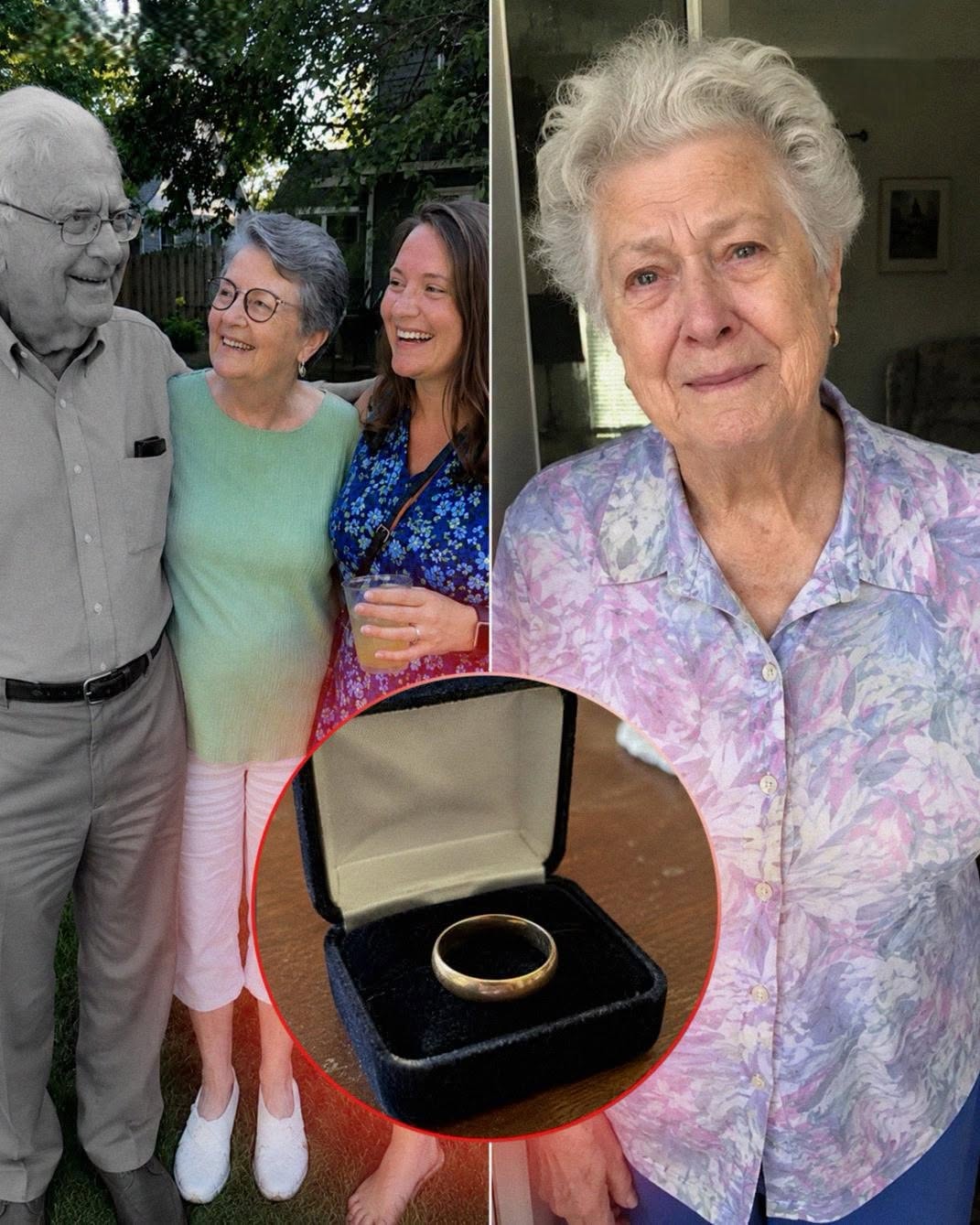
After my father passed away, the bank placed a small, dust-covered safe-deposit box into my hands—something he had quietly maintained for decades without ever mentioning it to anyone. I expected to find nothing more than old military medals, faded documents, or perhaps a few family keepsakes that elderly people often save for sentimental reasons. Instead, tucked inside a worn velvet pouch was a thin gold wedding ring and a handwritten note containing only six words. Those few words instantly destroyed everything I believed I knew about my father. For more than forty years, he had carried a burden in complete silence, intending to take the truth with him forever. Fate, however, had written a different ending.
My father was a man who lived according to routine and discipline. Every tool in his workshop had its assigned place, extension cords were neatly labeled, and even the smallest screws were carefully sorted into old coffee cans. He believed bills should be paid early, promises should never be broken, and emotions should remain private. Throughout my childhood, I rarely saw him cry or openly express vulnerability. When the bank manager informed me that I was the sole beneficiary of a safe-deposit box my father had rented back in 1978, I assumed it contained practical records, nothing more. The truth waiting inside would challenge everything I had ever admired about him.
Resting inside the velvet pouch was a delicate gold wedding band. Years of wear had left a noticeable scratch beside its small stone, evidence that someone had treasured it for a very long time. Folded beneath the ring was a single note written in my father’s unmistakable handwriting: “Return this to Sarah. I’ve waited too long.” Confused, I brought the ring home and showed it to my mother. She stared at it quietly before forcing a calm expression onto her face. Although she insisted she had never known anyone named Sarah, I noticed the hesitation in her voice and the brief catch in her breath. It wasn’t ignorance I was seeing—it was the fear that an old secret had finally surfaced.
Unable to ignore the mystery, I began examining my father’s financial records. My parents had always maintained separate bank accounts, something they claimed was simply a habit formed during difficult financial years early in their marriage. Once I knew where to look, unusual patterns slowly emerged. Year after year, stretching back decades, small payments had quietly left his accounts. Sometimes they appeared as cashier’s checks, other times they moved through different accounts or even a friend’s business. The transactions had been carefully disguised, not to conceal criminal activity, but to hide something far more personal—an obligation my father apparently believed he could never escape.
Eventually, the name Sarah appeared on an old business tax document connected to a small hardware store that had closed decades earlier. The address led me to a quiet neighborhood where a modest white house stood surrounded by aging flower beds. An elderly woman answered the door before I had finished knocking twice. The instant she saw the ring in my hand, all color disappeared from her face. She slowly lowered herself onto the porch steps, her hands visibly shaking. I gently explained that my father had recently passed away and that I had discovered the ring among his belongings. She listened silently before saying she had promised never to tell the story unless my father himself came to hear it.
I couldn’t accept leaving with only fragments of the truth. After a long silence, Sarah finally invited me inside and began explaining what had happened all those years ago. It wasn’t a story of betrayal between lovers or a hidden second family. It was the story of a devastating business failure. During the late 1970s, my father entered a partnership with a charismatic salesman named Tom. While my father handled the honest work, Tom managed the paperwork and finances. Trusting his partner completely, my father signed documents without fully understanding the risks. Tom had quietly used the business and the apartment above it as collateral for reckless investments. When everything collapsed, Tom disappeared, leaving my father’s signature attached to debts that destroyed several innocent lives.
Sarah had been one of those victims. Her financial future disappeared almost overnight because of decisions she never made. My father blamed himself completely. Although he hadn’t intended to harm anyone, he believed his careless trust had allowed the disaster to happen. On the night the hardware store permanently closed its doors, Sarah removed her wedding ring and handed it to him. She told him to keep it until he could somehow return the life that had been taken from her. My father accepted those words literally. For more than forty years, he quietly sent money whenever he could, believing he owed a debt that could never truly be repaid.
Finding Tom required weeks of searching. Eventually, I located him living alone in a small senior apartment several towns away. The confident businessman Sarah had once described no longer existed. Age and regret had replaced his charm. When I confronted him with the story, he admitted he had spent decades avoiding everyone connected to the business because he couldn’t bear facing the consequences of his actions. Two days later, I drove Sarah to meet him. Watching them sit across from one another felt like witnessing unfinished history finally demanding its conclusion. His apology could never erase the damage, but for the first time in over forty years, the truth was spoken aloud by the man responsible.
After the meeting, Sarah surprised me. Instead of asking for the remaining money my father had continued sending all those years, she told me to end the payments permanently. She explained that the debt had already been paid many times over. Her only request was that we restore the original sign from the old hardware store and display it one final time as a tribute to everything that had once existed there. A month later, after careful restoration, the weathered sign stood proudly once again outside the building where so many lives had changed decades before. For Sarah, it wasn’t about reclaiming the past—it was about finally letting it go.
When I returned home, I told my mother everything Sarah had shared with me. She listened quietly from beginning to end without interrupting. When I finished, she didn’t respond with anger or jealousy. Instead, she gently smiled and said my father had made mistakes long before they built their life together, and that he had spent the rest of his years trying to make peace with them. She believed his silence hadn’t been born from deception but from guilt. Returning that wedding ring allowed me to finish a promise my father had carried for nearly half a century. He wasn’t the flawless man I once imagined, but perhaps something far more admirable—a deeply imperfect man who never stopped trying to take responsibility for the pain he believed he had caused.