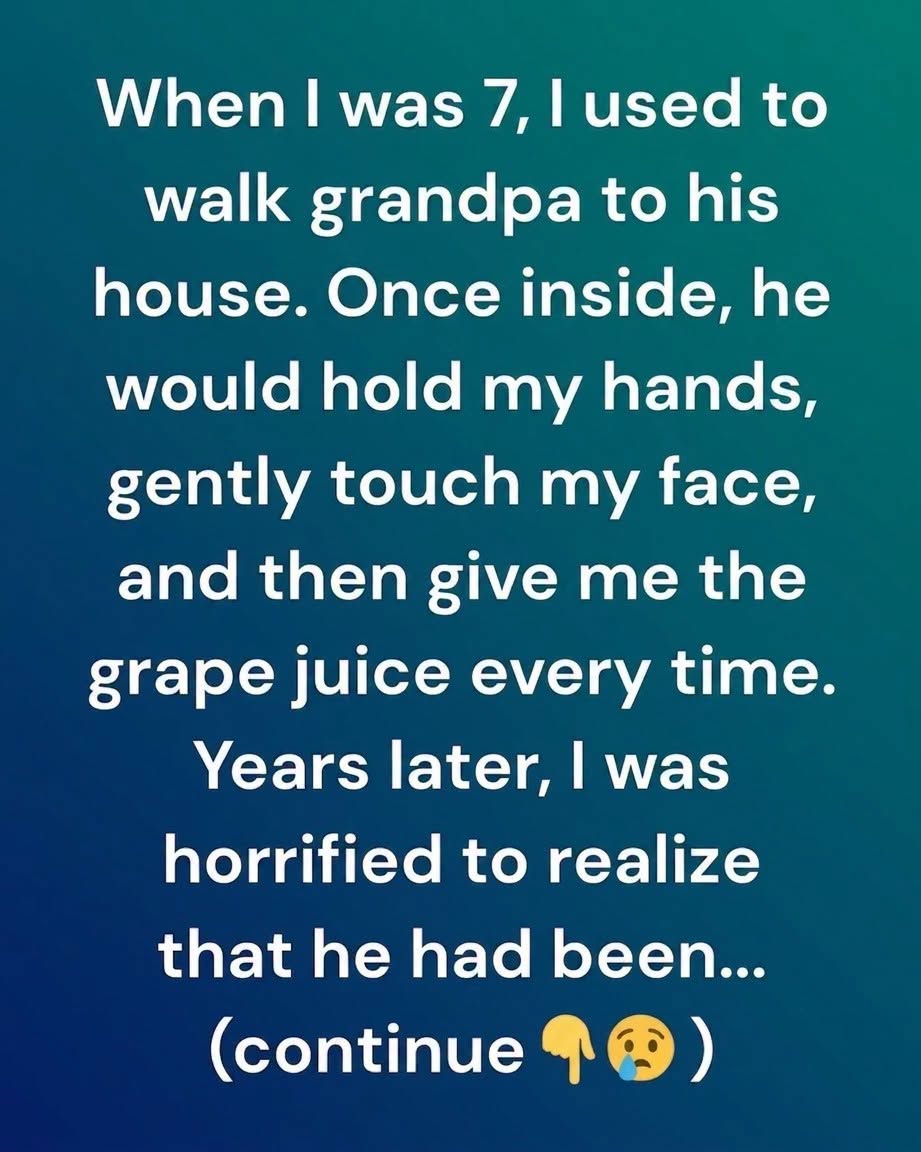
For most of my life, I believed the afternoons I spent with my grandfather were simply the kind of gentle memories every grandchild treasures. I remembered our slow walks through the yard, the way he patiently let me decide where we would go, and how he always raised a tiny glass of grape juice as though we were celebrating something extraordinary. I grew up convinced that I had been keeping him company, giving him laughter and purpose during his later years. What I never understood was that every smile he gave me hid a quiet fear. While I thought I was helping him feel less lonely, he was desperately trying not to lose the person who meant the most to him.
Only years after his passing did I uncover the heartbreaking truth about his battle with memory loss. That discovery transformed every childhood memory I had of him. The deep, unwavering way he looked at me—something I had always interpreted as simple affection—was actually something much more profound. He studied my face with incredible concentration because he feared that one day he would no longer recognize it. Every visit became an exercise in preserving me inside a mind that was slowly slipping away. He wasn’t merely watching his granddaughter grow up; he was fighting to make sure she didn’t disappear from his memory before he did.
The walks we took together suddenly carried an entirely different meaning. As a child, I believed we wandered aimlessly because he enjoyed following wherever my imagination led us. I’d chase butterflies, collect colorful leaves, or disappear behind trees while he quietly trailed behind me with remarkable patience. Looking back now, I realize those walks were never random. I had unknowingly become his anchor. He watched every movement with remarkable focus, memorizing the bounce of my hair as I ran ahead, the sound of my laughter echoing across the yard, and the excitement that lit up my face whenever I discovered something new. Somewhere deep inside, he understood that the ability to recognize those precious details was slowly fading. Every afternoon became another opportunity to store away as much of me as his fragile memory would allow before time inevitably stole the rest.
Even our familiar grape juice tradition revealed a hidden layer of meaning once I understood what he had been facing. As a little girl, I thought it was simply our special afternoon treat while the adults stayed inside talking. Only much later did I realize that those carefully timed breaks had become part of a structured daily routine designed to help him navigate life with memory impairment. Rather than allowing those routines to feel clinical or frightening, he transformed them into joyful little celebrations. He lifted his glass with a smile, invited me to do the same, and turned an ordinary moment into something magical. He refused to let me see him as someone defined by illness. Instead, he built my childhood memories around sweetness, laughter, and love, shielding me from the difficult reality he quietly carried every single day.
As I reflect on those visits now, even his home seems different in my memory. I remember how everything always appeared exactly the same. He wore the same comfortable sweater almost every time I visited. He preferred the same chair beside the window. He greeted me with the same familiar smile and asked nearly identical questions each week. At the time, I simply believed he was a predictable grandfather who enjoyed routine. Now I understand those repeated habits were carefully maintained lifelines. Asking about school, my teacher, or what I had been doing wasn’t absent-minded conversation—it was an attempt to reinforce memories before they slipped away. Repetition became his quiet strategy against a disease determined to erase the people and experiences he loved most.
For a long time after learning the truth, I struggled with overwhelming guilt. I replayed countless memories wondering how I could have missed the signs. I wished I had been older, wiser, or somehow capable of recognizing the battle he was fighting behind his gentle smile. I blamed myself for laughing so freely while he silently carried such enormous fear. But with time, those feelings gradually softened. I came to understand that there was never anything for me to recognize because he never wanted me to know. Protecting my childhood happiness had become just as important to him as protecting his remaining memories. He willingly shouldered the loneliness of his illness because he refused to let it become part of my childhood.
Today, my feelings are no longer dominated by regret but by profound gratitude. I finally understand that his love was never dramatic or attention-seeking. It was expressed quietly through patience, consistency, and countless ordinary moments that only revealed their true significance years later. Every repeated question, every slow walk, every shared glass of grape juice was another way of telling me I was loved without ever speaking those words aloud. He quietly sacrificed the opportunity to share his pain because he believed my innocence deserved to remain untouched for as long as possible.
The grace with which he faced his illness continues to amaze me. Memory loss often steals confidence, independence, and identity, leaving families overwhelmed by sadness and uncertainty. Yet somehow my grandfather transformed his own struggle into something remarkably gentle for the people around him. Rather than allowing fear to define our time together, he filled those years with laughter, small traditions, and peaceful afternoons that remain among my happiest childhood memories. He never asked for sympathy. He simply wanted to leave behind moments that would continue bringing comfort long after his own memories had disappeared.
Looking back now, I realize he was creating a far greater inheritance than anything material. He wasn’t leaving me money, property, or treasured possessions. Instead, he carefully built a lifetime of memories that would survive even after his own mind no longer could. Every garden walk, every smile, every quiet conversation became another page in a story he hoped I would carry forward. In many ways, those simple traditions became the final letter he ever wrote to me—a message composed not with ink, but with kindness, patience, and unwavering love.
Whenever I think of him today, I no longer picture only the elderly man sitting peacefully beside the window. I see someone displaying extraordinary courage in the face of a battle he knew he could never truly win. I hear love in the familiar questions he repeated so faithfully and feel it in the quiet routines that once seemed so ordinary. For years I believed I had been guiding him through those afternoons together. Now I understand the opposite was true. Every gentle step he took beside me, every tradition he protected, and every memory he quietly created was leading me toward this understanding. He wanted me to remember not the illness that slowly stole pieces of him, but the love that never faded. His story did not end with confusion or despair. It ended with quiet devotion, patiently woven into the memories he fought so hard to leave behind. Only now, after all these years, am I finally beginning to understand the extraordinary gift he gave me, and in that realization, I have found the same quiet peace he spent his final years trying to give away.