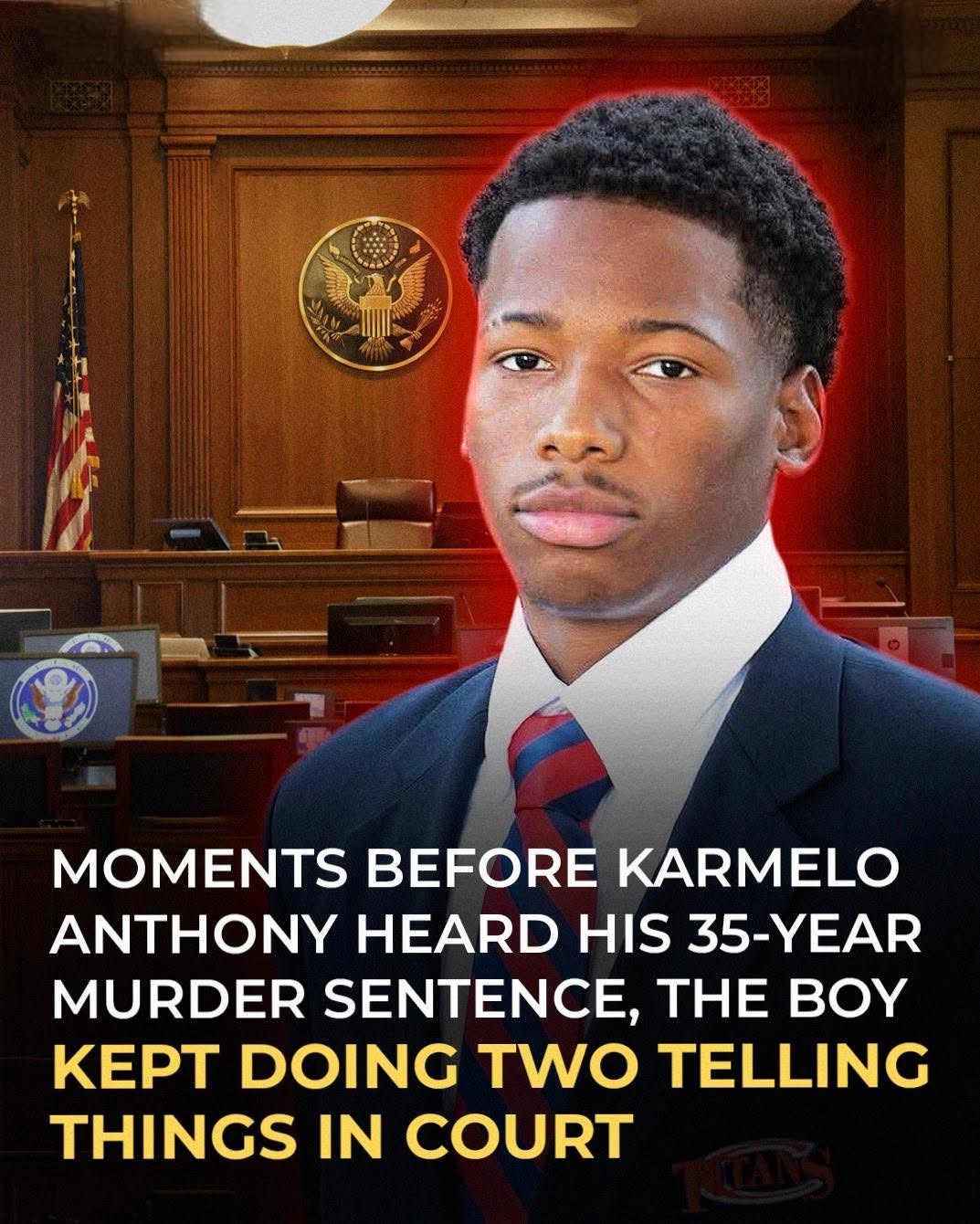
The atmosphere inside the Collin County courtroom was almost unbearable as the verdict was finally delivered. Family members sat frozen in place, some fighting back tears while others openly broke down. At the center of it all stood 19-year-old Karmelo Anthony, listening as jurors found him guilty of murder. What began as a disagreement between teenagers at a high school track meet had ended with one young man dead and another facing decades behind bars.
The case centered on the fatal stabbing of 17-year-old Austin Metcalf during a district track event held at Kuykendall Stadium in Frisco, Texas, on April 2, 2025. What should have been a normal day of competition quickly turned into one of the most shocking incidents the local community had ever witnessed.
According to testimony presented during the trial, the confrontation started when Anthony, a student from Centennial High School, was sitting in an area reserved for Memorial High School athletes. Austin Metcalf approached him and asked him to move. Witnesses described a tense exchange that escalated within seconds. Several recalled hearing Anthony warn Metcalf with words similar to, “Touch me and see what happens.”
Moments later, the argument turned deadly.
Jurors heard evidence showing that Anthony pulled out a knife and stabbed Austin in the chest. Despite immediate efforts to save him, the teenager later died from his injuries.
As the trial unfolded, the courtroom became the setting for two very different versions of the same event.
Defense attorney Mike Howard argued that Anthony was not acting out of hatred or premeditated intent. Instead, he portrayed his client as a frightened teenager who believed he was trapped and reacted in panic. The defense maintained that Anthony felt threatened during the confrontation and acted in what he believed was self-defense. Attorneys also highlighted his emotional reaction after the stabbing, noting that he repeatedly asked about Austin’s condition and appeared devastated by what had happened.
Prosecutors strongly rejected that interpretation.
Lead prosecutor Bill Wirskye argued that Anthony had multiple opportunities to walk away from the dispute but instead chose to escalate it. He described the stabbing as an unnecessary and unjustified act of violence. According to the prosecution, Anthony brought a knife to a school event and used it during an argument that never required deadly force.
Throughout the proceedings, prosecutors emphasized that self-defense protections do not apply when a person provokes or escalates a confrontation that could otherwise have ended peacefully.
The emotional impact of the case became especially clear during the sentencing phase.
Anthony’s mother, Kayla Hayes, took the stand and pleaded for mercy. Fighting back tears, she described her son as her first child and expressed hope that the jury would consider his age and future potential when determining punishment.
Across the courtroom, however, the Metcalf family spoke about a very different loss.
Austin’s twin brother, Hunter Metcalf, delivered one of the most emotional statements of the trial. He described the pain of losing someone who had been part of every stage of his life. He spoke about future milestones that would now be faced alone and the lasting emptiness left behind by his brother’s death.
For many observers, his testimony captured the human cost of the tragedy more powerfully than any legal argument.
After deliberating, jurors rejected the defense’s request to consider “sudden passion,” a legal finding that could have reduced the severity of the sentence. Instead, they returned a punishment of 35 years in prison.
The verdict produced intense emotions on both sides of the courtroom.
Members of the Metcalf family viewed the decision as a measure of accountability for Austin’s death. Meanwhile, Anthony’s family faced the reality that their son would spend much of his adult life incarcerated.
As Judge John Roach formally imposed the sentence, observers reported seeing Anthony quietly mouth the words, “I’m sorry,” toward his parents. Whether those words reflected regret, sorrow, or resignation, they could not undo the events that had brought everyone into the courtroom.
The impact of the case extends well beyond the individuals directly involved. Across Texas and beyond, the incident has fueled discussions about youth violence, accountability, school safety, and the consequences of carrying weapons.
What makes the tragedy particularly disturbing is how ordinary its beginning was. There was no long-standing feud, no elaborate plan, and no warning that such a catastrophic outcome was approaching. A brief disagreement between students escalated in seconds and permanently altered multiple lives.
For students, parents, teachers, and community leaders, the case stands as a painful reminder that decisions made during moments of anger can carry consequences that last forever.
Austin Metcalf lost his life.
Karmelo Anthony lost his freedom.
Two families were left carrying different forms of grief that will likely remain long after the headlines disappear.
Although the legal process has now concluded, the emotional consequences continue. Court rulings can determine guilt and assign punishment, but they cannot restore a life that has been taken or fully heal those left behind.
As Anthony enters the prison system and the Metcalf family continues learning how to live with unimaginable loss, the case remains a sobering example of how quickly a single moment can change everything. What happened during those few seconds at a high school track meet will continue to shape the futures of everyone involved for years to come.
The public debate surrounding the case continues, with many analyzing every detail in search of explanations. Yet for the families at the center of the tragedy, those discussions offer little comfort. The verdict may have closed the legal chapter, but the consequences of that brief confrontation will endure far beyond the courtroom walls.