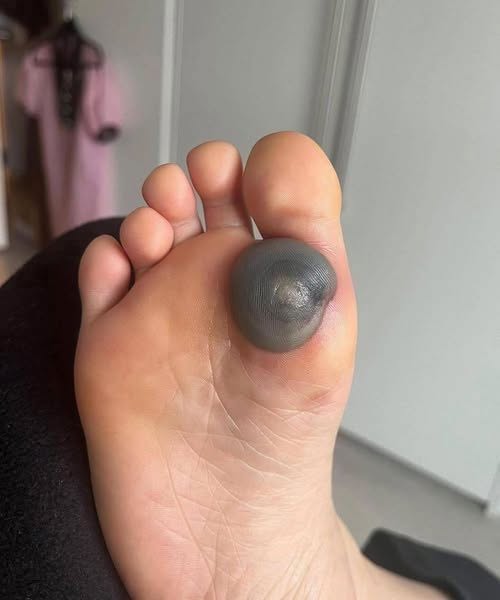
Few things worry a parent more than discovering a dark, swollen spot on their child’s foot. One moment everything seems normal, and the next, your child is limping, refusing to put weight on one foot, and pointing to a painful blister that appears almost black beneath the skin. Although its appearance can be alarming, a blood blister is often far less serious than it looks. In many cases, it develops after friction, pressure, or a minor injury causes small blood vessels beneath the skin to break while the outer layer of skin remains intact. Understanding what causes blood blisters, how to care for them properly, and when medical attention is necessary can help parents respond calmly and confidently while ensuring their child receives appropriate care if complications arise.
A blood blister forms when tiny blood vessels beneath the skin rupture after an injury.
Unlike a regular blister that fills with clear fluid, a blood blister contains blood trapped beneath an unbroken layer of skin.
This gives it its distinctive dark red, purple, or nearly black appearance.
Although the color may seem alarming, the blister itself is often part of the body’s natural healing process.
Children commonly develop blood blisters from everyday activities.
A pair of shoes that fit too tightly.
Hours of running and jumping.
Dropping a heavy object on the foot.
Pinching the skin between hard surfaces.
Repeated rubbing during sports or outdoor play.
Even a relatively small injury can create enough pressure to damage the tiny blood vessels beneath the skin.
Once the blood collects under the surface, the area becomes swollen, tender, and sensitive to touch.
Pain levels vary depending on the location and size of the blister.
Some children experience only mild discomfort.
Others may find it painful to walk, especially when the blister forms on the sole of the foot or near the toes where pressure is greatest.
Fortunately, most uncomplicated blood blisters gradually heal without medical treatment.
Over the course of one to two weeks, the body slowly reabsorbs the trapped blood while new skin develops underneath.
One of the most important steps during recovery is resisting the urge to pop the blister.
The intact skin covering the blister serves as a natural protective barrier.
It helps keep bacteria out while the tissue underneath heals.
Opening the blister unnecessarily increases the risk of infection and can delay recovery.
Instead, gentle protection is usually the best approach.
Keeping the area clean and dry helps prevent irritation.
If the blister is likely to rub against socks or shoes, covering it with a loose, non-stick bandage may provide additional comfort.
A cold compress applied for short periods can reduce swelling and ease discomfort during the first day or two after the injury.
Parents should also encourage children to avoid activities that continue placing pressure on the injured area until pain improves.
Most blood blisters resolve without complications, but there are situations where medical evaluation becomes important.
Seek medical attention if your child experiences:
* Severe or worsening pain.
* Increasing redness spreading around the blister.
* Warmth, swelling, or pus draining from the area.
* Fever or signs of illness.
* Difficulty walking that does not improve.
* A blister that developed without any obvious injury.
* Repeated blood blisters occurring frequently.
These symptoms may indicate an infection or another condition requiring professional evaluation.
Children with diabetes, circulation problems, immune system disorders, or bleeding disorders should also be assessed promptly if a blood blister develops, since healing may be slower and complications can occur more easily.
In some cases, what appears to be a blood blister may actually represent another skin condition.
Bruising.
Friction blisters.
Minor burns.
Certain infections.
Less commonly, other medical conditions affecting the skin or blood vessels.
If parents are uncertain about the diagnosis, a healthcare professional can examine the area and determine whether additional treatment is needed.
The good news is that most blood blisters are temporary injuries that heal naturally with simple home care.
Patience, gentle protection, and monitoring for signs of infection are usually all that is required.
While the appearance of a dark blister can certainly be frightening, understanding why it forms and knowing when to seek medical advice can help parents respond with confidence instead of panic.
In the vast majority of cases, time allows the body to repair itself, and within a couple of weeks, the blister gradually disappears, leaving healthy skin behind and your child ready to return to normal activities.