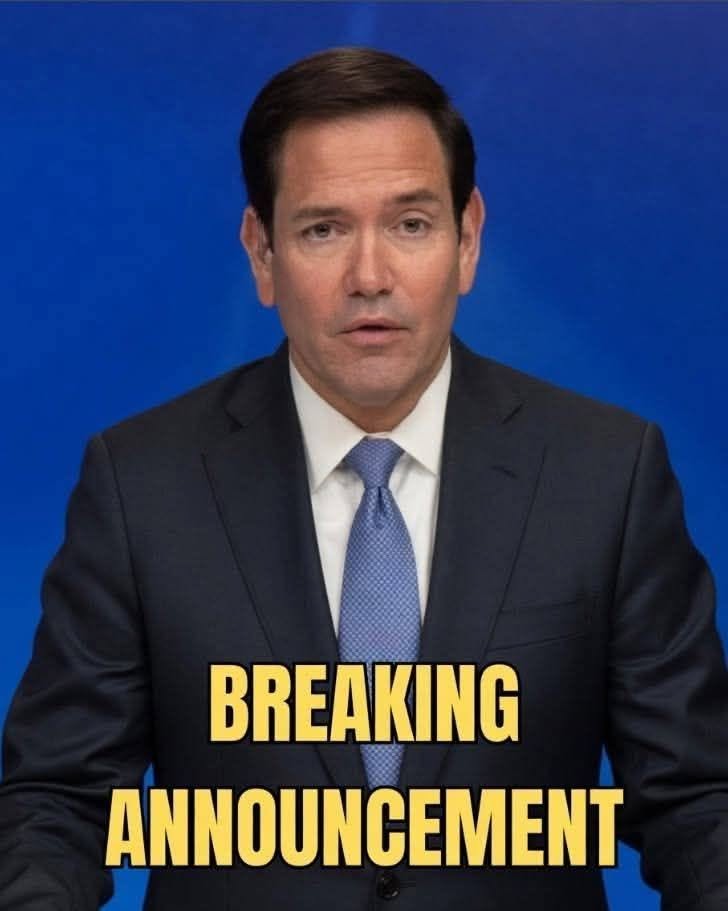
The warning coming from Washington is growing harder to ignore.
Publicly, officials continue to speak the language of diplomacy. Privately, the concern appears far more serious. As tensions rise across the Persian Gulf, Sen. Marco Rubio has made it clear that nobody in Washington is celebrating or assuming the crisis is under control.
“I’m not popping champagne,” Rubio reportedly said, a remark that reflects the uneasy mood surrounding efforts to prevent a wider regional confrontation.
At the center of the dispute lies one of the most strategically important waterways on Earth: the Strait of Hormuz.
Every day, enormous volumes of global oil shipments pass through the narrow passage connecting the Persian Gulf to international markets. Any disruption there would ripple far beyond the Middle East, affecting energy prices, financial markets, and economic stability across the globe.
That is why recent discussions surrounding a possible Iranian effort to impose fees, restrictions, or other controls on maritime traffic have triggered alarm among policymakers in Washington, Europe, and several regional capitals.
For American officials, the issue extends beyond economics.
The concern is about precedent.
If one nation can effectively transform a critical international shipping lane into a pay-to-pass corridor, many fear it could undermine longstanding principles governing global navigation and trade.
Rubio’s comments suggest that the United States views such a scenario as more than a diplomatic disagreement. Behind the measured language is a warning that certain actions would be viewed as crossing a line with consequences that could extend well beyond sanctions and negotiations.
At the same time, diplomatic channels remain active.
Pakistan has reportedly emerged as an unexpected intermediary, with senior officials engaging in discussions aimed at reducing tensions and keeping communication flowing between key players. Such efforts highlight the growing urgency among governments seeking to avoid escalation.
Across Europe, policymakers are also weighing additional pressure measures. While sanctions and economic restrictions remain among the preferred tools of Western governments, there is increasing recognition that financial penalties alone may not resolve the broader dispute.
Complicating matters further are ongoing regional conflicts and rivalries that continue to fuel instability.
Events involving Israel, Hezbollah, Lebanon, and Iran have created an environment in which a localized incident could quickly trigger broader consequences. Each new development adds another layer of uncertainty to an already fragile situation.
That uncertainty explains why references to a possible “Plan B” have attracted attention.
Officials rarely discuss alternative strategies publicly unless they believe negotiations may not succeed. The existence of contingency planning does not necessarily mean confrontation is imminent, but it does indicate that policymakers are preparing for multiple outcomes.
Meanwhile, markets, energy analysts, and military planners are watching closely.
The stakes are enormous.
A disruption to shipping through the Strait of Hormuz would affect not only governments but consumers worldwide, potentially influencing fuel costs, supply chains, and economic growth far beyond the region itself.
For now, diplomacy remains the preferred path.
Negotiators continue talking.
Messages continue moving between capitals.
Meetings continue behind closed doors.
Yet Rubio’s caution underscores a reality many officials appear to share: the situation remains delicate, the room for error is limited, and the decisions made in the coming weeks could have consequences far beyond the Persian Gulf.
Whether diplomacy ultimately succeeds or fails, one thing is clear.
No one involved appears willing to underestimate the risks anymore.