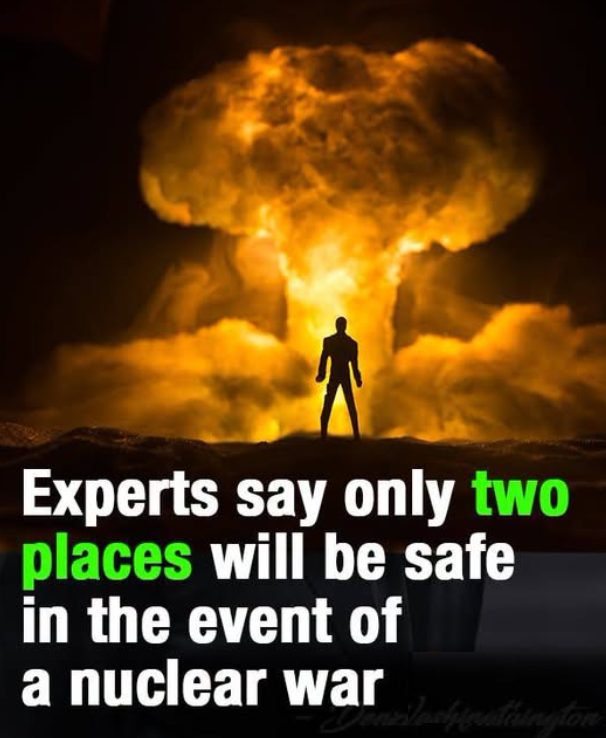
As tensions continue to rise following recent military actions involving the United States, Israel, and Iran, many people have begun asking an unsettling question: if a major global conflict were ever to escalate into a large-scale nuclear confrontation, where would the safest places be?
For older generations, such concerns evoke memories of the Cold War era, when schoolchildren practiced “duck and cover” drills designed to prepare them for the possibility of a nuclear attack. Although those exercises offered limited real protection, they reflected a period when fears of nuclear war were woven into everyday life.
Today, the geopolitical landscape is different, but anxieties surrounding global security remain. Recent developments in the Middle East have intensified public discussion about military escalation, strategic deterrence, and the potential consequences of a wider conflict involving nuclear powers.
Military analysts often note that one of the primary concerns in any hypothetical nuclear scenario involves strategic military infrastructure. Across the United States, significant portions of the nation’s land-based nuclear deterrent are located in states such as Montana, North Dakota, Nebraska, Wyoming, and Colorado. These missile fields have long been viewed as potential targets in any large-scale nuclear exchange because of their strategic importance.
Experts warn that an attack on such facilities could produce devastating immediate effects, including blast damage, fires, radioactive fallout, and long-term environmental contamination. Areas closest to strategic military targets would likely face the highest levels of risk, not only from direct strikes but also from lingering radiation that could affect surrounding regions.
Because of these factors, some researchers have examined which areas might experience comparatively lower exposure to radioactive fallout in certain hypothetical scenarios. Regions farther from major military installations and missile complexes are often identified as potentially less exposed to immediate radiation risks. Various analyses have highlighted portions of the northeastern, southeastern, and some western states as areas that could experience lower projected fallout levels under specific conditions.
However, specialists repeatedly emphasize that no location can be considered completely safe during a full-scale nuclear conflict. Modern nuclear weapons possess enormous destructive capabilities, and the indirect consequences of such a war could extend far beyond the areas directly targeted.
One of the greatest long-term concerns is the possibility of a nuclear winter. Scientists have theorized that widespread fires resulting from numerous nuclear detonations could inject vast amounts of soot and debris into the atmosphere. This could significantly reduce sunlight, lower global temperatures, disrupt weather patterns, and severely impact agriculture across large portions of the planet.
In such a scenario, survival would depend on far more than simply avoiding the initial blasts. Access to food, clean water, medical care, shelter, and stable infrastructure would become critical challenges. Agricultural production could decline dramatically, creating shortages that affect populations thousands of miles from any direct strike.
Some experts have suggested that countries in the Southern Hemisphere may face fewer long-term effects from a nuclear winter because of their geographic isolation and agricultural capacity. Nations such as New Zealand and Australia are frequently mentioned in discussions about long-term resilience due to their distance from many major geopolitical flashpoints and their ability to produce food domestically.
Even so, researchers caution that a global nuclear conflict would create worldwide consequences unlike any disaster in human history. Economic systems, supply chains, communication networks, healthcare services, and food production could all be disrupted on an unprecedented scale.
Ultimately, the most important lesson is not identifying where survival odds might be slightly higher, but recognizing the immense human cost that any nuclear conflict would carry. While strategic analyses can estimate risks and vulnerabilities, there is no truly safe outcome in a large-scale nuclear war. The best protection remains the prevention of such a conflict altogether through diplomacy, deterrence, and international cooperation.