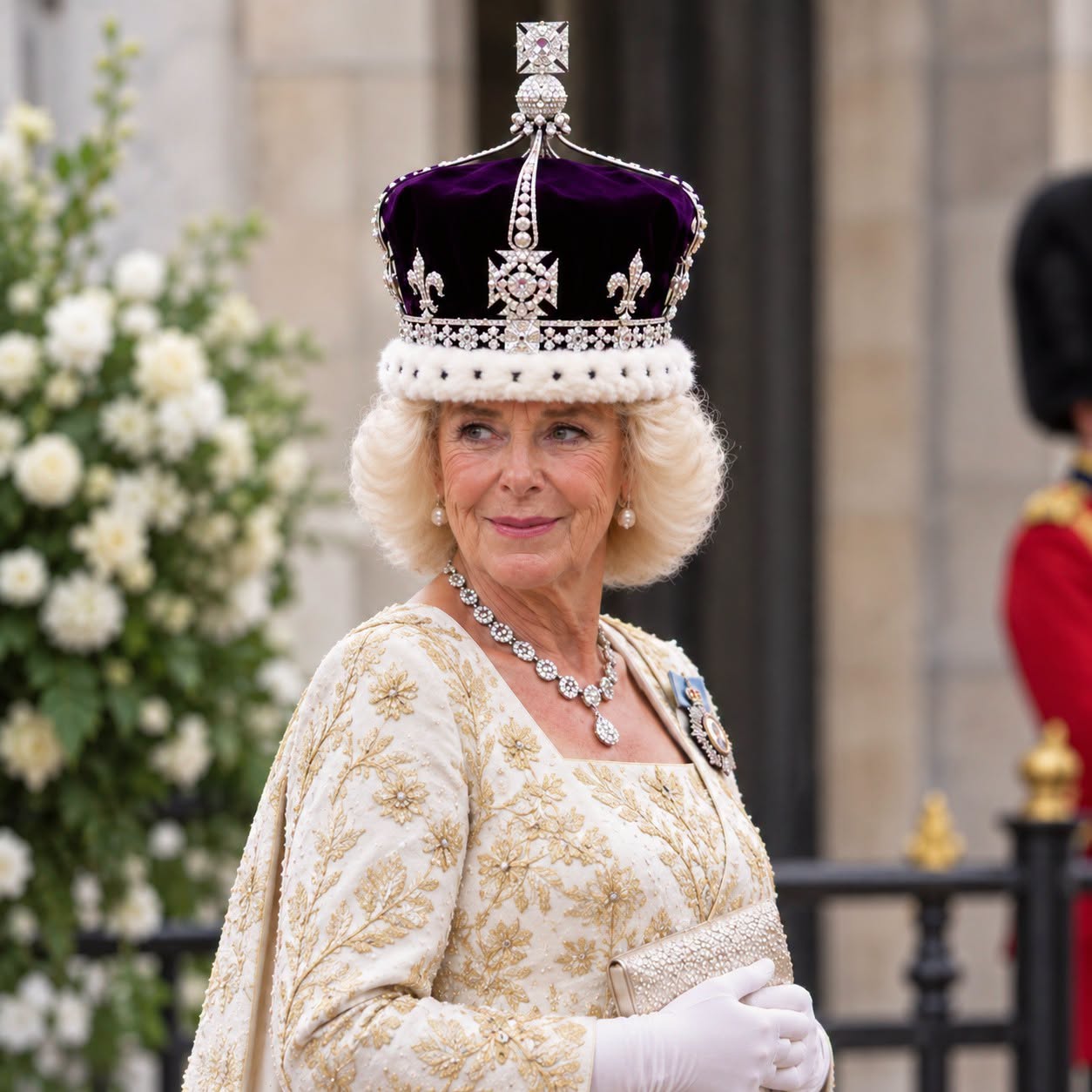
What that portrait truly captured was not necessarily forgiveness, and certainly not the disappearance of old wounds. If anything, it seemed to capture something quieter and more complicated: fatigue.
Years of public outrage, arguments, criticism, and emotional debate had slowly burned down to embers. The intensity that once surrounded Camilla had not necessarily vanished, but it had changed form. What remained was something less dramatic and, in some ways, more unsettling: coexistence.
People did not have to like Camilla.
They did not have to forget the controversies surrounding her.
They did not have to rewrite their memories of the past.
But they could accept that she was there.
She was in the photograph.
She was part of the ceremony.
She occupied the role that history had eventually given her.
And the monarchy, an institution that has always depended heavily on image, symbolism, ritual, and repetition, had gradually incorporated her into its visual language.
The crowns, the sashes, the formal clothing, the carefully arranged ceremonies, the symmetry of official portraits—all of these elements communicate stability. They create an image of continuity, even when the people inside that image have lived through extraordinary personal turmoil.
In that sense, the photograph said something larger than simply who was standing beside whom.
It showed how institutions can absorb complicated histories and eventually present them as part of an established order.
Camilla, once surrounded by controversy, was now standing within the same visual framework as the institution itself.
The image did not erase the past.
It simply placed the present on top of it.
That distinction matters.
Because acceptance is not always the same thing as forgiveness.
Time can soften anger without eliminating memory. People can become accustomed to something without ever becoming emotionally comfortable with it. A person can become familiar without becoming universally embraced.
That may be what the portrait revealed most clearly.
For some people, Camilla’s presence represents resilience.
They see a woman who endured years of intense public scrutiny and criticism and eventually found a place within the institution she had once been associated with so controversially. To them, her continued presence represents loyalty, endurance, and the ability to survive a narrative that seemed almost impossible to escape.
But for others, the same image carries a completely different emotional meaning.
Her presence can reopen memories connected to Diana, the breakdown of Charles and Diana’s marriage, divorce, and the broader dysfunction that surrounded the royal family during that period.
For those people, the past is not simply history.
It remains emotionally present.
That is why the power of the photograph lies partly in its refusal to resolve the disagreement.
It does not tell viewers what they are supposed to feel.
It does not announce that the controversy is over.
It does not erase Diana from the story.
It does not demand that everyone accept the same interpretation of what happened decades ago.
Instead, it presents a woman standing within an institution that has chosen to move forward.
And that creates a fascinating tension.
The monarchy has always understood the importance of repetition.
Ceremonies are repeated.
Traditions are repeated.
Photographs are repeated.
Titles and rituals are repeated.
Over time, repetition can create familiarity, and familiarity can gradually make even controversial realities seem permanent.
What once felt shocking can eventually become ordinary.
What once seemed impossible can become part of the official picture.
And what once existed outside the accepted image can eventually be placed directly at its center.
That does not necessarily mean that everyone has changed their minds.
It means that history has continued moving.
The institution has continued functioning.
And the people within it have continued taking their places.
Camilla’s journey through that process is therefore about more than one individual.
It also reveals something about how public memory works.
People rarely remember historical events in exactly the same way. Some remember the personalities. Others remember the scandals. Some remember the photographs. Others remember how they felt when those events were happening.
For many, Diana remains an enormously powerful presence in the emotional history of the monarchy.
Her image, her popularity, and the circumstances surrounding her life and death continue to shape how people interpret everything that came afterward.
That means Camilla’s presence can never be completely separated from that history.
Even when she appears in a formal portrait, surrounded by ceremony and symbols of royal continuity, the older story can remain just beneath the surface.
That is perhaps why the image feels more complicated than a simple picture of acceptance.
It shows the present.
But the past is still visible in the questions people bring to it.
There is also something striking about the contrast between the emotional history surrounding Camilla and the calm visual language of the photograph.
The setting may appear controlled.
The clothing may be formal.
The expressions may be composed.
Everything is designed to communicate order.
Yet the story behind the image contains years of conflict, heartbreak, public judgment, and competing memories.
The photograph is calm because institutions are often designed to look calm.
But calm does not necessarily mean uncomplicated.
Behind the symmetry are decades of history.
Behind the ceremony are personal stories.
Behind the crown are questions that cannot be completely answered by ritual.
And that may be the most revealing part of all.
Camilla survived a narrative that once seemed capable of defining her permanently.
Whether one views that story sympathetically or critically, the fact remains that public perception can be extraordinarily powerful. A person can become a symbol long before they have the opportunity to define themselves on their own terms.
Over time, however, symbols can change.
The person who was once defined primarily by controversy can become defined by endurance.
The figure who was once treated as an outsider can become part of the institution’s official image.
The controversy may remain, but the daily reality changes.
And eventually, the institution begins to look as though the controversial chapter was always destined to lead here.
That is the power of time.
But it is also the danger of time.
Time can heal some wounds.
It can create distance.
It can make old arguments feel less immediate.
But time can also make people forget how complicated the path actually was.
A polished portrait can make history look cleaner than it ever was.
The crown can create an impression of inevitability.
Yet inevitability is often something created after the fact.
The photograph exists because countless decisions, relationships, conflicts, losses, and changes came before it.
It is the final frame of a story that never had a simple beginning.
For some viewers, the image may represent closure.
For others, it may feel like the past has been repackaged rather than resolved.
Both reactions can exist without the photograph itself changing.
And perhaps that is precisely why the image is so powerful.
It does not settle the argument.
It does not force reconciliation.
It simply shows where history has arrived.
A woman who once stood at the center of one of the monarchy’s most painful chapters now stands within its formal visual language.
The institution has made room for her.
The rituals continue.
The photographs are taken.
The crowns remain.
But acceptance and memory are not always the same thing.
A person can become part of the institution while remaining a complicated figure in the public imagination.
A controversy can become less visible without becoming forgotten.
And a photograph can communicate stability while quietly reminding viewers of everything that came before it.
Perhaps that is the deeper meaning of the portrait.
It is not proof that everyone has forgiven.
It is not proof that everyone has forgotten.
It is evidence that history has continued moving forward, even while people continue carrying different versions of the past.
The monarchy has placed Camilla within its picture of continuity.
Time has softened some of the anger.
Repetition has made her presence familiar.
Ritual has made it official.
But none of those things can completely erase memory.
The crown sits.
The institution continues.
The photograph becomes another piece of history.
And the questions stay.