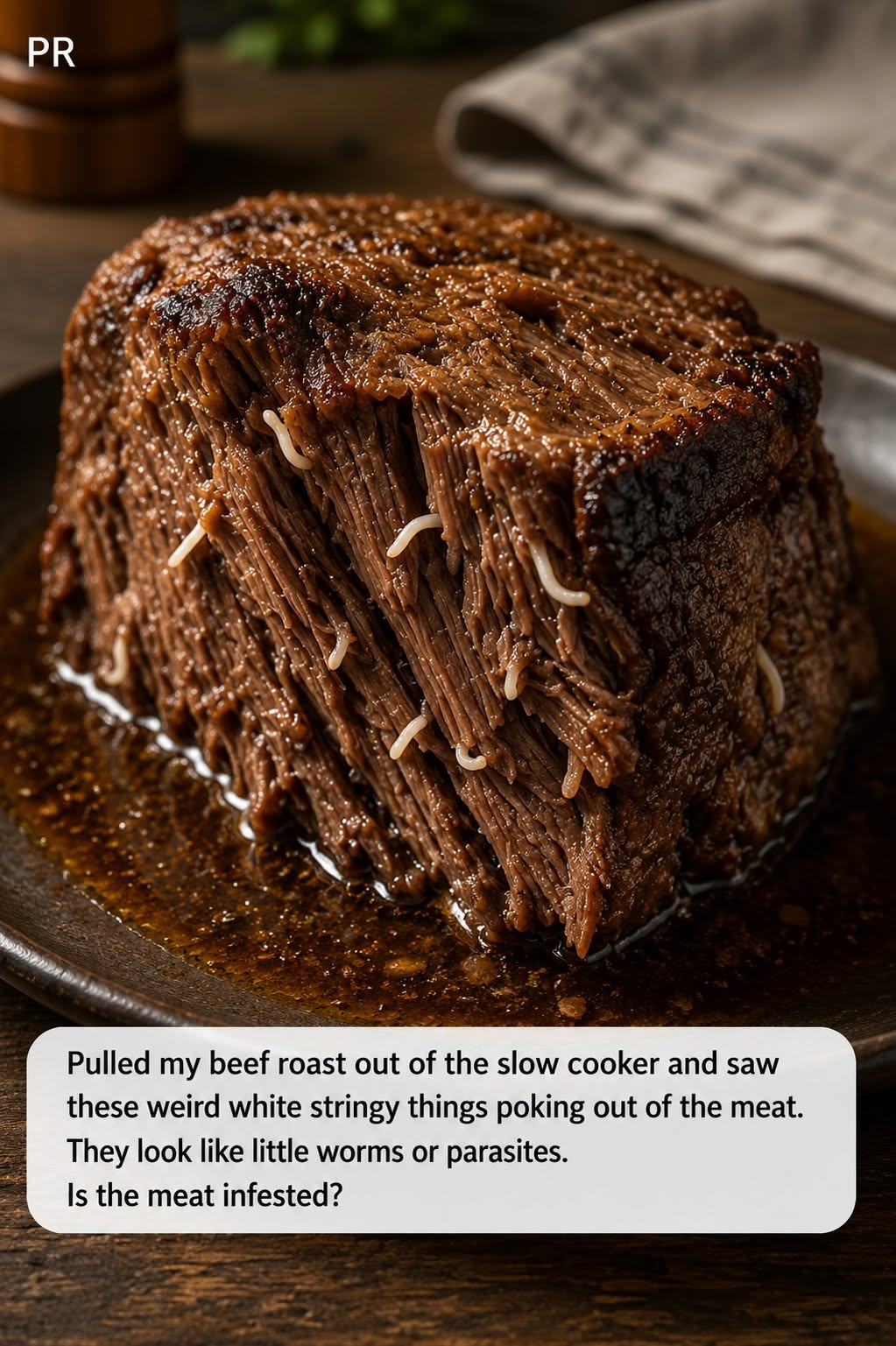
That first glimpse can be enough to make your heart skip a beat.
You carefully slice into a slow-cooked beef roast, expecting a tender, delicious meal. Then you notice something strange hiding between the fibers of the meat—thin, pale strands that look alarmingly like tiny worms. Instantly, your appetite disappears. Questions race through your mind. Is the meat contaminated? Is it dangerous? Should you throw everything away?
Before panic takes over, it’s important to understand what you’re actually seeing.
In most cases, those white, string-like strands are not parasites at all. They are a completely natural part of the meat itself. Beef contains large amounts of connective tissue rich in collagen, a protein responsible for holding muscle fibers together. During the slow-cooking process, especially when meat is cooked at low temperatures for many hours, that collagen gradually breaks down.
As it softens and melts, it can appear as pale threads, silky strands, or gelatin-like pieces woven throughout the roast. While the appearance may seem unusual or even unsettling, it is often a sign that the cooking process worked exactly as intended.
In fact, many barbecue enthusiasts and professional chefs consider this transformation a hallmark of properly cooked beef. The breakdown of collagen is what helps turn tough cuts of meat into tender, flavorful meals that practically fall apart with a fork.
Naturally, many people worry about parasites when they see these unfamiliar structures. However, in countries with modern food safety regulations and meat inspection systems, parasites in commercially sold beef are extremely uncommon. Furthermore, parasites cannot survive the internal temperatures recommended for safely cooking beef.
There are also visual differences. Connective tissue tends to appear soft, slippery, irregular, and easily pulled apart. Parasites, on the other hand, would typically appear as more distinct, structured, and uniform organisms.
If your roast smells normal, was stored correctly, and reached a safe internal temperature during cooking, those mysterious strands are almost certainly harmless collagen and connective tissue.
What initially looks alarming is often nothing more than food science in action.
So the next time you spot those pale strands in a slow-cooked roast, you can relax. Rather than being a warning sign, they are usually evidence that time, heat, and collagen have worked together to transform a tough cut of beef into a tender and flavorful meal.