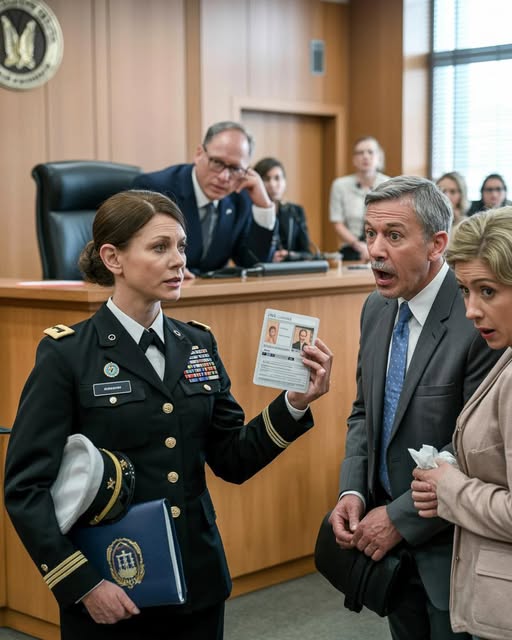
The judge’s voice lowered so much that for a moment I wondered if I had only imagined it. “Captain Bates, from Yemen?” Just seconds earlier, the courtroom had been filled with small, ordinary sounds—the tapping of the clerk’s keys, a cough from the back, the faint slide of paper across a desk. Then everything faded. My military ID rested between the judge’s fingers. My father’s chair made one last short scrape against the floor and went still.
The judge studied the card, then glanced at the ribbon bar on my chest, then back down at the case file before him. “I’m going to ask one question before we proceed.” Their lawyer rose halfway. “Your Honor, if this concerns military service, I fail to see its relevance to a property dispute.” “You’ll sit down, counsel.” He sat. The judge’s eyes returned to me. “At Al Hudaydah, were you assigned to the evacuation corridor outside the embassy annex?”
The brass compass in my pocket pressed into my thigh as I shifted slightly. “Yes, Your Honor.”
He held my gaze for a long second, then gave a small nod, almost to himself. “That’s what I thought.”
My father exhaled dryly through his nose, as if the exchange were just performance. My mother leaned again toward their attorney, but this time she didn’t whisper—she simply stared at the judge’s hand still resting on my ID. The judge instructed the clerk to admit my records and to bring Exhibit Fourteen from the supplemental file. That caught my father’s attention—because Exhibit Fourteen was not theirs. It was mine.
The clerk slid the tabbed document from my binder. Thick ivory paper. County seal. Two notarized signatures at the bottom. The judge adjusted his glasses and read the opening lines silently. Something subtle shifted across his face—not quite sympathy, not exactly surprise, but recognition of something precise and undeniable. Across the aisle, my parents’ attorney grabbed his copy of the petition and began flipping through it faster now. He hadn’t expected additional documents. He had expected a daughter in uniform and maybe a few sentimental remarks about service. He hadn’t expected records. He hadn’t expected sequence. He hadn’t expected my grandfather.
Long before the farm turned into a legal dispute, it had been a place with a porch that creaked under wet boots and a kitchen window that never fully sealed in January. The first thing my grandfather taught me there wasn’t how to drive a tractor or check a fence—it was how to stand still and listen. In summer, the soybeans whispered when the wind passed through. In winter, the well pump groaned before dawn. Every room held a scent tied to memory: motor oil by the mudroom, cedar in the hallway closet, coffee so dark it looked almost blue in his chipped mug. As a child, I used to sit beneath the kitchen table tracing the knots in the wood while my father and grandfather argued above me—about money, repairs, harvests, timing, weather. My father always sounded as if the farm had failed him. My grandfather always sounded as if the land was listening.
He wasn’t sentimental. He didn’t speak about legacy or heritage. He was practical, in the way farmers are practical—which means understanding that survival isn’t a philosophy, but a series of timely decisions. And the people you trust with those decisions aren’t always the ones you love most, but the ones who show up when the work is hard and uncertain. He trusted my father to charm people. He trusted my brother Ryan to sell a story. He trusted me with what had to remain standing.
That difference was clear early on. My father visited the farm the way people visit museums—appreciating what they see, but uninterested in what sustains it. He would stand on the porch, look across the fields, and talk about what the land could become if someone thought bigger—his way of wishing it were something else. Ryan came even less often, liking the farm in theory the way people like exercise in theory—something that improves self-image without requiring effort. He called our grandfather “the old man” and spoke of the land’s potential like a real estate agent selling a future that might never exist.
I was the one who returned between semesters to fix what needed fixing. The one who called every Sunday evening and listened to my grandfather talk about weather, crops, and fence posts—and understood he was really telling me the farm was still alive, and someday the responsibility of keeping it would pass on.
At thirteen, I learned to read tax notices before mastering algebra. At sixteen, I was the one he called when storms tore shingles from the equipment shed. By nineteen, after leaving for Annapolis, I had online access to the property account because, as he said, “Your father confuses wanting something with owning it.” He said it casually, peeling an apple on the back steps in August heat, cicadas screaming, his old dog asleep nearby. He never raised his voice to tell the truth—he simply placed it there and let it stand.
The farm spanned two hundred forty acres in tidewater Virginia—mostly soybeans, some timber, a creek that flooded every third spring. It wasn’t valuable in a flashy way. It was valuable in a quieter, more dangerous way—the kind that invites carelessness. My father had been careless his entire adult life, treating the farm as something that would one day belong to him without requiring effort.
My grandfather saw this clearly—not with anger, but with the sadness of someone who knows the next owner doesn’t understand what it takes to keep something alive.
I found Exhibit Fourteen two weeks after his funeral, though I didn’t yet know what it would mean. The house had been full of casseroles, handshakes, and loud grief that only came after death. My mother filled every room with flowers until the air felt heavy. Ryan took calls near the hallway, sounding important. My father stood by the mantle discussing upkeep costs before the minister had even left.
That night, after everyone was gone, I went into the study to close the windows. Rain had started. The room smelled of old tobacco, paper, and iron from the safe behind the cabinet. The safe wasn’t fully closed. Inside: deed folder, maps, and one sealed envelope with my name written in my grandfather’s unmistakable handwriting.
“Not open unless there is pressure.”
I slipped it into my bag unnoticed.
Three months later, in a barracks room under buzzing fluorescent lights, I opened it. Inside were three documents:
A notarized instruction naming me managing beneficiary.
A restriction requiring my written approval for any sale or transfer.
And a handwritten note:
Use paper. Not anger.
I carried that note through deployments, through Yemen, through exhaustion and decisions that mattered. And when I opened it again in the farmhouse kitchen after learning my father had filed to void the trust, the ink was faded—but the meaning was not.
Use paper. Not anger.
Back in the courtroom, the judge read the documents one by one. Their lawyer faltered. My father tried to deflect. My mother made a mistake by claiming confusion—because confusion had records too.
I submitted Exhibit Fifteen: a medical competency assessment confirming my grandfather was fully capable.
Then Exhibit Sixteen: documents showing lease money had been redirected to an LLC—Bates Family Holdings.
The room tightened. No shouting. Just evidence.
Then the final document—a sealed letter from my grandfather.
The farm stays with the one who kept it standing.
My father protested. The judge shut it down with a single word: “Enough.”
The petition collapsed. Not dramatically—but decisively.
The judge ruled in my favor. Restrictions upheld. Investigation referred. Control secured.
Later, outside, he spoke quietly: “I know the difference between absence and duty.”
The next morning, everything shifted into place. Payments redirected. Records updated. Locks changed.
My father arrived, tried one last appeal.
“You going to lock your own father out?”
“I’m securing trust property.”
That was the end.
By evening, the house settled back into its old rhythms. Coffee. Silence. The calendar still on the wall. My grandfather’s handwriting still marking the days.
I placed the brass compass on the table.
The needle trembled—then pointed north.
Outside, the fields waited. Work remained.
Because keeping something alive costs more than inheriting it.