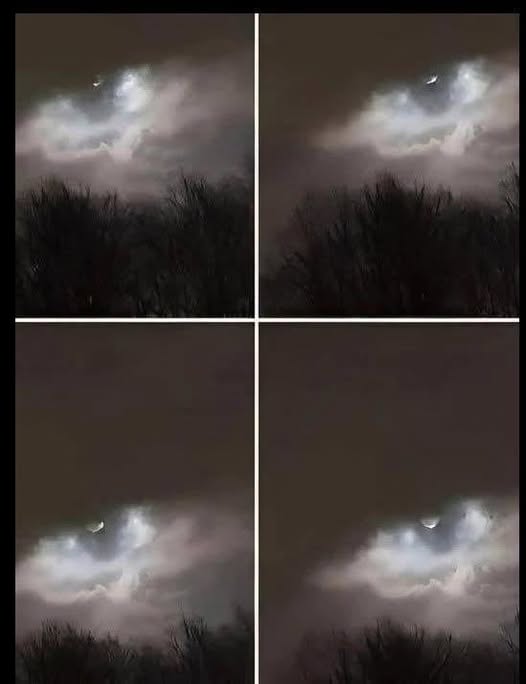
The sky looked ordinary at first.
A quiet afternoon.
A peaceful town.
Families going about their routines without the slightest hint that a single photograph would soon ignite debate across the internet.
Then someone looked up.
Hovering above the landscape was a cloud unlike anything most people expected to see.
Its shape appeared deliberate.
Its edges looked almost sculpted.
To some observers, it resembled a massive craft suspended motionless in the atmosphere. Others saw a symbol, a warning, or even something beyond conventional explanation.
Within hours, the image had spread far beyond the town where it was taken.
Social media users zoomed in, enhanced the photograph, and debated every detail. Theories multiplied rapidly. Some insisted the formation could not possibly be natural. Others claimed it resembled countless reports of unidentified aerial phenomena seen around the world.
The more people stared at the image, the stranger it seemed.
Yet meteorologists offered a far less dramatic explanation.
According to experts, unusual cloud formations occur more often than most people realize. Specific combinations of moisture, temperature, wind speed, and atmospheric pressure can create shapes that appear almost impossibly structured.
Lenticular clouds, for example, often form near mountain ranges when air flows over elevated terrain. Their smooth, layered appearance has caused them to be mistaken for spacecraft for decades.
Mammatus clouds create hanging pouch-like formations that can appear almost surreal against the sky.
Wave clouds, shelf clouds, and other rare atmospheric phenomena can transform familiar skies into scenes that seem borrowed from science fiction.
The explanation is scientific.
Yet the fascination remains emotional.
Because the real story isn’t always the cloud itself.
It’s the human response to it.
Our brains are extraordinary pattern-recognition machines. Throughout history, that ability helped humans survive. We learned to recognize faces, detect movement, and identify threats in complex environments.
Sometimes that same ability causes us to find meaning where none intentionally exists.
Psychologists call this phenomenon pareidolia.
It’s the reason people see faces in tree bark, animals in rock formations, and familiar shapes in clouds drifting thousands of feet overhead.
The mind fills gaps.
Creates narratives.
Connects random details into coherent stories.
And often does so automatically.
Yet understanding pareidolia doesn’t make experiences like this any less fascinating.
If anything, it makes them more revealing.
A strange cloud becomes a mirror reflecting our fears, hopes, beliefs, and curiosity. One person sees a weather event. Another sees mystery. Another sees wonder.
All are looking at the same sky.
The difference exists inside the observer.
That may be why photographs like this capture attention so powerfully.
They remind us how fragile certainty can be.
How quickly perception becomes interpretation.
How easily imagination steps into spaces where information remains incomplete.
In the end, the cloud was real.
The photograph was real.
The atmospheric conditions that created it were real.
But the stories built around it reveal something equally important.
Nature provides the image.
Physics creates the phenomenon.
Human beings provide the meaning.
And sometimes the most remarkable mystery isn’t what appears in the sky.
It’s what appears in our minds when we look at it.