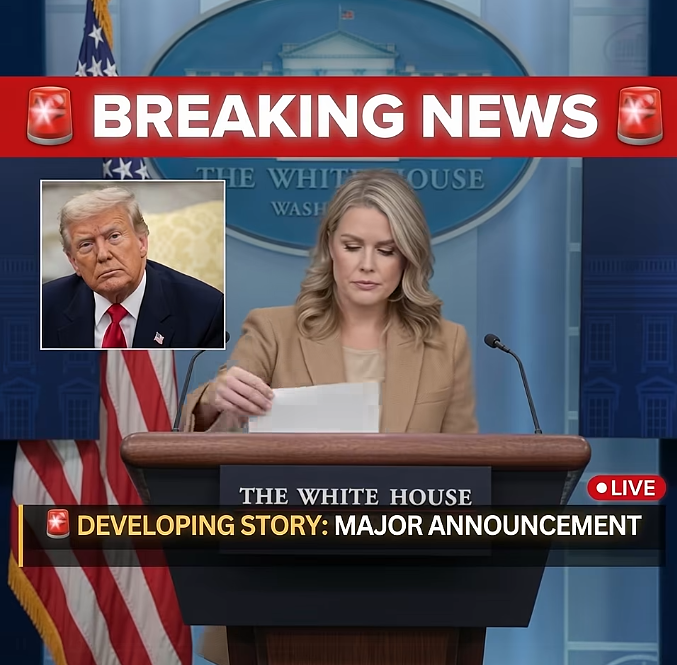
The briefing room fell unusually quiet the moment Karoline Leavitt cited the numbers. According to her, Donald Trump, only one year into his return to the White House, had already participated in more direct interactions with the media than Joe Biden had during his entire four-year presidency. The comparison immediately reignited one of Washington’s most heated debates—not simply about statistics, but about transparency, media access, and the relationship between presidents and the journalists tasked with covering them. Within minutes, supporters praised the contrast as evidence of a more open administration, while critics questioned both the comparison and the broader political message behind it. Once again, the discussion surrounding presidential communication quickly became a national conversation extending far beyond a single press briefing.
Leavitt argued that the issue went well beyond counting press conferences or interviews. In her view, President Biden’s relatively limited number of unscripted media appearances should have generated much stronger concern from members of the press. Instead, she claimed, many news organizations accepted the reduced access without demanding greater accountability. According to Leavitt, a president who rarely answered spontaneous questions from reporters was often portrayed as simply cautious or disciplined, rather than being challenged over limited public accessibility. She suggested that the standards applied during Biden’s presidency differed significantly from those used to evaluate previous administrations.
Building on that argument, Leavitt described the Trump administration’s media strategy as an intentional departure from what she viewed as an outdated system dominated by a relatively small group of established national news organizations. She argued that expanding access to regional outlets, digital media companies, independent journalists, podcasts, and newer online platforms allows a broader range of voices to participate in covering the presidency. Rather than concentrating influence among a handful of long-established organizations, she maintained that increasing the diversity of media representation creates a wider exchange of perspectives and gives more Americans an opportunity to hear different questions and viewpoints during official briefings.
Not everyone agrees with that assessment. Critics argue that expanding access alone does not automatically guarantee greater transparency or stronger accountability. Some media analysts have expressed concern that selecting newer or more ideologically friendly outlets could create opportunities for administrations to shape coverage more favorably while reducing the influence of experienced national correspondents who regularly challenge government officials. Others maintain that the most important measure of transparency is not simply the number of interviews or briefings, but the willingness of leaders to consistently answer difficult, unscripted questions regardless of which news organization asks them.
Leavitt rejected those criticisms, insisting that genuine openness cannot exist when access is concentrated among only a limited number of legacy institutions. From her perspective, broadening participation inside the briefing room reflects a more representative media environment that better mirrors the diversity of today’s information landscape. She argued that technological changes have transformed how Americans consume news, making it appropriate for presidential communications to evolve as well. In her view, greater variety among participating outlets strengthens public access rather than weakening it.
Ultimately, the debate extends far beyond a comparison between two presidents. It reflects a larger national conversation about transparency, accountability, media trust, and the changing relationship between government officials and the public they serve. Whether one agrees with Leavitt’s assessment or not, her remarks once again highlighted how deeply divided opinions remain over the role of the press in American democracy. As administrations continue adapting to an increasingly digital media environment, questions surrounding who receives access, how information is shared, and what truly defines openness are likely to remain at the center of political debate for years to come.