For the first time in years, Monday became Claire’s favorite day of the week.
At exactly noon, the familiar growl of motorcycle engines would echo through the valley. One by one, the riders would pull into the driveway, parking beneath the giant oak tree her mother had planted decades earlier.
They never arrived empty-handed.
Someone always brought fresh bread.
Someone brought vegetables from a garden.
Someone brought flowers for the kitchen table.
And every single time, they acted as though they were visiting a beloved family member rather than a house.
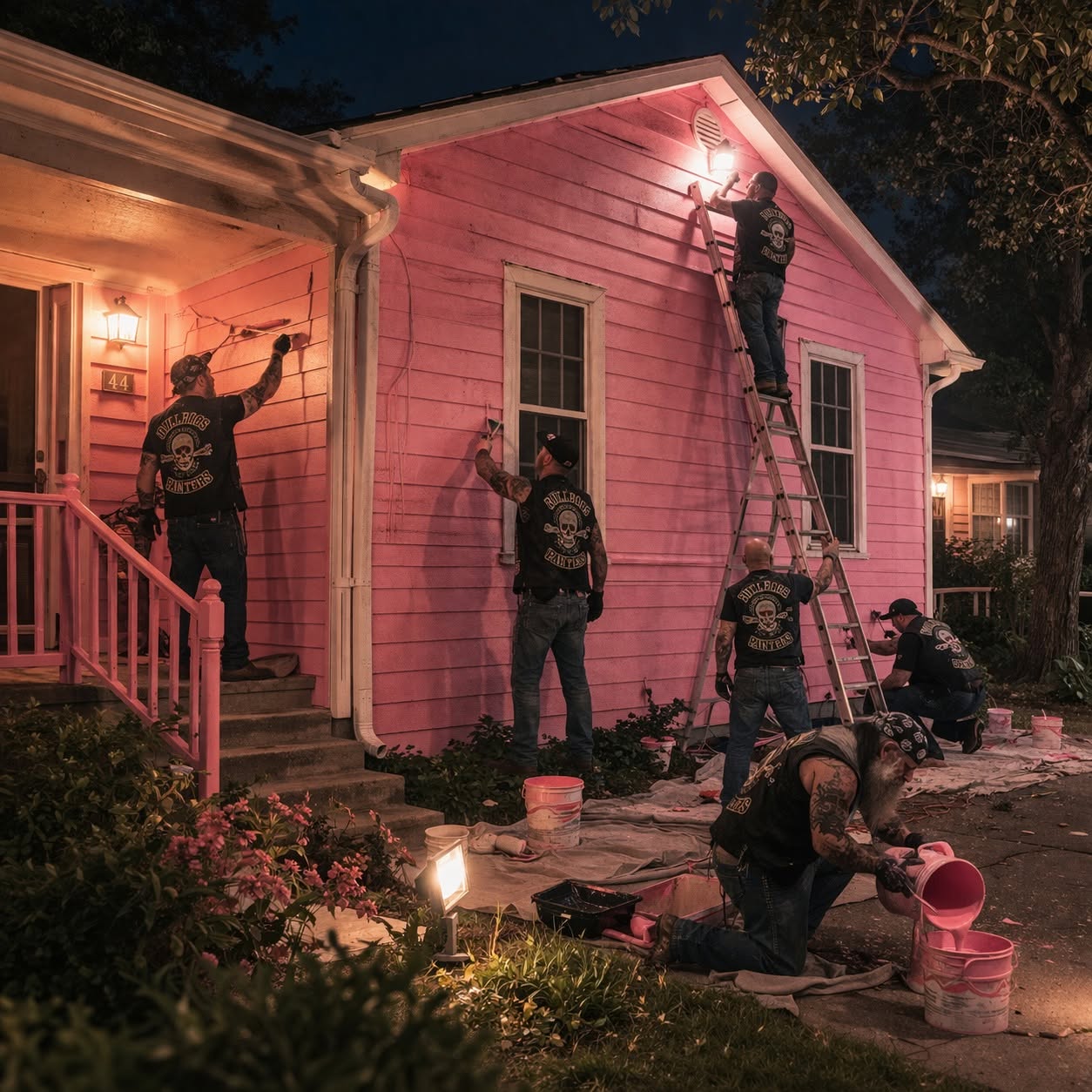
One rainy afternoon, several weeks after the painting was finished, Claire finally asked the question that had been lingering in her mind.
“Why did my mother mean so much to all of you?”
The conversation around the dining table fell quiet.
The men exchanged glances.
Then the oldest among them, a broad-shouldered biker named Walter, smiled softly.
“Because she never saw what everyone else saw.”
Claire frowned.
“What does that mean?”
Walter looked down at his coffee.
“Most people saw leather jackets.”
He glanced toward the others.
“They saw tattoos.”
“They saw motorcycles.”
“They saw trouble.”
His eyes moved toward the pink walls surrounding them.
“Your mother saw hungry people.”
Nobody spoke.
Walter continued.
“The first day we stopped here, she fed us before she even asked our names.”
Another biker chuckled.
“Actually, she didn’t ask our names until the third week.”
Laughter spread around the room.
The warmth of it surprised Claire.
Walter nodded.
“She said names weren’t important until she knew whether someone had a good heart.”
The room grew quiet again.
Claire stared at the table.
That sounded exactly like her mother.
And somehow completely different from the woman she thought she knew.
Later that evening, after everyone had left, Claire wandered through the house alone.
For the first time, she wasn’t looking at the peeling wallpaper or the aging floors.
She was looking for her mother.
Not the mother from her childhood memories.
The woman these people described.
The woman who had quietly built a community without ever telling anyone.
Upstairs, inside an old cedar chest, she found another box.
Inside were dozens of letters.
Some were handwritten.
Others were typed.
All of them were addressed to her mother.
Claire carefully opened the first one.
It was from a young woman.
Thank you for paying my electric bill when I couldn’t afford it.
You told me not to tell anyone.
I never forgot.
Claire opened another.
Thank you for sitting with my father during chemotherapy when I couldn’t get off work.
Another.
Thank you for bringing meals after my wife died.
Another.
Thank you for helping me get sober.
Another.
Thank you for reminding me I was worth saving.
By midnight, tears blurred every word.
The stack seemed endless.
Page after page.
Year after year.
Quiet acts of kindness.
Invisible acts of kindness.
Acts nobody had celebrated.
Acts nobody had posted online.
Acts her mother had never mentioned during their brief phone calls.
Claire finally understood why so many people kept showing up.
Her mother hadn’t collected possessions.
She had collected people.
The next morning, Claire drove into town.
The real estate agent was waiting outside a café.
He smiled when he saw her.
“Ready to relist the property?”
Claire shook her head.
“No.”
His smile faded.
“No?”
She looked toward the distant hillside where the pink house stood against the morning sky.
“My mother spent thirty years building something there.”
The agent looked confused.
“I thought you said it was just an old house.”
Claire smiled through tears.
“So did I.”
Several months later, a new wooden sign appeared beside the front gate.
Visitors slowed down to read it.
The words were simple.
Margaret’s House.
Everyone Welcome.
The bikers helped build it.
The neighbors helped maintain it.
People who had once received kindness began stopping by to offer it to others.
Some brought food.
Some brought books.
Some simply brought their time.
And every Monday afternoon, the motorcycles still arrived.
The driveway still filled.
The laughter still drifted through the open windows.
Because some homes survive long after the people who built them are gone.
Not because of bricks.
Not because of paint.
But because love leaves fingerprints on everything it touches.
And long after her mother’s voice had fallen silent, Claire discovered that those fingerprints were everywhere.