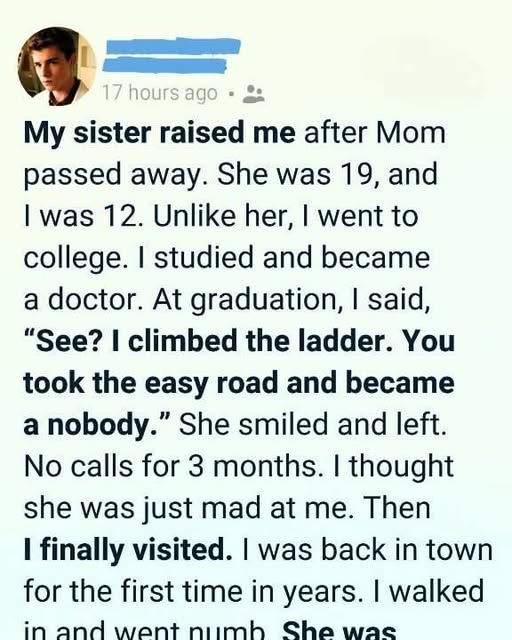
For years, I believed my life was proof that hardship could be overcome through determination alone. Every diploma hanging on my wall, every promotion, every award, and every milestone felt like evidence that I had escaped the pain of my childhood. Friends admired my accomplishments, colleagues praised my discipline, and relatives proudly pointed to my achievements as the family’s triumph. I accepted every compliment without hesitation because I truly believed I had earned every step entirely on my own. My sister, I assumed, had simply chosen a quieter life. I never questioned why she stayed behind while I kept moving forward. Then one ordinary afternoon changed everything I thought I knew—not only about her, but about myself.
The phone call came without warning. A concerned neighbor explained that my sister hadn’t been seen outside for several days. She hadn’t answered her phone, collected her mail, or responded to knocks at the door. At first, I tried to reassure myself that she was probably resting or visiting someone. Yet something in the neighbor’s voice carried enough urgency to silence every comforting explanation I could invent. I left work immediately and drove toward the small house where my sister had lived for years.
The closer I came, the heavier my thoughts became. We had spoken only occasionally over the past several months. Busy schedules always seemed to interfere. There was always another meeting, another deadline, another business trip. I promised myself we would spend more time together “soon,” believing there would always be another opportunity. Like so many people, I confused love with intention, forgetting that intentions mean very little when they never become actions.
When I reached the house, an uneasy silence greeted me. The curtains remained closed despite the bright afternoon sunlight. Newspapers had begun collecting near the front steps. The flowers she once cared for so carefully had wilted beneath the summer heat. Everything looked strangely frozen, as though time itself had quietly stopped at her front door.
After several unanswered knocks, I used the spare key she had given me years earlier. The house felt unusually still. Every room carried signs of someone who had slowly stopped keeping up with daily routines. Dishes rested untouched in the sink. Prescription bottles stood scattered across the kitchen counter. The familiar warmth that had always filled her home had been replaced by an unsettling emptiness.
I found her lying on the living room floor.
She was conscious, but barely. Her face looked pale, her breathing was shallow, and every attempt to sit upright seemed to exhaust what little strength remained. I rushed to her side, called for emergency medical assistance, and stayed beside her until help arrived. She tried to smile when she saw me, apologizing softly for “making such a fuss.” Even in that moment, she worried more about inconveniencing me than about her own suffering.
At the hospital, doctors explained that her condition hadn’t developed overnight. She had been quietly battling a serious illness for years, attending appointments alone, managing treatments in silence, and hiding the true extent of her struggles from almost everyone—including me. I listened in disbelief, unable to understand how someone so close to me could have carried such an enormous burden without ever asking for help.
As she slowly recovered, I began spending more time at her house, helping organize paperwork, paying bills, and cleaning rooms she no longer had the strength to manage. That was when I started discovering pieces of a story I had never known.
Inside an old wooden drawer were folders filled with unpaid invoices, carefully organized receipts, and decades of financial records. At first, they appeared ordinary. Then I noticed something unexpected. Many of the payments matched important moments from my own life—university tuition, textbooks, rent deposits, travel expenses, even emergency costs I barely remembered mentioning years earlier.
The handwriting on every payment belonged to my sister.
Confused, I continued searching. Hidden inside another folder were letters she had never mailed. Some were addressed to scholarship offices asking for additional time because she couldn’t afford her own education. Others were job applications she never submitted after accepting extra work instead. Page after page revealed dreams quietly postponed—not because she lacked ambition, but because someone else needed her more.
For the first time, I understood why she had never left our hometown.
After our mother passed away, I believed we had simply divided responsibilities naturally. I focused on school while my sister found work. That was the story I carried for decades. She never challenged it. She never reminded me of what she sacrificed. She simply encouraged me to study harder, dream bigger, and never worry about finances. Whenever I thanked her, she laughed and insisted everything would work itself out.
It hadn’t worked itself out.
She had worked it out.
While I attended university lectures, she worked double shifts. While I celebrated internships, she skipped meals to save money. While I built professional connections, she quietly paid bills I never knew existed. Every opportunity I embraced rested upon countless sacrifices she never mentioned because she wanted me focused entirely on building a better future.
Suddenly, every achievement I had once celebrated alone looked completely different.
The framed diplomas decorating my office no longer represented individual accomplishment. They represented partnership. Every certificate had another invisible signature beside my own. Every promotion reflected years of sacrifice that belonged not only to me but to the sister who quietly carried burdens I never noticed.
The realization was overwhelming.
For days, guilt followed me everywhere. I replayed birthdays I had missed because of work. Phone calls I rushed through. Holidays shortened by business commitments. Every excuse that once seemed reasonable now sounded painfully hollow. I hadn’t intentionally neglected her, yet intention offered little comfort. Love left unexpressed still leaves empty spaces.
When she finally grew strong enough to return home, our relationship began changing in ways neither of us expected. Instead of brief visits squeezed between appointments, I rearranged my schedule completely. We shared meals together. We talked for hours about memories we hadn’t revisited in years. Slowly, she began telling stories she’d kept hidden—not to make me feel guilty, but because she finally trusted that I was ready to hear them.
She admitted there had been difficult nights when she questioned her choices. There were moments she wondered what life might have looked like had she pursued her own education, traveled, or built the career she’d once imagined. Yet every time she watched me move closer to my dreams, she felt certain she had chosen the right path. Seeing me succeed became its own reward.
Her words only deepened my admiration.
I realized that heroism rarely announces itself with applause. Sometimes it wears ordinary clothes, works exhausting jobs, misses opportunities without complaint, and quietly protects someone else’s future without expecting recognition. My sister never sought praise because genuine love often works silently, asking for nothing in return.
Today, many of the awards that once filled me with pride still hang on my walls, but I see them differently now. They no longer remind me of personal ambition alone. They remind me of shared sacrifice, invisible generosity, and a woman whose strength shaped my entire future without ever demanding credit.
Success, I finally learned, is almost never achieved alone. Behind countless accomplishments stand parents, siblings, teachers, friends, mentors, and loved ones whose sacrifices often remain invisible. Some contribute money. Others contribute time, encouragement, patience, or opportunities they quietly surrender so someone else can move forward. Their names may never appear on diplomas or awards, yet their fingerprints remain on every achievement.
As I now help care for my sister with the same devotion she once gave me, I understand that life has quietly come full circle. I no longer measure success by promotions, titles, or applause. Instead, I measure it by something far more meaningful: whether my choices reflect the gratitude I owe the woman who believed in me long before anyone else did. Because in the end, the greatest heroes are rarely the ones standing on the stage. More often, they are the ones waiting quietly in the shadows, holding the ladder steady so someone they love can climb.