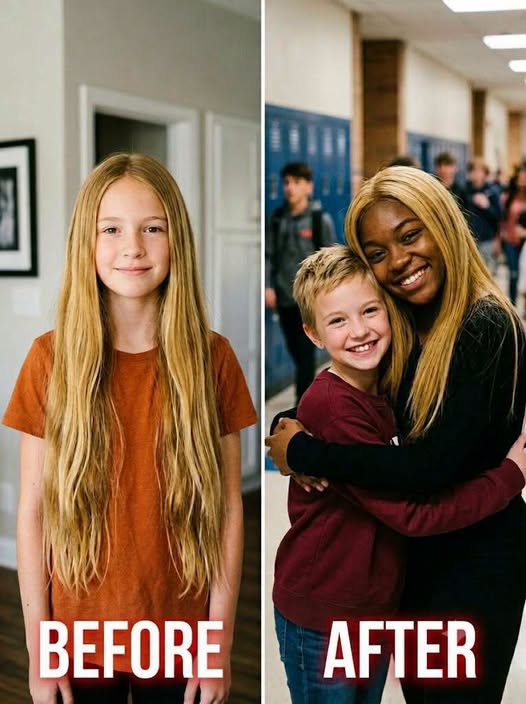
My daughter stood in the bathroom holding a pair of scissors, surrounded by strands of hair that covered the floor like fallen feathers. My heart stopped. For one terrifying moment, grief came crashing back with a force I hadn’t felt since my husband died. I rushed toward her, convinced something else was slipping away from me, another piece of the life we had struggled so hard to rebuild. But before I could speak, she looked up with tear-filled eyes and quietly explained why she had done it. In that single moment, everything I believed I understood about loss, love, and the extraordinary ways kindness survives began to change.
When Jonathan passed away, it felt as though the world had simply stopped moving. Every ordinary routine became a painful reminder of the life we no longer had. The empty chair at dinner, the silence in our bedroom, and the countless decisions I suddenly faced alone made every day feel heavier than the last. My greatest fear wasn’t just learning how to survive without him—it was raising our daughter, Letty, while carrying a grief that often left me struggling to breathe. I wanted to be strong for her, but there were days when simply getting through the afternoon felt like an impossible victory.
Letty grieved differently than I did. She rarely cried in front of me, choosing instead to keep her emotions tucked quietly beneath gentle smiles that seemed far too mature for a child her age. She spent hours drawing pictures, writing little notes about her dad, and keeping his favorite baseball cap safely folded beside her bed. Although we talked often about Jonathan, I worried about the feelings she never put into words. I wondered whether she was carrying burdens no child should ever have to bear.
That morning seemed perfectly ordinary until I noticed the bathroom door had been closed for much longer than usual. When I knocked, there was no answer. A wave of panic swept through me as I pushed the door open. There stood Letty, scissors still in her hand, with uneven chunks of hair lying across the floor. My first instinct was fear. I thought grief had finally overwhelmed her in a way I hadn’t been able to prevent.
“What happened?” I asked, barely able to get the words out.
She looked at me with eyes full of uncertainty before quietly saying, “There’s a girl at school who lost all her hair because she’s sick. Everyone keeps staring at her. I thought maybe if my hair looked funny too, she wouldn’t feel so alone.”
For several seconds, I couldn’t speak. Every emotion inside me seemed to collide at once. The panic that had filled my chest slowly gave way to something entirely different. Standing before me wasn’t a little girl making an impulsive mistake. She was a child whose heart had become so compassionate through her own pain that she was willing to sacrifice something she loved simply to ease someone else’s embarrassment.
Later that day, I learned more about her classmate, Emma, who had recently begun chemotherapy. The treatments had taken away her hair, and with it much of her confidence. Some classmates had been kind, but others stared or whispered, making each school day more difficult than the last. Letty had watched Emma eat lunch alone, trying to hide beneath a hat she rarely removed. Without asking for permission or recognition, my daughter had decided she wanted Emma to know she wasn’t facing those stares by herself.
News of Letty’s decision spread quickly throughout the school. What began as one child’s quiet act of compassion soon inspired teachers, parents, and students alike. A local salon volunteered to repair Letty’s uneven haircut free of charge while also helping collect donated hair for children who needed wigs. Community members began contributing money toward organizations that provided wigs for young cancer patients, and soon dozens of families joined the effort. What had started in our small bathroom unexpectedly grew into something far larger than either of us had imagined.
A few days later, another surprise arrived. Several of Jonathan’s former coworkers showed up at our front door wearing the same worn work jackets they had always worn on the job. They carried flowers, food, and an envelope. Inside was a generous donation collected by the people who had worked beside my husband for years. They told me Jonathan had often spoken about helping families facing difficult times and had quietly organized collections for coworkers long before his own illness. Now they wanted to honor his memory by continuing the kindness he had started.
As we talked, I realized something I had been too overwhelmed to notice before. Jonathan’s love hadn’t disappeared when he died. It had continued moving through the people whose lives he had touched. His generosity lived on in friends who refused to forget us, coworkers who kept their promises, neighbors who checked on us, and now, somehow, in our daughter. Without realizing it, Letty had inherited not only her father’s smile but also the remarkable kindness that had defined the way he lived every single day.
The school principal soon introduced new programs encouraging students to support classmates facing serious illnesses or personal challenges. Acts of kindness that once happened quietly became something celebrated throughout the school community. Emma received a beautiful custom-made wig funded by local donations, but perhaps even more importantly, she returned to school knowing she no longer had to face her fears alone. Letty’s simple decision had reminded everyone that compassion often begins with one person willing to act.
Over the following months, our dinner table gradually became fuller again. Jonathan’s old friends visited often. Neighbors stopped by just to talk. Families we had never met before became part of our lives through the friendships formed during the fundraiser. The loneliness that had once filled every room slowly gave way to laughter, conversation, and the comforting realization that family isn’t always limited to the people we’re born with. Sometimes it grows from shared kindness during life’s hardest seasons.
Looking back, I realize I walked into that bathroom expecting to correct my daughter. Instead, I witnessed one of the bravest moments of her young life. The uneven haircut I first saw as a sign of heartbreak became a symbol of extraordinary compassion. Through one child’s selfless decision, countless others discovered reasons to give, to comfort, and to remember.
Grief never truly disappears, but it changes. That day taught me that love does not end with goodbye. It continues through every act of generosity, every promise kept, and every heart willing to carry it forward. Jonathan’s greatest legacy was never something he left behind—it was the kindness he planted in the people who loved him. And every time I look at Letty, I see living proof that genuine love never really leaves. It simply finds new hands, new hearts, and new ways to keep changing the world.