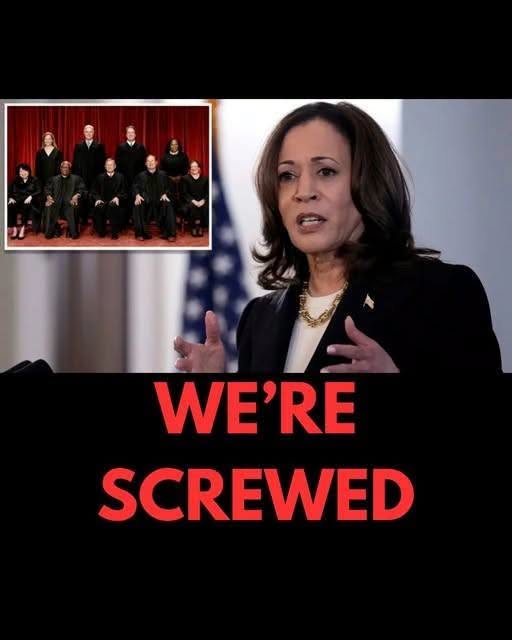
The political debate erupted almost instantly.
What began as a discussion about voting rights, congressional maps, and the future of American institutions quickly evolved into a much larger argument about who holds power in the United States—and how that power should be exercised.
At the center of the controversy were comments from former Vice President Kamala Harris calling for Democrats to consider major structural reforms, including discussions about Supreme Court expansion, Electoral College reform, and statehood for Washington, D.C., and Puerto Rico.
To supporters, the proposals represent a response to what they view as years of institutional advantages favoring Republicans. They argue that court decisions, redistricting battles, and existing electoral structures have diluted the influence of urban and minority voters, making reform necessary to ensure broader representation.
To critics, however, the ideas signal something far more alarming.
Republican leaders and conservative commentators quickly condemned the proposals, arguing that altering the size of the Supreme Court or fundamentally changing electoral institutions would weaken long-standing constitutional norms. Some accused Democrats of seeking to change the rules after suffering political defeats.
The sharp reaction reflects a deeper conflict that extends far beyond any single politician.
At stake are competing visions of democracy itself.
One side argues that existing institutions no longer reflect the realities of a changing nation and must evolve to ensure fair representation. The other warns that aggressive structural changes could undermine stability, weaken public trust, and trigger an endless cycle of political retaliation whenever power changes hands.
The debate over Supreme Court reform illustrates this divide clearly. Supporters see expansion as a constitutional tool available to Congress. Opponents view it as a dangerous precedent that could transform the judiciary into a partisan battleground.
Meanwhile, disputes over redistricting, voting rights, and representation continue to intensify across multiple states, fueling concerns on both sides that future elections may be shaped as much by legal rules as by voter persuasion.
Whether these proposals ever become reality remains uncertain.
What is certain is that the struggle over America’s political institutions has entered a new phase—one in which questions about courts, maps, elections, and representation are no longer academic debates, but central battles in the nation’s ongoing contest over power, fairness, and democratic legitimacy.