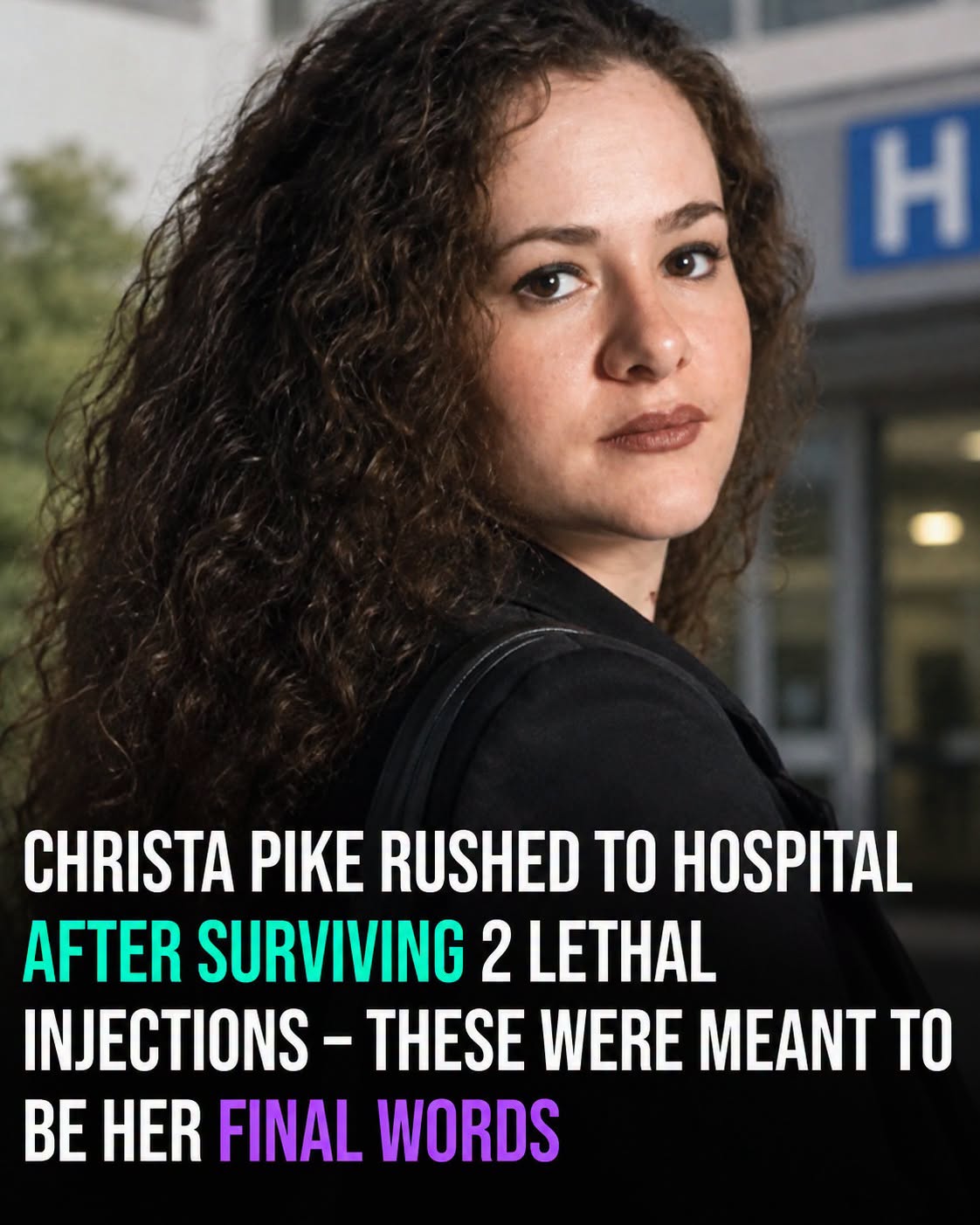
She was supposed to die.
Needles were placed in her arm. Last prayers were whispered. Reporters and witnesses waited behind glass, expecting to watch the final moments of a death sentence carried out by the state.
After two lethal injections, Christa Pike should have been gone forever.
Instead, she groaned.
She snored.
She continued breathing.
And she remained alive long after the procedure was expected to have ended her life.
What followed was not the quiet, controlled conclusion everyone had anticipated. Officials were confronted with an unfolding medical crisis, witnesses were left listening for signs of what was happening behind the curtain, and Pike’s attorneys began confronting a new set of legal questions.
Now, the details of her final hours have become part of the larger controversy surrounding the failed execution—her words, her apparent calm, her prayers, and the moment when the carefully planned procedure began to fall apart.
In the hours before the execution, Pike wrote that she was not afraid of death itself. What troubled her was the way death would come.
That distinction shaped the atmosphere surrounding her final moments.
For someone who had spent decades under a death sentence, the approach of the execution was no longer an abstract possibility. The date had arrived. The legal challenges had reached their final stages, and the state was preparing to carry out the punishment that had followed the 1995 murder for decades.
Yet when the moment finally arrived, Pike appeared remarkably composed.
She faced the witnesses and spoke about love.
She said she was leaving this world “with love,” expressing affection not only toward the people who had supported her but also toward those who criticized and opposed her. Her words were striking because they came at a moment when the entire room was gathered to witness the state’s ultimate punishment.
With her spiritual advisor beside her, Pike prayed quietly.
She asked for peace.
She asked for gentleness.
And her prayers extended beyond herself.
She also prayed for the people standing behind the glass—the witnesses who had come to watch her die. In a room built around punishment, her attention turned toward the people observing her final moments.
Then the drugs entered her veins.
And the script shattered.
The procedure that had been designed to follow a controlled sequence began producing unexpected reactions. Pike winced and asked whether what she was feeling was supposed to hurt.
Someone told her to relax.
She tried.
Despite what was happening, she smiled. At moments, she even laughed. A single tear reportedly moved down her cheek as the procedure continued.
For the people watching, those reactions made the situation increasingly difficult to understand.
This was supposed to be the final stage of a sentence that had lasted nearly thirty years.
Instead, the prisoner was still conscious and reacting.
The room waited.
The procedure continued.
And still, the expected ending did not arrive.
Minutes passed.
Then more minutes.
The state had prepared for death, but death was not occurring on schedule.
Forty minutes later, Pike’s heart was still beating.
That single fact transformed the situation.
There was no immediate pronouncement of death. Instead, uncertainty spread through the chamber. Officials had to confront the possibility that the execution had failed, while witnesses and reporters were left trying to understand what was happening behind the barriers separating them from the prisoner.
The carefully rehearsed sequence had become something else entirely.
The execution chamber had effectively turned into a medical emergency.
Pike was eventually transferred to an off-site hospital, where she could receive medical attention. The woman who had entered the prison expecting to die was now being transported away alive.
For her attorneys, the failed execution immediately created new legal questions.
For officials, it created a procedural crisis.
For the witnesses, it left behind the memory of a scene that had been very different from the controlled ending they had expected.
And for the public, it reignited an argument that extends far beyond one prisoner or one state.
What does it mean for an execution to be called controlled when the person being executed remains conscious and alive?
What happens when the state’s carefully designed process fails?
And what obligations arise after the government has attempted to take a person’s life but has not succeeded?
Pike’s final words became an especially striking part of the story because they contrasted so sharply with the chaos that followed. Before the drugs entered her body, she had spoken about love, peace, and gentleness.
Afterward, the room was filled with uncertainty.
The contrast was difficult to ignore.
Her words had suggested acceptance.
The procedure produced struggle.
Her prayers had asked for peace.
The aftermath produced confusion.
And the execution that was supposed to provide finality instead created another chapter of legal, medical, and political controversy.
For the family of Pike’s victim, the failed execution meant another painful delay after decades of waiting. The sentence had been intended to close a case that began in 1995, but instead the execution itself became the center of a new public dispute.
For critics of capital punishment, the incident raised questions about whether any execution can truly be described as predictable or humane when something goes wrong. For supporters of the death penalty, the failure raised different concerns about the reliability of the process and the state’s ability to carry out its own sentence.
The debate would continue long after Pike left the death chamber.
But the most haunting part of the story remains the contrast between what everyone expected and what actually happened.
She entered the chamber knowing she was supposed to die.
She prayed.
She spoke about love.
The drugs were administered.
And then the expected ending simply did not happen.
Instead of a pronouncement of death, there was confusion.
Instead of silence, there were sounds of breathing and struggle.
Instead of a body being removed from the chamber, there was a hospital transfer.
And instead of a final conclusion, Tennessee was left facing a renewed and bitter debate over the meaning of justice, punishment, and the limits of state power.
The execution was supposed to be the end of Pike’s story.
Instead, it became another beginning.
And her final words—spoken calmly before the procedure began—now exist alongside the disturbing reality of what happened afterward, leaving behind a question that extends far beyond one death sentence:
When a system designed to deliver a final punishment fails, what does the failure reveal about the system itself?