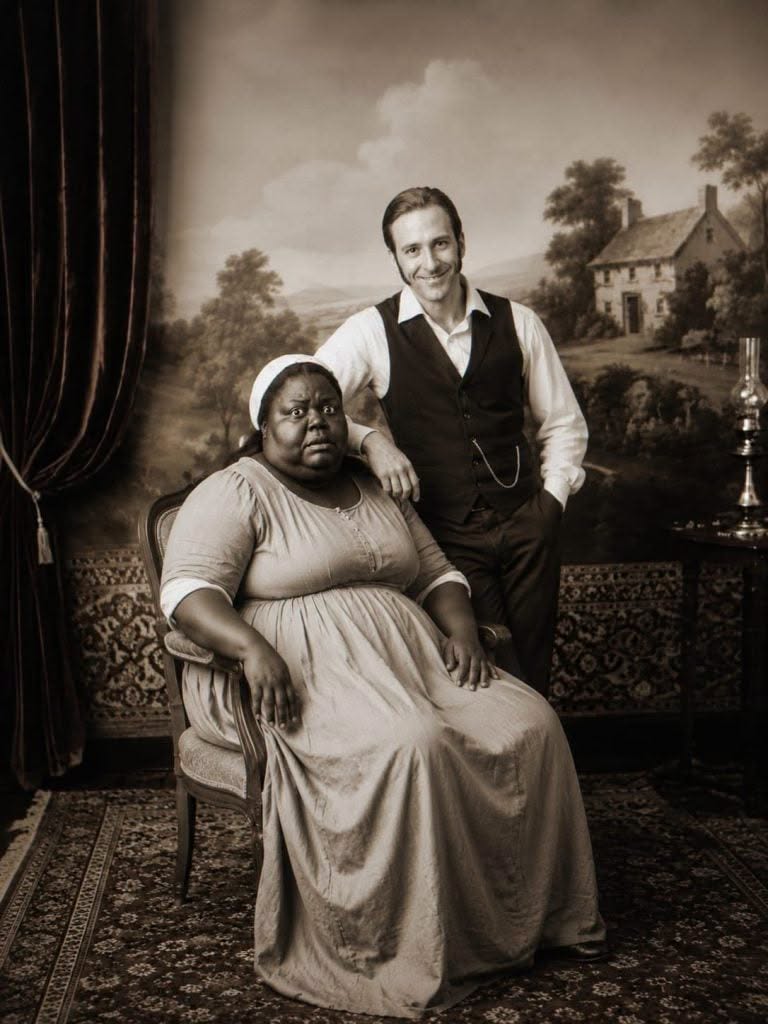
They displayed her before the crowd as though she were a burden no one wanted to carry. Potential buyers examined her briefly before turning away, muttering that she was too tall, too stubborn, too difficult to control. With every rejection, her value seemed to fall even further. The bidding slowed, and the price dropped to a level that bordered on humiliation. Then, just when it appeared that no one was willing to take the risk, a single voice broke the silence. The offer was modest, almost insignificant, yet it instantly captured everyone’s attention. It was more than a purchase—it was a decision to see potential in someone the rest of the world had already dismissed.
In the harsh reality of a society fueled by wealth, plantations, and human exploitation, Benedita had gradually become known less as a person and more as a problem. Stories followed her from one place to another. She was described as defiant, strong-willed, and unwilling to submit completely to those who sought to dominate her. Every owner who rejected her added another layer to the reputation that surrounded her. Over time, those labels became so powerful that they began shaping not only how others viewed her, but also how she viewed herself. By the time she stood before the crowd in Vassouras, she had become a symbol of resistance in a system that demanded obedience.
Many saw her determination as a flaw rather than a strength. To them, she represented uncertainty and difficulty. They measured human worth through usefulness and compliance, and Benedita fit neither expectation. The whispers among the crowd reflected those attitudes. People spoke about her as though she were damaged, incapable of fitting into the rigid structure they expected. Few bothered to consider what her resilience truly represented or what she had endured to preserve it.
Then Joaquim Lacerda stepped forward.
His bid was so unexpected that it briefly silenced those gathered around the auction platform. While others saw a liability, he saw something entirely different. He recognized a woman who had survived circumstances that might have broken many others. Where others saw defiance, he saw determination. Where others saw trouble, he saw strength. His decision was not based on the same calculations that guided everyone else. He looked beyond reputation and recognized the value hidden beneath years of judgment and rejection.
That single moment did not erase the cruelty of the system that placed her on the auction block. It did not undo the suffering she had experienced or the injustice that surrounded both of their lives. Yet it changed the direction of one person’s future. In a world designed to reduce individuals to property, one unexpected choice created a different possibility. For the first time in a long while, Benedita was seen as something more than the labels attached to her name.
The significance of the moment extended beyond the transaction itself. It challenged assumptions that had followed her for years. Every previous rejection had reinforced the idea that her strength made her undesirable. Joaquim’s decision suggested the opposite—that the very qualities others feared might actually be her greatest assets. His willingness to see beyond appearances disrupted a narrative that had long defined her existence.
As the crowd watched, many struggled to understand his reasoning. Some viewed the purchase as foolish. Others assumed it would eventually end in regret. Yet Joaquim appeared unmoved by their opinions. He seemed to understand something they did not: resilience carries value that cannot be measured by conventional standards. The qualities that made Benedita difficult to control were the same qualities that had allowed her to endure unimaginable hardship.
In a society built upon power, hierarchy, and exploitation, individuality was often treated as a threat. People who resisted were punished, isolated, or dismissed. Benedita had experienced all of those consequences. Yet despite everything, she remained unbroken. Her spirit had survived years of rejection and adversity. That survival became the very thing Joaquim recognized when everyone else chose to look away.
The moment he placed his bid did not transform the larger system around them, nor did it suddenly create justice where none existed. However, it altered one life in a meaningful way. Instead of allowing her strength to become the reason for her continued suffering, it became the reason someone finally believed in her potential. In a world determined to punish individuality, one unexpected decision gave Benedita an opportunity to redefine herself—not as a warning, not as a burden, but as a person whose resilience could become a source of possibility rather than condemnation.