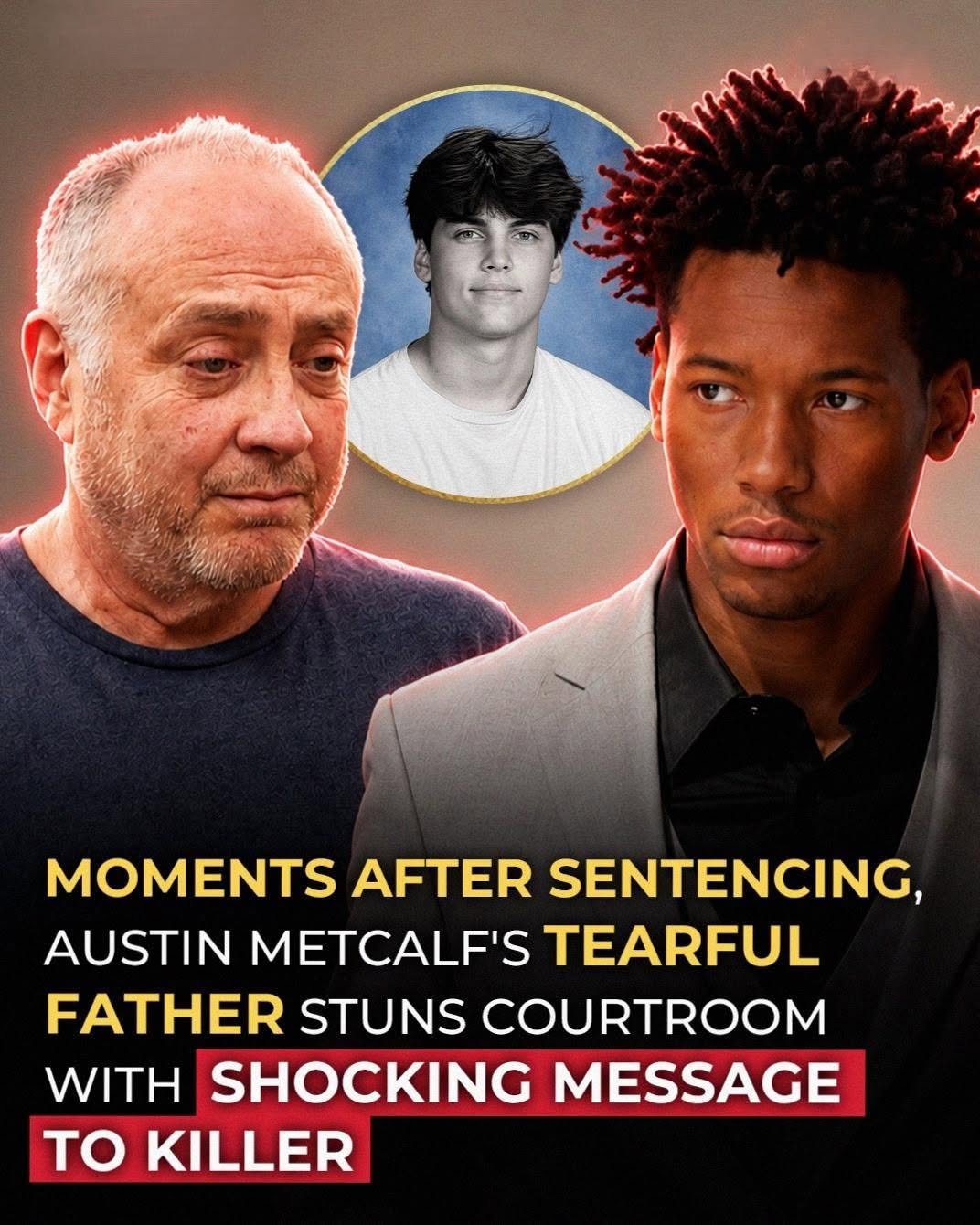
The family of Austin Metcalf entered the courtroom carrying a burden no legal decision could ever erase. They were not there seeking revenge or celebration. They were there to speak about the young man they had lost and the pain that had followed them every day since his death. More than a year had passed, yet the wound remained as raw as ever.
When the time came to address the court, Austin’s family spoke with remarkable composure, though emotion frequently interrupted their words. They described a future that had been taken away in an instant and a family forever changed by a tragedy that occurred on what should have been an ordinary day.
Austin’s mother shared the reality of living with loss. She spoke about visiting her son’s grave, carrying on conversations that could no longer be answered. She described the heartbreak of walking past his bedroom, a place that still felt connected to him despite his absence. Every corner of the house served as a reminder of the life that should have continued.
Other family members reflected on the person Austin had been. His aunt remembered a young man known for his kindness, someone who loved spending time with family and never hesitated to show affection to the people closest to him. To them, he was far more than a name connected to a court case. He was a son, a nephew, a brother, and a friend whose presence had touched countless lives.
Then Austin’s father stood to speak.
The emotion in his voice was impossible to ignore. Years of hopes, dreams, and memories seemed to pour out in a matter of minutes. He spoke about the opportunities Austin would never have, the goals he would never achieve, and the man he would never have the chance to become. He reflected on the scholarship established in Austin’s honor and the legacy his family hoped would continue despite the tragedy.
At one point, he looked directly toward Karmelo Anthony and expressed the frustration and pain that had built inside him since the day his son died. His words reflected not only anger but also the deep anguish of a father forced to confront the person responsible for a loss that could never be undone.
Nearby, Austin’s twin brother faced a different kind of struggle. Losing a sibling is devastating under any circumstances, but losing a twin carries a unique weight. He spoke about trying to navigate life while constantly feeling the absence of the person who had shared every stage of his journey. He wrestled with difficult questions about forgiveness and faith while knowing there would be future milestones his brother would never experience.
Birthdays would arrive without him.
Family celebrations would continue without him.
Future weddings, careers, and children would exist only as possibilities that would never become reality.
When the court ultimately imposed a 35-year prison sentence, it marked the conclusion of the legal process. Yet for Austin’s loved ones, the verdict brought little sense of closure. No amount of prison time could restore the life that had been lost or heal the damage left behind.
For the justice system, the case may have reached its end.
For Austin’s family, it never truly will.
They will continue carrying memories, unanswered questions, and a grief that extends far beyond any courtroom. The sentence handed down by the judge has a defined length. The sentence imposed on those who loved Austin has no end date.
The legal proceedings may be finished, but the empty seat at family gatherings, the missing voice in conversations, and the future that disappeared with Austin remain permanent reminders of a loss that no verdict can ever fully address.
The case is closed.
The heartbreak remains.