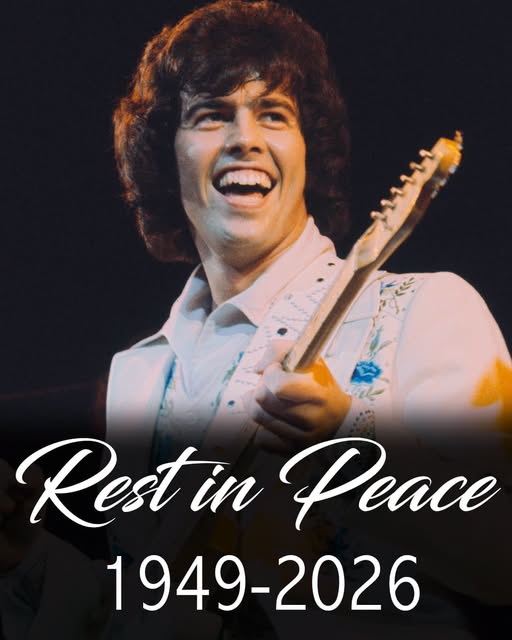
Alan Osmond’s final moments shattered the illusion of distance between a famous performer and the people who loved him most. The man who had spent decades helping build one of America’s most recognizable musical families passed away quietly at his home in Lehi, Utah, with his wife, Suzanne, and all eight of his sons by his side. There was no stage, no spotlight and no roaring audience waiting for another performance. Instead, there was family, silence and the people who had been closest to him throughout a lifetime filled with music, sacrifice and faith. Alan died on April 20, 2026, at the age of 76.
For the Osmonds, those final hours represented something much more personal than the ending of a musical career. Alan had spent much of his life carrying responsibilities that were often hidden behind the family’s public success. While Donny and Marie eventually became household names in their own right, Alan had been one of the original forces behind the family group. He helped shape its sound, contributed as a songwriter and producer, and played a major role in transforming a group of singing siblings into an international entertainment phenomenon. His influence was often felt even when his face was not the one receiving the most attention.
The story began long before the television appearances and sold-out performances. Alan and his brothers Wayne, Merrill and Jay started singing together as a barbershop quartet in the 1950s. Their early performances eventually led to national exposure, including appearances on *The Andy Williams Show*, and the family act continued expanding as younger siblings joined. Alan became an important creative force within the group, helping write songs including “One Bad Apple” and “Crazy Horses.” He also worked behind the scenes as a producer, including on *The Donny & Marie Show*.
But fame was never the only measure of Alan’s life. In 1987, he was diagnosed with multiple sclerosis, a condition that would shape the later decades of his life. Eventually, he stepped away from regular performing, but retirement from the stage did not mean retirement from his family or from the values that had guided him. He remained deeply involved in the lives of his wife and eight sons, and his family became one of the most important sources of strength throughout his years with MS.
His final chapter was therefore not defined simply by illness. It was defined by the people around him. His wife, Suzanne, whom he married in 1974, remained beside him after more than five decades of marriage. His eight sons were also there, turning what could have been a lonely goodbye into a deeply personal family moment. Alan is survived by Suzanne, their eight sons, 30 grandchildren and five great-grandchildren, along with his surviving siblings.
The family did not publicly identify a specific cause of death. What was known was that Alan had spent decades living with multiple sclerosis and that his health had declined in his final period. According to reporting based on a family spokesperson, he had spent time in intensive care before returning home to hospice care shortly before his death. Those details make the presence of his family at his side even more significant: after a lifetime of performing for audiences, his final hours belonged entirely to the people he loved.
His brothers remembered him not simply as another member of The Osmonds, but as someone who quietly carried enormous responsibility. Donny described Alan as his protector and guide, saying he had carried so much responsibility so the rest of the family could shine. Merrill also described spending time with Alan shortly before his death, recalling a deeply emotional conversation between brothers. Their memories offered a glimpse of the man behind the public image—a brother, husband and father whose influence extended far beyond the songs that made the family famous.
Alan’s legacy therefore cannot be reduced to chart positions, television appearances or the fame of the Osmond name. It lives in the music he helped create, in the family he helped hold together and in the generations who grew up hearing those songs. From the earliest barbershop performances to the height of the Osmonds’ fame and through decades of living with MS, his story was one of persistence and devotion.
And perhaps that is what makes his final moments so powerful. After decades in a world where millions knew his name, Alan Osmond’s last chapter was remarkably private. There were no flashing cameras demanding another smile and no audience waiting for an encore. There was simply a husband surrounded by his wife, a father surrounded by his sons, and a family saying goodbye to someone whose presence had shaped their lives for generations. He left behind a musical legacy that will continue to echo, but for the people who knew him best, his greatest legacy was never the spotlight—it was the family he spent his life loving.