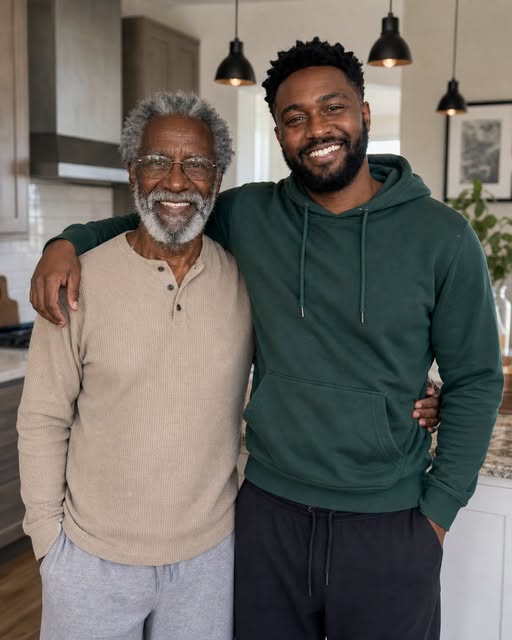
The night before the transplant, Daniel thought the only thing he might lose was his health. He was wrong. He had spent days thinking about the surgery, the risks, the pain, and the uncertain road ahead. But nothing had prepared him for what would happen in the quiet hours before dawn. In a dim hospital room, with monitors beeping softly and the hallway outside almost silent, his father finally broke. There was a confession, a name Daniel had never heard, and a truth about his own birth that suddenly changed everything he thought he knew about his family.
For years, Daniel had believed that Robert was his biological father. There had never been a reason to question it. Robert had been there through childhood illnesses, school problems, birthdays, disappointments, celebrations, and all the ordinary moments that quietly build a family. Daniel had never needed a DNA test to prove what he believed was already certain.
But now, with the transplant approaching, Robert seemed unable to carry the secret any longer.
In the dim hospital light, he reached for Daniel’s hand. His voice shook, not so much from illness as from the weight of what he was about to say. He told Daniel about a young man named Margaret had loved before him—a man whose life had ended tragically in an accident just weeks before Daniel was born.
That man had wanted desperately to become a father. He had imagined a future with Margaret and the child they were expecting. But that future disappeared before it could begin.
Robert explained that he had married Margaret knowing she was pregnant. He knew the child might not be his biologically, but he made a promise anyway. He promised that the baby would never grow up feeling abandoned by the man they had lost. There would be no complicated explanations, no constant reminders of what might have been. Robert would simply raise Daniel as his own.
There had never been a DNA test. There had never been an official confirmation of biological parentage. There had only been a quiet agreement between two adults who believed that love and responsibility mattered more than blood.
For Daniel, the revelation landed with the force of something much larger than a family secret. Suddenly, memories he had always understood one way seemed to have another meaning. The man who had taught him things, protected him, argued with him, embarrassed him, encouraged him, and stayed beside him through life might not share his blood.
And yet, he had never stopped being his father.
The transplant went ahead. The surgery was long and grueling, filled with uncertainty and exhausting recovery. But eventually, both men survived. In the days afterward, Daniel’s physical pain slowly became more manageable. His body began the difficult process of healing, but another kind of pain remained.
His scar hurt less than the question burning inside his chest.
If biology didn’t bind them, what did?
Daniel watched Robert recovering in the hospital ward. He saw him slowly learning to walk again, stopping to rest when his body demanded it, making tired jokes despite the exhaustion. Robert asked about the grandchildren. He worried about ordinary family matters. He complained about small things. He smiled when Daniel entered the room.
Nothing about him seemed different.
And that was what made the truth so difficult—and eventually, so clear.
Daniel began to understand that the relationship they had built had never depended on a blood test. Robert had not needed biology to make a decision about being a father. He had made that decision consciously, knowing exactly what he was accepting. He had chosen to stay.
He had chosen to raise a child who might never carry his blood. He had chosen the sleepless nights, the sacrifices, the arguments, the celebrations, the worries, and the endless responsibilities that come with parenthood. He had shown up when nobody was watching and continued showing up long after the original promise had been made.
Slowly, painfully, Daniel realized that perhaps the secret had changed the history of his birth—but it did not have to change the history of his life.
The man whose blood he carried remained unknown. But the man who had carried him through childhood was sitting right there.
And perhaps that distinction mattered.
A father, Daniel finally understood, isn’t necessarily the man whose blood runs through your veins. He can be the man who chooses you, protects you, teaches you, forgives you, challenges you, and stays when leaving would be easier. He can be the person who keeps showing up, year after year, until the relationship becomes something stronger than biology.
The revelation had taken something from Daniel: the certainty of a story he had believed his entire life. But it also gave him something unexpected. It forced him to look at his relationship with Robert without the assumption that blood was what had made it real.
And when Daniel looked closely, he found the answer everywhere.
In every hospital visit. Every birthday. Every difficult conversation. Every tired joke. Every sacrifice. Every time Robert had simply been there.
The truth about Daniel’s birth had changed one part of his story. It hadn’t erased the love that came afterward.
Because sometimes family begins with biology—but it becomes real through choice, sacrifice, presence, and love.
And sometimes the person who isn’t connected to you by blood is the person who proves, every day, that he is your father.