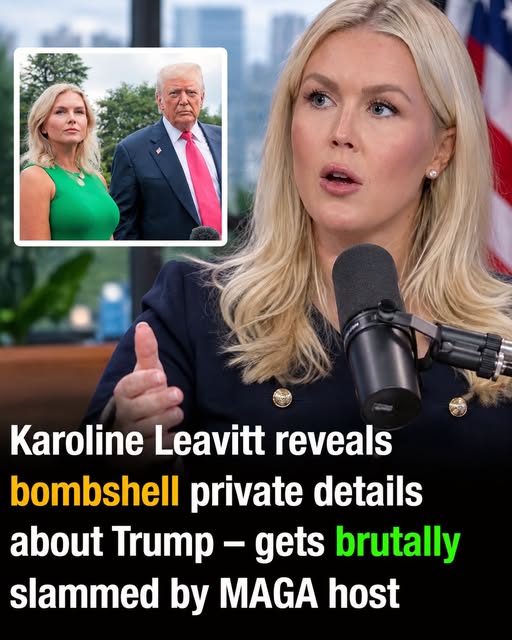
Karoline Leavitt thought she was simply telling a story. Instead, her decision to describe what she witnessed behind closed doors with Donald Trump and foreign leaders quickly became a new point of controversy inside Trump’s political movement. During an appearance on Sean Hannity’s podcast, the former White House press secretary offered an unusually candid account of how Trump speaks to world leaders when cameras are gone. What she presented as an example of Trump’s consistency and bluntness soon triggered a furious response from Newsmax host Greg Kelly, who accused her of gossiping about private presidential meetings and called the disclosure a “breach of trust.”
Leavitt’s appearance on “Hang Out with Sean Hannity” was released on September 22, 2026, and covered her experience working in the Trump administration, including behind-the-scenes moments involving foreign leaders. She argued that the version of Trump Americans see publicly is not dramatically different from the man who sits across the table from presidents and prime ministers in private. According to Leavitt, Trump does not necessarily change his personality simply because the cameras have disappeared. Instead, she portrayed his directness as something that follows him into the most sensitive diplomatic conversations.
One of the most striking stories involved Keir Starmer, who was then Britain’s prime minister. Leavitt recalled sitting with Trump and Starmer during a lunch in the United Kingdom. According to her account, the conversation eventually turned toward British immigration policies, and Trump began criticizing Starmer directly. She said Trump told him that his policies were “so stupid,” urged him to close Britain’s borders, and argued that people in the country opposed what Starmer was doing. Leavitt described the moment as an example of how openly Trump speaks to foreign leaders, even when he is a guest in their country.
What made the story particularly striking was the setting. This was not a campaign rally, television interview, or press conference. According to Leavitt, it happened around a lunch table during Trump’s visit to Britain. She recalled that she and Stephen Miller looked at each other as the conversation unfolded, anticipating what was coming next. When Hannity asked whether she found the situation entertaining, Leavitt answered that she did. Her description was intended to illustrate the bluntness she said was characteristic of Trump in private as well as in public.
Leavitt went further, saying that what Trump tells the media publicly is essentially what he says behind the scenes. In her telling, there is not a completely different private version of the president carefully hidden from the public. Instead, she argued that Trump’s tendency to speak directly, sometimes harshly, is consistent regardless of whether he is talking to reporters, allies, or adversaries. She presented that consistency as evidence of candor rather than as evidence of disorder or unpredictability.
She also discussed Trump’s interactions with other world leaders, including Chinese President Xi Jinping and Russian President Vladimir Putin. Fox News reported that Leavitt described tense conversations with foreign leaders and emphasized the same basic theme: Trump, in her account, speaks to powerful people in private much as he does when addressing the public. The stories gave listeners a glimpse into how a former senior administration official says Trump approaches high-stakes conversations when there is no press conference taking place.
But the reaction to Leavitt’s stories quickly shifted the focus away from Trump’s negotiating style and toward the question of whether a former White House official should publicly describe private diplomatic encounters. Greg Kelly, a Newsmax host and Trump supporter, sharply criticized Leavitt after the interview. On September 27, he accused her of “gossiping” about private meetings between the president and foreign leaders and characterized the disclosure as a “breach of trust.” He also called her behavior “immature.”
Kelly’s criticism touched on a particularly sensitive question within Trump’s political coalition: where does loyalty end and public disclosure begin? His reaction suggested that, in his view, leaving government service does not necessarily erase an obligation to protect the confidentiality or privacy surrounding presidential interactions. Rather than focusing primarily on whether Leavitt’s description portrayed Trump positively or negatively, Kelly objected to the decision to share details of a private diplomatic encounter at all.
Leavitt, however, did not frame her comments as an attack on Trump. Quite the opposite. Her broader message was that Trump is exactly the person his supporters see in public. She used the Starmer story to demonstrate that the president does not reserve his strongest language for cameras and microphones. In her telling, his bluntness remains present even during private conversations with foreign leaders, and that consistency is part of what she believes defines him.
That creates an unusual tension between the two interpretations. One side sees the disclosure as revealing something important about presidential diplomacy: what happens when political leaders leave the stage and sit together in private. The other sees