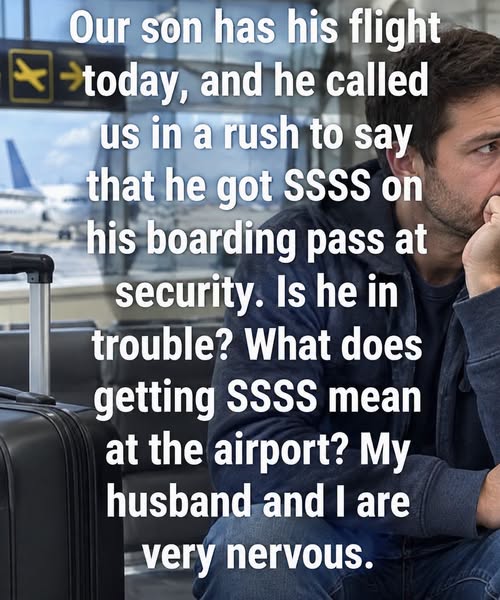
Four letters on a boarding pass can turn an ordinary airport call into a parent’s worst fear. When your son suddenly calls to say he has been singled out before boarding, the mind can immediately begin imagining the worst. Every unanswered question feels urgent, every minute seems longer, and the physical distance between a worried parent and a child at an airport can suddenly feel enormous.
The letters may look mysterious and intimidating, especially when they appear on a boarding pass without any explanation. A parent may wonder whether something has happened, whether their child is in trouble, or whether there is some serious reason security officers have stopped him. But those four letters do not tell the whole story. Understanding what they mean can help separate a routine security procedure from the frightening assumptions that naturally arise in a stressful moment.
SSSS stands for **Secondary Security Screening Selection**. It is a designation indicating that a passenger has been selected for additional security screening before flying. Seeing SSSS printed on your son’s boarding pass does not, by itself, mean that he has committed a crime, violated a rule, or is suspected of wrongdoing.
The designation can be unsettling precisely because passengers are not always given a detailed explanation of why they were selected. Selection may occur randomly or may be associated with certain travel or booking circumstances, while the specific reason may not be disclosed to the passenger. The letters therefore should not automatically be interpreted as an accusation.
For someone standing at an airport with a departure time approaching, however, the experience can still be stressful. The passenger may suddenly find themselves separated from the ordinary flow of travelers and directed toward additional screening. They may have to wait while security personnel conduct checks that other passengers do not experience.
That difference can make the situation feel much more serious than it actually is. A traveler who has never encountered SSSS before may have no idea what is happening or how long the process will take. If they call a parent during the screening, their nervous voice can make the situation sound even more alarming.
The additional screening can include a closer inspection of luggage and personal belongings. Security personnel may also perform swab tests designed to detect traces associated with explosives. Depending on the circumstances and applicable procedures, a passenger may also undergo a pat-down or be asked questions related to the trip.
The exact process can vary, and screening times are not necessarily the same for every passenger. Some travelers may complete the additional checks relatively quickly, while others may experience a longer wait depending on the airport, staffing, passenger volume, or circumstances surrounding the screening.
That uncertainty can be particularly difficult for family members who are not physically present. A parent may be sitting hundreds or thousands of miles away, staring at a phone and waiting for another call. They may know only that their son has been stopped and that boarding time is getting closer.
In that moment, the most important thing to remember is that SSSS is a **screening designation, not a declaration of guilt**. The letters themselves do not establish that a passenger has done something wrong. They simply indicate that additional security procedures are required before the traveler can continue through the airport process.
Passengers who encounter SSSS can generally make the experience easier by allowing additional time at the airport. Arriving early gives security personnel more time to complete the required procedures without creating unnecessary pressure caused by an approaching departure time.
Following the instructions of security staff is also important. The screening process may feel unusual or inconvenient, but cooperating with the established procedures can help the process move forward. Asking calmly for clarification about what is required can also be useful when a traveler is uncertain about the next step.
For parents, the distinction between being screened and being accused can be especially important. Hearing that a child has been “singled out” can immediately trigger fear, but additional screening does not necessarily indicate that an emergency is taking place.
The situation can become even more confusing because the airport environment is already stressful. Travelers are watching the clock, carrying luggage, navigating unfamiliar terminals, and worrying about missing their flights. Being pulled aside for additional checks can make all of those ordinary pressures feel much more serious.
A nervous passenger may therefore call home and describe the situation in a way that reflects their anxiety rather than the actual seriousness of the procedure. The parent’s imagination can then fill in the missing information, creating a much more frightening picture than the facts support.
Once the additional screening has been satisfactorily completed, passengers are generally able to continue with their journey, subject to the normal security and boarding requirements. The fact that someone was selected for additional screening does not automatically mean that their trip will be canceled or that they will be prohibited from flying.
For travelers who receive the designation repeatedly, the experience can understandably become frustrating. They may feel that they are being subjected to additional procedures more often than other passengers. Even so, the presence of SSSS on a boarding pass should be understood in terms of the screening process itself rather than treated as evidence of misconduct.
The most useful response is therefore preparation rather than panic. If the designation is visible before arriving at the airport, allowing extra time can reduce stress. Keeping travel documents organized and following security instructions can also make the process more manageable.
For family members receiving an unexpected phone call, patience can be equally important. The first instinct may be to assume that something serious has happened, but asking what security personnel actually told the passenger can help distinguish facts from fears.
A son calling his parent from an airport and saying, “They stopped me,” can sound terrifying without context. But the next questions matter: Was he told he was under arrest? Was he simply directed to additional screening? Was his luggage being inspected? Was he waiting for a security procedure to finish?
Those details can dramatically change the meaning of the situation.
The four letters themselves may look ominous, but they are not a complete explanation of what is happening. They are an indication that additional screening is required, and the actual experience depends on the circumstances of the passenger and the airport.
For a worried parent, that distinction can bring some perspective. The nervous phone call may reflect an unfamiliar and inconvenient airport experience rather than the emergency that those four letters initially suggest.
Travel already involves uncertainty, and security procedures can make that uncertainty feel even stronger. But understanding common airport designations can prevent a moment of confusion from turning immediately into panic.
SSSS does not tell a parent that their son has done something wrong. It tells them that additional screening is taking place. The passenger may have to answer questions, undergo additional checks, wait longer, or have belongings inspected before proceeding.
Eventually, once the required procedures are completed, the traveler can generally continue through the airport process. What began as a frightening interruption can therefore turn out to be nothing more than an unfamiliar security requirement.
For the parent waiting on the other end of the phone, the most reassuring fact may be the simplest one: the letters are a screening designation, not an automatic accusation.
The airport can be an intimidating place when someone you love is suddenly separated from the normal flow of travelers. But understanding what SSSS means can replace some of that fear with context. The process may take additional time, and it may feel uncomfortable or intrusive, but the designation itself does not establish wrongdoing.
Sometimes the scariest part of an unexpected airport call is simply not knowing what the words on the boarding pass mean. Once those four letters are understood, the situation becomes much easier to place in perspective: additional screening, additional questions, and potentially additional waiting—not necessarily the emergency a worried parent first imagined.