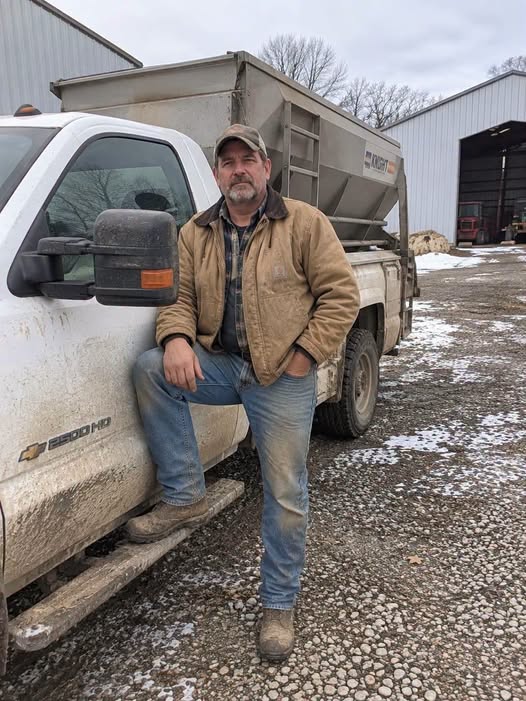
His father left him a truck—and gave his brother the farm. After twenty-two years of working the same Nebraska ground, Wade Kucera drove away with nothing but an old feed truck, a pair of worn leather gloves resting on the dashboard, and a hurt he could not bring himself to name. He had spent most of his adult life helping his father plant, repair, harvest, and maintain those four hundred acres. Yet when the will was read, the land went to Phil. Wade received the truck. He never challenged the decision, never demanded an explanation, and never told his brother how deeply the choice had wounded him. But four months later, when the summer heat began drying out the fields and the irrigation system started failing, Phil arrived at Wade’s house with muddy boots, his cap held nervously in his hands, and a request that would force both brothers to confront everything they had left unsaid.
Wade had grown up believing that a farm was more than a piece of property. It was a responsibility passed from one generation to the next, a place where every fence post, every field, and every weathered building carried the memory of the people who had worked there. His father had taught him to rise before sunrise, check the equipment before the day’s work began, and never leave a problem for tomorrow if it could be fixed today. Wade had followed those lessons faithfully. For twenty-two years, he had put his strength, time, and patience into the family farm, often sacrificing his own plans because there was always another field to prepare or another machine that needed attention.
When his father grew older, Wade gradually took on more of the daily responsibilities. He knew which sections of land held water after heavy rain, which tractor needed a little extra attention, and which irrigation lines were likely to cause trouble during the hottest weeks of summer. He understood the farm through years of experience, not simply through numbers on a balance sheet. He had imagined that one day he might continue working that land, perhaps with Phil beside him, preserving what their father had spent a lifetime building.
But after their father died, the will revealed a different future. Phil inherited the entire four hundred acres. Wade received the old feed truck that had been used around the farm for years. Nobody offered an explanation that made sense to him. Perhaps their father had his reasons. Perhaps he had believed Phil needed the land more. Perhaps there were family considerations Wade would never fully understand. Whatever the truth, the decision left him feeling as though twenty-two years of labor had been reduced to something that could be driven away in an aging truck.
Wade could have contested the will. People told him so. They reminded him that he had worked the farm for decades and that his contributions mattered. Some suggested that he should demand a share of the land or at least ask why his father had made such a decision. But Wade refused to turn his father’s death into a legal battle. He had no desire to spend months arguing over property while grief was still fresh. He also knew that a fight with Phil could destroy whatever remained of their relationship.
So he accepted the truck and left.
The first weeks were harder than he expected. Wade moved his cattle to rented pasture and took a job at the local agricultural cooperative. His new work was honest and familiar enough, but it lacked the feeling of responsibility he had once carried every day. He no longer had to inspect the irrigation system before breakfast or decide which field needed attention first. Instead, he spent his days helping other farmers with supplies, equipment, and repairs, returning home in the evening to a quiet house.
The old feed truck became part of his new routine. Its engine rattled on cold mornings, and the driver’s seat had a tear that caught the edge of his work jeans. The paint had faded, and the bed bore scratches from years of hauling feed and tools. Wade knew every sound the truck made. He also knew the worn leather gloves that remained on the dashboard. They had belonged to his father, who had left them there after one of their last days working together.
Sometimes Wade would glance at those gloves while driving and remember the mornings when his father had sat beside him, explaining how to repair a broken line or judge whether a field was ready for planting. He missed those conversations more than he admitted. Even when his father had been difficult, there had been comfort in knowing that they shared the same land and the same work.
Now the farm belonged to Phil, and Wade had decided that he would not ask for anything.
Phil, meanwhile, discovered that owning four hundred acres was not the same as knowing how to manage them. He had grown up around the farm, but he had never carried the same daily responsibility that Wade had. He understood the broad outline of planting and harvesting, yet the countless small decisions that kept a farm running smoothly were unfamiliar to him. A field that appeared healthy from the road could conceal drainage problems. An irrigation line that seemed to be working could have a blockage several rows away. Equipment that had been maintained regularly could fail when it was needed most.
At first, Phil tried to handle everything himself. He told neighbors he was learning and assured them that he would figure things out. He spent evenings studying equipment manuals and walking the fields, trying to remember what his father and brother had done in previous years. Whenever he encountered a problem, he searched for a solution rather than admitting that he did not know where to begin.
The difficulty was that farming did not wait for confidence to arrive.
As spring turned toward summer, the irrigation system began showing signs of trouble. Water was not reaching some parts of the fields evenly, and the crop needed more attention as temperatures climbed. Phil attempted repairs, but each solution seemed to reveal another problem. The longer he struggled, the more anxious he became. He knew that if the crop suffered, the financial consequences could last far beyond the season. Seed, fertilizer, fuel, equipment payments, and other expenses did not disappear simply because the harvest failed.
He also knew who could probably help him.
Wade would have recognized the problem quickly. He had repaired that system many times and understood the farm’s quirks better than anyone. Phil could picture his brother walking along the irrigation lines, listening to the pumps, checking the connections, and identifying the source of the trouble. The thought brought relief, followed immediately by shame.
How could he ask Wade to rescue the farm after inheriting it himself?
Every time Phil considered calling, pride stopped him. He worried that Wade would remind him of the will or ask why their father had chosen one brother over the other. He feared hearing the anger he knew he deserved, even if Wade had never expressed it directly. So Phil continued trying to solve the problems alone.
Wade, for his part, watched the situation from a distance. News traveled quickly in a farming community. He heard that the irrigation system was struggling and that some sections of the crop were not getting enough water. He wondered whether Phil had discovered the problem and whether the young plants would survive the heat. More than once, he considered driving over to check on things.
But he stopped himself.
Phil had inherited the farm. Phil had the responsibility. Wade had made a decision to move forward with his own life, and he did not want to appear as though he were waiting for an invitation to return. He also feared that offering help without being asked would reopen the wound he had worked so hard to contain. He could not bear the thought of walking across those fields as a visitor on land where he had once felt he belonged.
Neither brother called.
The silence between them became its own kind of burden. Wade was hurt but unwilling to ask for recognition. Phil was overwhelmed but unwilling to admit that he needed his brother. Both men had spent their lives learning to work through difficult conditions without complaining. Their father had taught them endurance, but he had rarely taught them how to speak about disappointment, fear, or the need for help.
By June, the situation on the farm had become urgent. The crop could not wait much longer for a reliable water supply. Phil had exhausted the repairs he knew how to attempt, and every day of delay increased the risk of losing part of the harvest.
That was when their neighbor Butch decided he had seen enough.
Butch had known the Kucera family for years. He had watched Wade work the farm through good seasons and bad ones, and he had seen Phil struggle to carry the responsibility that came with the inheritance. He understood that the brothers were caught in a silence neither knew how to break. Butch also understood something that pride had hidden from them: the crop was more important than the argument neither man was willing to have.
One afternoon, he found Phil standing near a field, staring at the irrigation equipment. After listening to Phil explain the latest problem, Butch shook his head and told him what he had been avoiding.
“You need to talk to your brother,” he said. “He knows that farm better than anyone. You don’t have to settle everything between you today. But you do have to decide whether your pride is worth more than the crop.”
Phil looked away. For a moment, he seemed ready to argue. Then he looked back across the field, where the plants were struggling under the summer sun. He knew Butch was right.
That evening, Phil drove toward Wade’s house.
The trip was short, but he spent the entire drive rehearsing what he would say. He tried to imagine how Wade would react when he saw the truck pulling into the yard. He considered turning around twice. By the time he reached the house, his hands were tight on the steering wheel, and the words he had practiced seemed inadequate.
Wade was outside when Phil arrived. He looked up from what he was doing and immediately recognized his brother. For a moment, neither man spoke.
Phil climbed out of the vehicle. His boots were muddy, and he held his cap in both hands, twisting its brim as he struggled to find the courage to begin. He looked older than Wade remembered, worn down by weeks of pressure and too little sleep.
“I need to ask you something,” Phil finally said.
Wade waited.
Phil swallowed and glanced toward the truck parked nearby. The old feed truck sat where Wade had left it, the familiar shape of his father’s gloves visible through the windshield. Seeing it made Phil hesitate. He had not thought about what their father had left Wade in quite some time, and the sight reminded him that the decision had affected both brothers in ways he had never fully considered.
“The irrigation system is giving me trouble,” Phil admitted. “I’ve tried fixing it, but I can’t figure out what’s wrong. The crop needs water, and I don’t know what else to do.”
He paused, struggling to meet Wade’s eyes.
“Would you come out and look at the farm? Just tell me what you think. I know you know that place better than I do.”
Wade had imagined this moment many times, although he had never admitted it to himself. He had imagined Phil asking for help and then imagined refusing. He had imagined demanding an explanation for the will, asking whether twenty-two years of work meant anything to their father, or telling Phil that the farm was no longer his concern.
But standing in front of his brother, Wade found that the anger he had carefully rehearsed did not come as easily as he expected. He saw a man who was struggling, frightened about the crop, and ashamed to admit that he could not manage everything alone. He saw his brother, not merely the person who had inherited the land.
Wade looked down at the ground for a moment. The hurt was still there. His father’s decision had not suddenly become fair in his eyes, and Phil’s request did not erase the months of silence. Yet he knew what it meant to watch a crop suffer while a problem remained unsolved. He knew the work that had to be done, and he knew that helping Phil would not mean surrendering his own dignity.
“Saturday,” Wade said at last. “I’ll come out Saturday and take a look.”
Phil lifted his head, surprised by the answer.
“I’m not promising I can fix everything,” Wade added. “I’ll look at the system, and we’ll figure out what’s going on.”
It was not forgiveness, not yet. It was not a resolution to the questions surrounding their father’s will. Wade was offering only what he had agreed to offer: his time, his knowledge, and an honest assessment of the problem.
But it was enough to break the silence.
Phil nodded, and for the first time since arriving, his shoulders seemed to relax. He thanked Wade quietly. There was no long speech, no dramatic embrace, and no attempt to explain the inheritance. Both men understood that too much had been left unsaid for a single conversation to repair everything.
When Phil drove away, Wade remained in the yard for a while. He looked at the old truck and the gloves on the dashboard. He wondered whether his father had understood what his decision would do to his sons. Perhaps he had believed that Phil needed the farm more. Perhaps he had assumed Wade would find his own path. Or perhaps there were reasons neither brother would ever discover.
Wade could not answer those questions, and he could not change the will. What he could do was decide what kind of brother he wanted to be now.
On Saturday morning, he drove back to the farm.
The familiar road brought back memories of countless trips made before sunrise. As he approached the fields, he noticed details that had once been part of his daily life: the gate that needed adjusting, the stretch of fence near the western pasture, and the equipment shed where his father had stored tools for decades. The land looked both familiar and strange. It was still the place where he had learned to work, but he no longer knew whether he could think of it as home.
Phil was waiting near the irrigation system. He had gathered the tools he thought they might need and made a list of the problems he had encountered. Wade listened as Phil explained what he had tried, asking questions and examining the equipment. Slowly, the old rhythm of working together began to return.
They checked the lines, inspected the connections, and traced the water flow across the field. Wade pointed out a section that needed closer attention, and Phil followed him without arguing. For the first time in months, they were talking about a problem they could actually solve.
They still had difficult conversations ahead. Wade deserved an opportunity to explain what the inheritance had cost him emotionally, and Phil needed to acknowledge that his brother’s years of labor had mattered. They would have to learn how to discuss their father’s decision without allowing it to define every interaction between them.
But that morning was a beginning.
As they worked, Wade realized that helping his brother did not mean pretending he had never been hurt. Phil, meanwhile, began to understand that asking for help was not the same as admitting he had no right to own the farm. They could disagree about the past and still recognize what the other was capable of contributing in the present.
Their father had left them a complicated legacy. One son had inherited the land, while the other had received a truck and memories. Neither brother could rewrite that decision. Yet the farm had always required something more than ownership papers. It required knowledge, patience, cooperation, and the willingness to face difficult problems before they became disasters.
Perhaps that was a lesson their father had intended to teach. Perhaps it was simply a lesson his sons had been forced to learn for themselves.
By the end of the morning, the brothers had made progress, although there was still work to do. Wade wiped his hands on a rag and looked across the field. Phil stood beside him, quiet but no longer hiding behind his cap.
For months, each had waited for the other to make the first move. Wade had refused to ask for recognition, and Phil had refused to ask for help. Their pride had kept them apart even as the farm they both loved began to struggle.
Now, at least, they were speaking plainly.
The old wounds would not disappear in a day, and the question of their father’s will remained unanswered. But Wade had returned to the fields, and Phil had finally admitted that he could not do everything alone. That small exchange had opened a door neither brother had known how to approach.
Sometimes, a family does not begin to heal with an apology or an explanation. Sometimes, it begins with a difficult request, an honest answer, and two brothers standing together in a field, willing to do the work that needs to be done.