They wanted her money—and four days of her life every single week. At sixty-seven, widowed Judy found herself facing an impossible choice. Her own daughter offered her a place to live in the basement for $800 a month, but the arrangement came with conditions that made Judy’s heart sink. She would be expected to help with groceries, contribute to household expenses, and take care of her grandchildren four days a week. To reach the bathroom, she would have to climb thirteen stairs, a difficult thought for a woman who was beginning to feel every year of her age. Yet the hardest part was not the money or the stairs. It was the realization that her own daughter seemed to view her presence as something that needed to be paid for and justified.
Judy had never imagined that life would bring her to this point. For decades, she and her late husband, Dale, had built their lives around a modest farmhouse filled with memories. Every corner reminded her of their years together—the kitchen table where they shared morning coffee, the porch where they watched the changing seasons, and the garden Dale had carefully tended every spring. After his death, his former employers had generously allowed Judy to remain in the farmhouse. Their kindness had given her time to grieve without the immediate fear of losing her home. But circumstances eventually changed. Their son was starting a family of his own, and the farmhouse was needed for the next chapter of their lives.
Judy understood. She could not expect another family to put their future on hold for her. Still, knowing she had to leave the only home she had known for so long made her feel as though she were losing Dale all over again. She had already lost her husband, her daily routines, and the companionship that had made even the quietest evenings feel warm. Now she had to figure out where she belonged in a world that suddenly seemed much smaller.
Her daughter’s proposal initially sounded like a practical solution. Judy could move into the basement, pay $800 each month, help cover utilities, contribute toward groceries, and watch the children four days a week while her daughter worked. Her daughter presented the arrangement as a reasonable way for everyone to help one another. Perhaps she even believed she was offering her mother a favor.
But Judy sat quietly as the details unfolded, feeling a growing heaviness in her chest. She received just $1,640 a month in widow’s benefits. After paying $800 in rent, she would have less than half of that amount remaining for everything else. Electricity, groceries, transportation, medication, clothing, and unexpected expenses would quickly consume what little she had left. She would have to stretch every dollar and constantly worry about whether she could afford the next month.
And then there was the childcare.
Four days every week meant that her retirement would no longer feel like retirement. She would be responsible for feeding the children, keeping them occupied, preparing for their needs, and making sure they were safe while their parents worked. She loved her grandchildren deeply, but love did not mean she had unlimited energy. At sixty-seven, she wanted to spend time with them because she enjoyed their company, not because her housing depended on it.
What hurt most was the feeling that she would have to earn her place in her daughter’s home. Judy had spent much of her life caring for other people. She had been a devoted wife, a hardworking partner, and a mother who had sacrificed countless hours to raise her family. Now, when she needed a little security and understanding, she feared she would become an unpaid employee in a basement that was never truly hers.
She did not argue. She did not accuse her daughter of being selfish or list all the things she had done for the family over the years. She simply listened, thanked her for considering the arrangement, and said she needed some time to think.
That evening, Judy sat alone with a small notebook and a pen. She wrote down her monthly income and began subtracting the expenses she knew she would face. The numbers did not lie. Even if she managed to make the arrangement work financially, she could not ignore the emotional cost. She imagined waking up every morning knowing that four days of her week had already been promised away. She imagined climbing those thirteen stairs whenever she needed the bathroom, carrying laundry up and down, and trying not to feel like an inconvenience in a house full of people.
For the first time in many years, Judy asked herself a question she had rarely allowed herself to consider: What if she chose herself?
The next morning, she put on her coat, took her purse, and drove into town. She had no elaborate plan. She simply knew she needed to look for another possibility before agreeing to something that would leave her feeling trapped. She passed familiar storefronts and quiet streets until she reached the feed store, a place where people often shared local news and pinned notices about work, furniture, and available rentals.
Judy asked the owner, Mr. Brandt, whether he had heard of any small homes available to rent. He paused for a moment, then remembered a notice that someone had recently brought in. It was for a modest little house on a quiet street, not far from the shops and services Judy needed.
Mr. Brandt took the notice down and showed it to her. The house had a small porch with a swing, a bright kitchen window, and a simple entrance with just one step. It was not large, luxurious, or newly renovated. The paint might need touching up, and the rooms were modest, but the place looked peaceful. More importantly, it was a home where Judy could come and go without asking anyone’s permission or explaining why she needed a little quiet.
The rent was $550 a month, with electricity and gas charged separately.
Judy read the number twice.
At first, she wondered whether she had misunderstood. The rent was considerably lower than what her daughter had proposed, and there were no conditions requiring her to provide childcare in exchange for a place to sleep. She would still need to budget carefully, especially during cold months when heating costs could rise, but the arrangement offered something she had almost forgotten was possible: independence.
She asked Mr. Brandt for the landlord’s contact information. Within a short time, she had arranged to see the house. As she walked through the front door, she noticed the sunlight spilling across the kitchen floor. She could picture a little table near the window, a comfortable chair in the living room, and a few pots of flowers on the porch. There was enough space for her belongings, her memories, and the peaceful routines she wanted to rebuild.
The house was small, but it did not make her feel small.
Judy looked out through the kitchen window and imagined drinking her morning coffee there. She pictured herself tending a few flowers, reading in the afternoon, and inviting her grandchildren over when she had the energy and wanted to see them. She could still be a loving mother and grandmother without giving away control of her entire week.
When the landlord agreed to rent the house to her, Judy wrote the check. Her hand trembled slightly as she signed her name, not because she was uncertain, but because she understood what the decision meant. She was choosing a future that might be modest and sometimes lonely, yet it would belong to her.
Then came the moment she would remember for the rest of her life.
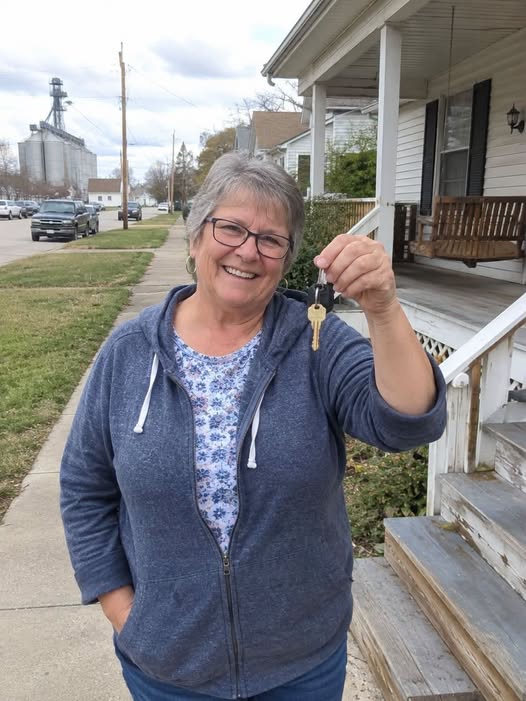
The landlord placed two small brass keys in her palm. They were ordinary keys, the kind anyone might carry without thinking twice. But Judy stared at them as though they were something precious. One would open the front door, and the other would give her access to a life in which she did not have to justify her existence.
She turned her face away, hoping no one would notice the tears gathering in her eyes. For months, she had worried that growing older meant becoming dependent on others, accepting whatever arrangement was offered, and keeping quiet to avoid being a burden. Now, standing in front of a little house with a porch swing and a bright kitchen window, she realized that asking for less did not mean she deserved less.
At sixty-seven, Judy was not starting over because she had failed. She was starting over because life had changed, and she still had the right to decide how she wanted to live.
The house would not bring Dale back. It would not erase the pain of losing him or guarantee that every day ahead would be easy. She would still have bills to pay, meals to prepare, and quiet evenings when she missed the sound of his footsteps. But she would also have a place to put her photographs, a kitchen where she could make coffee whenever she pleased, and a front door she could unlock with her own key.
Most of all, she would have choices.
She could visit her daughter when she wanted to. She could spend time with her grandchildren out of love rather than obligation. She could rest when she was tired, make plans without seeking permission, and enjoy the simple dignity of living in a space that was truly hers.
As Judy walked toward her car, she closed her fingers around the brass keys and smiled through her tears. They were small, inexpensive pieces of metal, but they represented something her money could not buy and her family could not give her unless she claimed it for herself.
They represented freedom, dignity, and the quiet courage to begin again.
And for the first time since Dale had died, Judy felt that the next chapter of her life might still hold something beautiful.