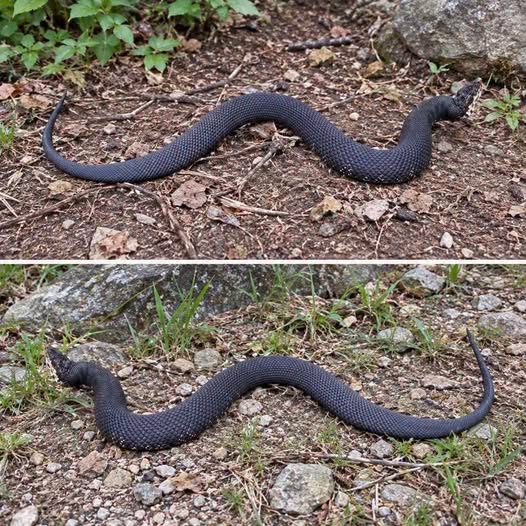
One unseen snake turned a turkey hunt into an urgent trip to the hospital. What had started as an ordinary day outdoors changed in an instant when a dark animal hidden deep within thick brush suddenly struck. The hunter had little opportunity to see what was happening before the bite, and the dense vegetation made it nearly impossible to get a clear look at the snake. Instead of taking a chance by moving closer, he photographed the animal from a safe distance before leaving the area to seek medical attention. The photograph became the only visual clue available, but it could not provide a definite identification.
The uncertainty made the situation even more complicated. Snakes can be difficult to identify when only part of the body is visible, especially in thick vegetation and poor lighting. Stress and the pressure of a possible venomous bite can also make visual identification unreliable. A distant photograph may capture color or general shape while failing to show the specific characteristics needed to determine the species. For that reason, the hunter did not rely on his own interpretation of the image before deciding what to do next. The priority was getting away from the animal and reaching medical professionals as quickly as possible.
The hunter’s most important decision was to leave the area and get medical help. Although he managed to safely photograph the snake from afar, the image could not establish exactly what had bitten him. Poor visibility, partial views, and the pressure of the moment made appearance an unreliable guide. Trying to get a closer photograph could have created another dangerous encounter, and attempting to capture the animal would have introduced an unnecessary risk. The safest choice was to leave the snake alone and allow medical professionals to handle the uncertainty.
At the hospital, doctors monitored him carefully for signs of complications. He did not develop severe symptoms of envenomation, which was reassuring, but the absence of immediate serious symptoms did not mean that observation was unnecessary. Medical teams continued watching his condition because some complications following certain snake bites can develop later rather than immediately. His condition remained stable, but the uncertainty surrounding the species and the bite meant that caution was still appropriate.
The experience also demonstrated why confidence can be dangerous when dealing with unidentified wildlife. A person may believe they recognize a snake based on its color, size, or general appearance, but those observations can be misleading when the animal is partially hidden. Even experienced outdoor enthusiasts can have difficulty identifying a snake accurately during a stressful encounter. A photograph taken from a safe distance can potentially help professionals later, but it should never come at the cost of remaining near the animal or delaying medical treatment.
The encounter offers a practical reminder for anyone heading into dense cover, whether hunting, hiking, working outdoors, or simply exploring natural areas: identification should never take priority over safety. After a snake bite, the first priority is to move away from the animal and seek prompt emergency medical evaluation. Do not attempt to capture, kill, touch, or corner the snake. If a photograph can be taken safely from a distance without delaying medical care, it may provide useful information, but getting a perfect picture is never worth increasing the risk.
In this case, professional medical monitoring—not confidence in a fleeting glimpse—provided the safety net while the immediate uncertainty remained. The hunter could not be certain what kind of snake had struck him, but he made the crucial decision to treat the bite seriously rather than gamble on an identification made under pressure. The experience serves as a reminder that when wildlife and people unexpectedly meet, the safest response is often the simplest one: create distance, avoid further contact, and let trained professionals take over.