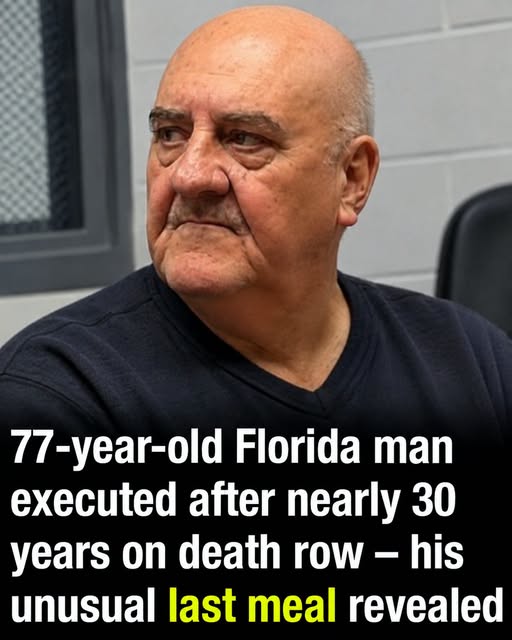
After nearly three decades on death row, Curtis Wilkie Beasley faced his final hours. The Florida inmate, convicted in the 1995 killing of Carolyn Monfort, was 77 when the state carried out his execution by lethal injection. Before the drugs were administered, Beasley offered an apology, bringing a final moment of reflection to a case that had remained part of the state’s death-penalty system for decades.
For a man who had spent nearly thirty years waiting for his sentence to be carried out, the final hours represented the end of an extraordinarily long legal and personal journey. The execution brought the case to its final stage, while the circumstances surrounding Monfort’s death remained the central reason Beasley had been condemned.
Before entering the death chamber, Beasley was permitted to request a final meal. His choice was notably simple: grilled cheese sandwiches and ice cream. According to a Florida Department of Corrections spokesman cited by the Associated Press, those were the foods he requested before the execution.
Florida allows condemned inmates to request a final meal costing no more than $40, using food available locally. The tradition has become a familiar part of executions in the United States, but the meals themselves can vary dramatically from one inmate to another. In Beasley’s case, the selection was uncomplicated, consisting of familiar foods rather than an elaborate final feast.
The simplicity of the meal stood in striking contrast to the gravity of the circumstances surrounding it. A person who had spent decades awaiting execution was sitting in his final hours, knowing that his life was about to end. Outside the death chamber, the legal process that had continued for years was reaching its conclusion.
On Tuesday, a spiritual adviser sat beside Beasley during the execution at Florida State Prison near Starke. The presence of a spiritual adviser provided him with support during the final moments as officials prepared to administer the lethal injection.
Before the drugs were administered, Beasley spoke a final statement of apology. He said, **“I want to apologize for all the mistakes I made.”** The words were brief, but they marked his final public statement before the execution was carried out.
At 6:12 p.m., Beasley was pronounced dead.
The execution brought an end to a case that had begun in August 1995 with the discovery of Carolyn Monfort inside her Dundee home. According to the account, Monfort’s daughter became concerned after being unable to reach her mother for two days. When she went to check on her, she discovered that her mother had died.
The discovery immediately raised questions about what had happened inside the home. Investigators examined the scene and found evidence that would become important to the subsequent investigation, including a bloodied hammer head nearby.
A witness also linked Beasley to Monfort’s vehicle, providing investigators with another piece of information as they worked to establish what had happened. The investigation eventually led authorities to Beasley, who was later arrested after fleeing Florida.
The case ultimately went to trial, and in 1998 Beasley was convicted of murder, robbery, and grand theft auto. The convictions resulted in the death sentence that he would spend nearly three decades awaiting.
For years afterward, the case remained within the legal system as Beasley remained on death row. Death-row cases can extend for many years as appeals and other legal proceedings take place, meaning that the period between conviction and execution can be dramatically longer than the original trial itself.
For Beasley, that period stretched across much of his adult life. He entered death row decades before the final execution and remained there as the years passed and the case continued through its legal stages.
By the time of his execution, he was 77 years old. The man entering the death chamber was therefore far older than the person who had been convicted in 1998, reflecting the extraordinary length of time between the original conviction and the final sentence.
The passage of time does not erase the original crime or the conviction. It does, however, illustrate how long capital cases can remain active within the legal system. Nearly thirty years separated the conviction from the execution in Beasley’s case.
For the victim’s family, the story began with a completely different moment—the discovery of Carolyn Monfort dead inside her home. The years that followed brought an investigation, prosecution, conviction, and ultimately an execution.
No public statements from either family were reported following the execution. That absence leaves the final public record focused primarily on the official account of the execution and the history of the case rather than on personal reactions from those closest to either side.
The final meal, the presence of a spiritual adviser, and Beasley’s brief apology offered a glimpse into the final hours, but they did not change the underlying history of the case. The execution was the final act of a process that had begun with Monfort’s death in 1995.
For Beasley, the final hours were shaped by the knowledge that the sentence he had awaited for decades was about to be carried out. The simple meal of grilled cheese and ice cream preceded the final preparations, while the spiritual adviser remained beside him.
At 6:12 p.m., the state formally ended his life through lethal injection.
The execution also closed a chapter that had remained open for nearly thirty years. From the initial discovery in Dundee to the investigation, Beasley’s flight from Florida, his arrest, the 1998 convictions, and the long years on death row, the case passed through multiple stages before reaching its conclusion.
What remains in the public record is a stark sequence of events: a woman was found dead in her home in 1995, investigators gathered evidence, Beasley was arrested after fleeing the state, he was convicted in 1998, and decades later the death sentence was carried out.
The final apology did not provide a detailed account of the crime or answer every question surrounding the case. It was simply the statement Beasley chose to make immediately before his execution.
His final meal was equally straightforward. Grilled cheese sandwiches and ice cream became the last food he requested, a small and ordinary choice placed within an extraordinary and irreversible moment.
For nearly three decades, the case had remained connected to Florida’s death-row system. On the day of the execution, that long period finally came to an end.
The story of Curtis Wilkie Beasley therefore concludes not with another appeal or another court proceeding, but with the execution itself. At 77, after almost thirty years on death row, he faced the final moments of a sentence imposed after his 1998 conviction.
The apology, the final meal, the spiritual adviser, and the execution at Florida State Prison near Starke marked the final hours of his life.
And with his death at 6:12 p.m., a case that had begun with the discovery of Carolyn Monfort’s body in a Dundee home in August 1995 reached its final chapter.