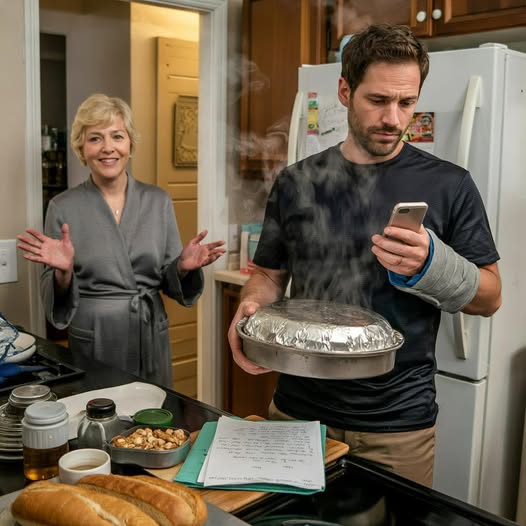
The sweet potatoes were still steaming when my phone rang. I had spent six hours on that casserole—roasting each one individually the way my grandmother taught me, making the praline topping from scratch, letting the pecans caramelize until they looked like little pieces of amber. Outside my apartment, the city carried that rare Thanksgiving quiet, as if even the traffic had decided to lower its voice.
It was 9:12 a.m. My sister Ashley hadn’t sent the schedule yet. My mom hadn’t called with her usual, “You’re bringing your fancy casserole, right?” No one had said anything all week. I told myself they were just busy—because that’s what I always did. I made excuses like it was my responsibility.
When I finally called Ashley, she picked up on the sixth ring, sounding rushed and out of breath. In the background, I could hear laughter, overlapping conversations—the kind of noise that only comes from a house full of family.
“Oh my god,” she said, her voice dropping suddenly. “Nathan.”
My stomach tightened.
“Hey,” I said, trying to sound casual. “Just checking what time I should come by. The casserole’s ready.”
The silence that followed said everything.
“I thought Mom told you,” Ashley said at last.
“Told me what?”
“Well… we decided to have Thanksgiving early this year. Last weekend, actually. Mom wanted to avoid the holiday rush at the stores.”
I stared at the casserole like it had turned against me. They had all been there—my parents, siblings, their families—and no one thought to include me. No one thought I should even know.
“Why didn’t anyone tell me?” I asked, gripping the counter.
Ashley hesitated. “I really thought Mom had called you. Nathan, I’m sorry. This is… awkward.”
Awkward. As if my absence was just a minor inconvenience, not something meaningful.
“Do you want to come now?” she added. “We still have leftovers.”
Leftovers.
I pictured walking into a house where everything was already finished—everyone full, relaxed—my casserole arriving too late, like an afterthought.
“No,” I said. “I’m good. Enjoy your day.”
I hung up before she could say anything else.
I stood there in my kitchen—thirty-three years old—looking at a dish I had made for people who had forgotten me. Part of me tried to be rational: It’s just a misunderstanding. Things happen.
But another part of me—quieter, older, more tired—refused to ignore it this time. Because this wasn’t new. It was just the first time I stopped making excuses for it.
I took the casserole to my elderly neighbor, Mrs. Kowalski. When she opened the door in her robe, her face lit up instantly.
“Oh, honey,” she said warmly. “That’s so sweet of you. Come in, sit, have some with me.”
The invitation hit harder than I expected. A near-stranger offering me a place without hesitation. For a second, I almost accepted.
But I shook my head. “I’m okay. I’ve got things to do.”
She looked at me carefully. “Things can wait,” she said gently. “You don’t have to be alone.”
I smiled—the kind of practiced smile meant to reassure people—and left.
Back upstairs, I ordered pizza and started scrolling through my phone. At first, I wasn’t looking for proof—just something to make me feel less foolish. But the truth surfaced anyway.
Group chats I’d never been part of. Photos from family gatherings I didn’t know existed—my nephew’s birthday, my brother Kyle’s promotion, Sunday brunches, Ashley’s baby shower I’d only heard about afterward.
These weren’t spontaneous events. They were planned.
I just wasn’t included.
At 9:00 p.m., my phone buzzed. A text from my mom:
“Ashley told me about the confusion. Sorry, honey. Thought your sister told you. Hope you still had a nice, quiet Thanksgiving.”
Confusion. Like forgetting me was accidental.
I stared at the message without replying.
What was I supposed to say? That this wasn’t a mistake—that it was a pattern?
They would apologize just enough to move on. Tell me I was overreacting. Turn it into something I had to fix.
So I said nothing.
The next morning, I opened my calendar. It was filled with reminders I had built over the years—birthdays, anniversaries, everything that kept our family connected.
I started deleting them.
My mom’s birthday. Gone.
Kyle’s. Gone.
Ashley’s anniversary. Gone.
My dad’s birthday. Gone.
Every reminder I had created so I wouldn’t forget them.
It took twenty minutes to erase years of effort.
It didn’t feel cruel. It felt… clean.
Three weeks later, my mom’s sixty-fifth birthday passed. I didn’t call. I didn’t text.
The next day, my dad called.
“Nathan,” he said, disappointed, “your mother was hurt you didn’t acknowledge her birthday.”
“I forgot,” I said.
A pause. “You forgot your own mother’s birthday?”
“That’s what I said.”
“That’s not like you.”
Of course it wasn’t.
“I’ve had a lot on my mind,” I replied.
“She’s your mother,” he said. “You need to call her.”
“I will,” I said—and hung up, knowing I wouldn’t.
I buried myself in work. I designed buildings—structures that made sense, where effort led to results. Unlike family.
When Kyle’s birthday came, I didn’t show up. No explanation.
His voicemail: “What the hell, man? This isn’t like you.”
I deleted it.
For Ashley’s anniversary, I went hiking instead. Alone. Somewhere quiet, where no one expected anything from me.
When I got back, my phone was flooded with messages:
Where are you?
You need to be here.
Stop acting like a child.
This is unacceptable.
And my mom’s voicemail:
“You’re hurting people who love you.”
I sat there, staring at my phone.
Did they love me?
Or did they love the version of me that was always available, always giving, never asking for anything in return?
I saved the voicemail. Not because it meant something to me, but because something inside me had started keeping records.
March came with more family events—my father’s birthday, my nephew’s party, even a dinner I only learned about because a cousin accidentally added me to a Facebook event.
I didn’t go to any of them. I didn’t acknowledge a single one.
After my dad’s birthday passed, my mom stopped calling. Ashley’s messages, though, became more urgent.
Nathan, please. I don’t understand what’s happening. Talk to me. Tell me what we did wrong.
The fact that she had to ask—that she genuinely didn’t see it—was answer enough.
In April, my girlfriend Zara sat across from me on the couch and said gently, “I think you should talk to someone.”
Zara was different from my family. She didn’t use guilt to control people. She asked questions—and actually listened to the answers.
“I’m fine,” I said automatically.
“You’re not.”
There was something in her certainty that tightened my throat. After a moment, I nodded. “Okay. I’ll go.”
Dr. Raymond Woo’s office smelled faintly of coffee and cleaning solution. He was calm, steady—his voice the kind you could lean on. When I told him everything, he didn’t interrupt. Didn’t defend my family. Didn’t tell me to forgive.
He just listened.
When I finished, he paused before saying, “What you’re describing sounds like a pattern of invisible labor.”
“Invisible labor?”
“Emotional labor,” he clarified. “You were the one maintaining connections—remembering dates, reaching out, showing up. That’s work. And your family system grew dependent on you doing it.”
“So what happens when I stop?” I asked.
He gave a small, knowing look. “The system destabilizes. People react—not necessarily because they miss you, but because they miss what you provided.”
The truth of it hit hard—but it also made something inside me loosen. Like someone had finally put a name to what I’d been feeling.
Over the next sessions, we broke it down further. In my family, I had been the glue—the organizer, the one who remembered everything, who made sure everyone else stayed connected.
I had built their sense of closeness with my effort.
And they called it family.
“What do you want?” Dr. Woo asked me one day in May.
I stared at the floor for a long time. “I want them to miss me,” I said finally. “I want them to notice I’m not just… background.”
“And if they don’t?”
That question stayed in the air.
“Then I learn how to live without them.”
In June, Zara proposed.
We were hiking when we reached the top of a small mountain. She pulled out a ring, her hands shaking slightly, and said, “Nathan Cross, will you marry me?”
“Yes,” I said immediately, my voice breaking.
People nearby clapped. Zara laughed through tears and kissed me, and for the first time in a long while, I felt something simple—pure happiness, without conditions.
That afternoon, we called our closest friends and planned a small engagement party.
When Zara asked softly, “Do you want to tell your family?” I felt my chest tighten.
“No,” I said. And it surprised me how sure I felt. “I don’t want them there.”
She didn’t push. She just squeezed my hand. “Okay. Then we celebrate with the people who actually show up.”
The party was perfect. Her family welcomed me like I had always belonged. Our friends filled the apartment with laughter and genuine excitement.
And when I looked around, I realized something unexpected:
I wasn’t missing anyone.
The next day, Zara posted photos.
Within an hour, my phone lit up—calls from my mom, Ashley, Kyle. I ignored them all.
Then came the texts:
I can’t believe I found out from Facebook.
This should’ve been a family moment.
We’re not even worth a call?
The entitlement was unbelievable. Months of silence—and now they expected to be included in my happiness.
Zara read over my shoulder and said quietly, “They don’t miss you. They miss what you did for them.”
Her sister Rya—blunt and fiercely loyal—added me to a family group chat I’d never been part of before.
I sent one message:
I got engaged. I had a party. I invited the people who are consistently present in my life. That list didn’t include any of you.
Then I muted the chat.
That night, Zara found me standing on the balcony.
“Your family’s losing it,” she said.
“I know.”
“Do you want to talk?”
I shook my head. “I don’t want to be the lesson. I don’t want to be the thing that teaches them consequences.”
“You’re not,” she said gently. “You’re protecting yourself.”
That was the difference—boundaries, not revenge.
In July, my grandmother passed away.
I found out from my uncle. The news hit hard—I hadn’t seen her in months, caught up in my distance from everyone else.
“I’ll be there,” I said.
At the funeral, my family sat together in the front. I stayed near the back with Zara.
My mom saw me—relief, surprise, then anger crossing her face.
After the service, she came straight to me. “We need to talk.”
“Not today,” I said.
“You’ve ignored us for months,” she said. “We deserve an explanation.”
“You forgot to invite me to Thanksgiving,” I replied quietly. “And that wasn’t the first time.”
My father stepped in. “This is not the time for your drama.”
Drama.
“My point exactly,” I said calmly.
As I turned to leave, Ashley stopped me. “We miss you.”
I looked at her—really looked.
“You don’t miss me,” I said. “You miss what I used to do for you.”
We left soon after.
For the first time, I didn’t feel guilty.
A week later, my uncle gave me a letter from my grandmother.
In it, she wrote that she had seen everything—how hard I tried, how often I was overlooked, how her silence had been a mistake.
You deserve better, she wrote.
I broke down reading it.
For years, I felt invisible.
Now I knew I hadn’t imagined it.
Someone had seen me all along.
In October, we got married.
It was perfect—sunlight, autumn leaves, a small ceremony filled with people who genuinely cared.
For the first time, I was surrounded not by obligation…
…but by real belonging.
When the officiant said, “We’re not only born into family—we also choose it,” something in my chest settled. Not bitterness. Peace.
We danced until midnight, toasted until we were giddy, laughed until our faces hurt. For the first time in my life, I experienced a family celebration without obligation or tension—just love, mutual and present.
The photos went up the next day. Among the comments were familiar names. My cousin: Congratulations! Wish I could’ve been there. Ashley: a simple heart emoji.
They’d seen the wedding they weren’t invited to. Now they knew exactly how it felt.
Months passed. Work flourished. Life was full—in a good way. Quiet weekends. Long hikes. Dinners with Zara’s family. At some point, I realized I wasn’t thinking about my birth family constantly anymore. When they did cross my mind, it was with less heat, less ache, more distance.
In January, Ashley emailed me. No expectations, just thoughts.
She wrote about therapy, noticing patterns she’d never questioned, realizing she’d relied on me without acknowledging it. Thanksgiving wasn’t “one mistake”—it was the crack revealing the foundation.
I’m sorry, she wrote. I’m not asking you to come back. I just needed you to know I see it now.
I replied: Thank you for acknowledging it. I’m not ready to rebuild yet, but I’m glad you’re working on understanding your part.
Her answer: I understand. Take all the time you need.
No guilt. No demands. Just respect.
In August, Kyle showed up at my office. I let him in.
“I’m in therapy,” he said. “I owe you an apology. You were right. We forgot you. Not just Thanksgiving—years. We treated you like you existed to serve us. And when you stopped, we got angry instead of reflecting.”
His eyes were wet. “I don’t expect forgiveness. I just needed you to hear it.”
“Why now?”
“I got divorced,” he said. “And I realized I treated Morgan like we treated you—took her for granted. She left. Losing her made me understand losing you.”
We sat in silence.
“I appreciate the apology,” I said finally. “It matters. But the relationship we had is gone. I don’t know what comes next.”
“I know. I just wanted to say it,” he replied.
In September, my mother called. Unknown number.
“Nathan,” she said, voice shaky, “your father and I are getting divorced.”
I didn’t know what to say.
She laughed bitterly. “Turns out, strip everything away—kids, grandkids, holidays—we don’t actually like each other much. I’m not calling to make you come home. I just… I see now. The way we treated you, assumed you’d always be there. That was wrong.”
An apology. The thing I’d once longed for.
But I didn’t need it the way I once did. I had already built a life without it.
“Thank you for saying that,” I said carefully.
We talked briefly, awkwardly, then hung up. I felt done—not cold, finished. A chapter closed.
October came—our first anniversary. Zara and I returned to the botanical garden, walking under gold-leafed trees.
“This has been the best year of my life,” she said.
“Despite all the family stuff?” I asked.
“Because of how you handled it,” she corrected. “You chose yourself. You chose us. That takes courage.”
That night, she told me she was pregnant.
“A baby?” I whispered.
“Yes,” she smiled through tears.
Our daughter was born on a rainy April morning. Tiny. Perfect. Loud enough to make the nurses laugh.
We named her Lily Ruth—Ruth for my grandmother, who saw me when I felt invisible, a legacy of fierce love and quiet truth.
When Ashley held Lily, she cried. “She’s beautiful. Nate… you’re going to be an amazing dad.”
Looking at my daughter, I felt something settle completely. She would never wonder if she mattered. She would never be forgotten.
Years ago, my family forgot to invite me to Thanksgiving. I stopped remembering their birthdays and more. But in that forgetting, I reclaimed myself.
I stopped building a family out of obligation and started building one out of reciprocity. I built a life where people showed up because they wanted to.
For the first time, family didn’t feel like a job. It felt like love.