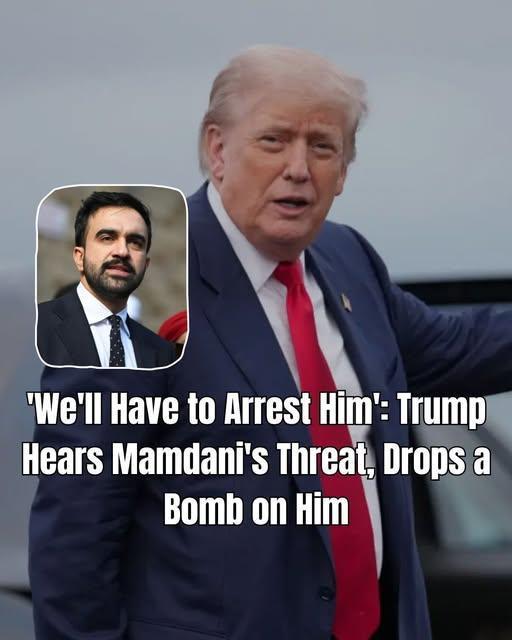
The gloves are off.
In a single, explosive interview, Donald Trump launched into a sharp and unfiltered attack on New York City’s newly elected socialist mayor, framing him not just as a political opponent, but as a serious threat. He labeled him a dangerous “communist,” a word chosen deliberately for impact, and went further—hinting that Washington holds the power to stall, restrict, or even suffocate the mayor’s agenda before it fully takes shape. The message wasn’t subtle. It was a warning, delivered with the weight of federal authority behind it.
At the center of this clash is a 34-year-old political newcomer who has already proven he can command attention. After campaigning on bold promises and unapologetic rhetoric, he had openly criticized Trump, calling him a “despot” and pledging to “stop the next Trump” from rising. That defiance helped fuel his momentum, energizing supporters who saw him as a new kind of leader—young, outspoken, and unafraid to challenge established power. But now, only days into his victory, he finds himself facing direct pressure from a president who made it clear he intends to “watch him very carefully,” suggesting oversight that goes beyond politics and into something more personal, more strategic.
Trump’s remarks pulled back the curtain on a growing power struggle—one that stretches far beyond rhetoric and into the mechanics of governance itself. On one side stands Washington, with its control over funding, approvals, and federal cooperation. On the other stands a newly reshaped New York City Hall, led by Zohran Mamdani, whose historic win marked a significant shift in the city’s political identity. As the first Muslim and South Asian mayor of New York City, his election was more than a local victory—it was symbolic, signaling change, representation, and a break from traditional power structures.
But that symbolism has quickly collided with resistance.
Trump framed Mamdani’s leadership as something dangerous, not just different. He warned that ideas rooted in socialism—policies aimed at expanding public housing, strengthening social safety nets, and resisting federal immigration enforcement—were not only misguided, but historically proven to fail. “It has not worked for thousands of years,” he suggested, reducing complex policy debates into stark, absolute terms designed to resonate with his base. In his view, this wasn’t innovation—it was risk.
Mamdani’s supporters, however, see something entirely different. They see a leader trying to address long-standing inequalities in one of the most expensive and diverse cities in the world. His platform speaks to affordability, access, and protection—issues that resonate deeply with working-class communities, immigrants, and younger voters. His stance against aggressive ICE crackdowns, in particular, has drawn both praise and criticism, placing him squarely at the center of a national debate about immigration and federal authority.
And that’s where the tension intensifies.
Because beneath the sharp exchanges and headline-grabbing insults lies a more fundamental question—one that goes beyond personalities and into the structure of power itself: who truly controls the direction of America’s largest city?
Mamdani argues that the answer lies with the people. That voters, through their choices, have already begun reshaping the system. That the conditions which allowed figures like Trump to rise must be challenged, dismantled, and replaced with something more equitable. His vision is rooted in local autonomy, in the idea that cities should have the freedom to define their own priorities without constant federal interference.
Trump, on the other hand, frames the situation differently. From his perspective, cooperation is not optional. He insists the mayor must “reach out,” must engage with Washington on its terms, must operate within a framework where federal power still sets the boundaries. Implicit in that message is leverage—the idea that funding, support, and approval are not guaranteed, but conditional.
Between these two positions, the conflict is already unfolding.
It’s there in Mamdani’s victory speech, filled with urgency and conviction. It’s there in Trump’s response, sharp and unmistakably confrontational. And it’s there in the uncertainty that now surrounds the city’s immediate future.
Because this isn’t just a political disagreement.
It’s a collision of visions—of what governance should look like, of who holds authority, of how far change can go before it meets resistance. And as both sides dig in, the stakes extend far beyond New York itself.
They touch on something broader.
On the balance between local power and federal control.
On the limits of political change in a divided nation.
On whether bold new leadership can operate freely—or whether it will always be shaped, challenged, and constrained by forces beyond its reach.
For now, the battle is still taking shape.
But one thing is already clear: New York’s future isn’t just being planned.
It’s being contested—line by line, decision by decision, and moment by moment.