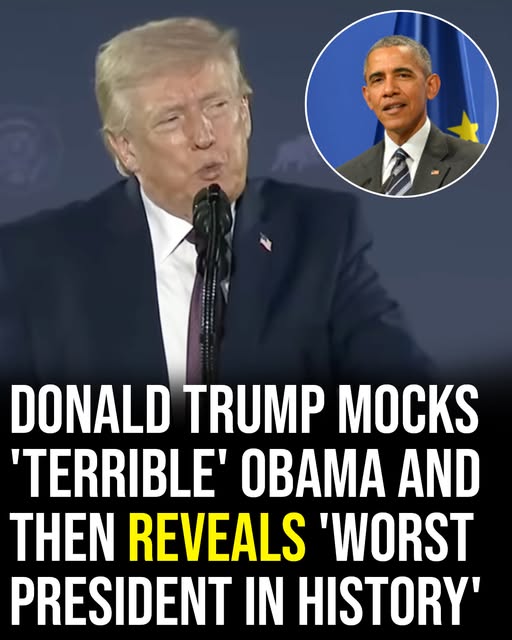
Trump didn’t hold back. In a blistering closed-door speech, he tore into two of his White House successors, delivering his remarks with the kind of force that left little room for interpretation. The audience—donors, strategists, and party loyalists—had gathered with a clear purpose: to find momentum, direction, and perhaps a spark that could shift the energy ahead of a difficult midterm season. What they got instead was something sharper, more personal, and far more revealing.
One former president was labeled “a great divider” and dismissed as “terrible,” a critique aimed not just at policy, but at legacy. Another drew even harsher language—called the “worst president in history,” a phrase delivered with emphasis, as if designed to linger in the room long after the speech ended. Then, almost as abruptly as the criticism came, Trump shifted tone, hinting at what he described as hidden “military triumphs” involving Iran—actions, he suggested, too sensitive or classified to be shown on television. The claim hung in the air, dramatic and unverifiable, adding another layer of intensity to an already charged address.
Behind the closed doors of the National Republican Congressional Committee dinner, the speech was more than a series of insults. It carried the weight of strategy, of positioning, of shaping a narrative for what lay ahead. Trump framed Republicans as the final barrier protecting “every hardworking patriot,” casting the stakes in stark, almost existential terms. In his telling, the contrast was clear: strength versus weakness, control versus chaos. He portrayed Obama as a leader who deepened divisions and strengthened adversaries like Iran, while reserving his most pointed criticism for Biden—blaming him for rising inflation, energy instability, and a world that felt increasingly uncertain.
The room responded as expected. There was laughter, applause, and moments of visible agreement. But beneath that reaction, something more complicated lingered. The speech didn’t just energize—it exposed. It revealed a party navigating a narrow path, balancing urgency with uncertainty. The Republican majority in the House remained fragile, thin enough that any shift could tip the balance. History, too, loomed in the background, with midterms often turning against the party in power. And beyond domestic politics, a volatile global stage added another layer of pressure, making every claim, every promise, and every warning feel heavier.
Trump’s references to “decimating” Iran and achieving unseen military victories injected adrenaline into the room, reinforcing a message of strength and decisiveness. Yet at the same time, those claims underscored a deeper unease—one that couldn’t be masked entirely by applause. The sense that rhetoric was escalating faster than resolution. That conflicts, both political and global, remained unsettled. That the country itself was still grappling with divisions that had not healed, only shifted in form.
In that sense, the speech functioned on two levels. On the surface, it was a rallying cry, designed to motivate, to unify, and to sharpen contrasts ahead of a critical political moment. But underneath, it reflected a broader tension—within the party, within the political system, and within the country as a whole. A tension between confidence and concern, between projection and reality.
As the evening moved on and conversations resumed, the impact of the speech lingered. Not just in the headlines it would generate, or the soundbites that would circulate, but in the questions it left behind. About direction. About strategy. About how a nation moves forward when its political discourse grows louder, sharper, and increasingly uncompromising.