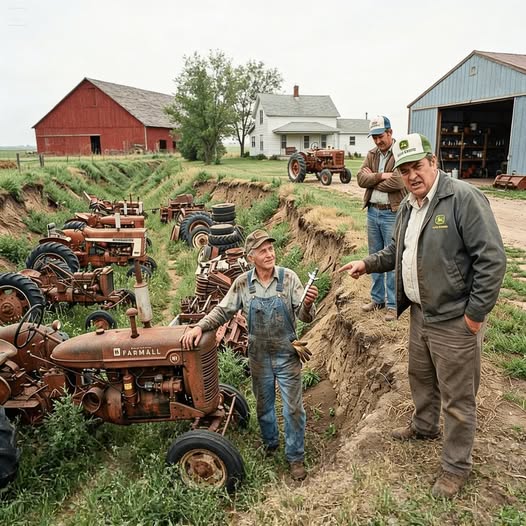
In the wide, rolling heart of the American grain belt, where the golden fields stretch to the horizon and the worth of a man is often measured by the gleam of his newest tractor or the square footage of his barn, Roy Hassel was slowly becoming a figure of quiet scandal. To the casual traveler speeding down the county road, his farm looked like nothing short of a disaster zone. Jagged piles of skeletal machinery leaned like fallen soldiers across rusted soil, and twisted iron protruded from the grass like forgotten relics of a bygone industrial age. The neighboring farmers, who prized neat rows and polished implements, had taken to calling it with a mixture of derision and disbelief: “The Junkyard.” The name stuck. It became shorthand for Roy Hassel himself, a man whose reputation teetered somewhere between eccentric genius and local pariah. But behind the chipped red paint of the barn doors, amid the haphazard stacks of tractors and spreaders, a quiet revolution was quietly taking place, one bolt, one gear, one bearing at a time.
It all began with a single, simple “yes.” A farmer down the road had asked Roy if he could drop off a broken-down combine header—“don’t want to throw it away,” the man had said—and Roy, without hesitation, had agreed. That moment would set the tone for what would become a two-decade-long transformation of his farm. Within two years, the barn had evolved into the final sanctuary for the county’s discarded machinery. Farmers who couldn’t afford the steep prices of new equipment began bringing their dead or dying machines: grain drills with jammed gearboxes, hay balers with stripped chains, manure spreaders with floors that had rotted entirely through. Roy welcomed them all. While other men spent their Saturday nights relaxing on porches or watching television, Roy retreated to his barn, grease-stained hands moving with the precision and devotion of a craftsman. He disassembled what others had given up on, cleaned, repaired, and meticulously cataloged each part that the outside world had abandoned. No piece of iron was too small, no spring too bent to escape his attention.
By 1970, the barn had become more than a storage shed; it was a cathedral of salvaged steel. Every corner hummed with organized chaos: rows of engines, shelves of manifolds, stacks of transmission cases, all meticulously labeled. Roy had cataloged 412 distinct parts by that time, ranging from Farmall head gaskets to Oliver manifolds, each entry recorded in a spiral-bound ledger that had become something like scripture in his household. Dates, machine types, and condition notes were written in Roy’s exacting hand, making it possible for a farmer in trouble to phone Roy and know, almost miraculously, that he had exactly the part they needed. His wife, Dela, observed this growing obsession with a mixture of exhaustion, awe, and quiet concern. One evening, after a particularly long day of sorting gearboxes, she leaned against a shelf and sighed, “Roy, the neighbors are calling this place a dump. When does it stop?”
Roy, eyes still on a set of brake shoes he was marking with masking tape, barely looked up. “When I run out of room,” he said quietly, almost as if he weren’t speaking to her at all but to the machines themselves, promising them sanctuary.
However, Roy’s vision extended far beyond personal satisfaction or mere hobbyism. Without intending to, he had disrupted an entire local economy. Merl Gustiffson, the county’s John Deere dealer, watched Roy’s farm with growing alarm. In Merl’s world, the rules were simple: farmers buy new, dealers sell new, and profit flows predictably from the showroom floor to the balance sheet. Every broken hydraulic pump, every salvaged gearbox that Roy could refurbish and send back into circulation represented a lost sale, a small but tangible dent in Merl’s revenue. He began a quiet campaign of gossip and intimidation, using the local co-op meetings as a platform to sow doubt. Roy’s farm, Merl claimed, was a safety hazard, a “cheat on the system,” and a threat to progress itself. Fourteen dead tractors, six abandoned combines, and the visual chaos of rusted steel were weaponized in conversation after conversation. The implication was clear: Roy was keeping the county stuck in the past, hindering the forward march of expensive, shiny, debt-fueled modernity.
What Merl did not, and perhaps could not, comprehend was the true purpose of Roy’s work. He wasn’t a junk man. He was a preservationist, a quiet historian of machines and an unseen champion for struggling farmers. In an age when planned obsolescence was beginning to shape the economy, Roy provided a lifeline. The small-scale farmer, one broken part away from bankruptcy, could now breathe. A cracked manifold or a bent axle would no longer mean financial ruin. Instead, there was hope, patience, and a man willing to see value in what others had discarded. Roy was not just fixing metal; he was preserving livelihoods, keeping the wheels of agriculture turning, and honoring the ingenuity embedded in machines that were slowly vanishing from the earth.
As the “junkyard” grew larger and the whispers grew louder, the tension in the township reached a crescendo. Community members debated Roy’s methods. Neighbors muttered under their breath, co-op meetings crackled with disapproval, and the local media occasionally ran stories of the “eccentric collector.” And yet, Roy remained unmoved. His eyes never left the rusted forms in front of him. He understood something that the world outside the barn did not: within that corroded metal lay the heart of the American farm, the sweat of generations, the persistence of human ingenuity, and the quiet courage to keep going even when the world had long given up. To outsiders, he was collecting trash. To the struggling farmers of the county, he was a guardian, a man holding the fragile future together with nothing more than salvaged steel, a spiral-bound ledger, and unwavering dedication. Roy Hassel had transformed “obsolete” from a word of dismissal into a philosophy of survival, ingenuity, and hope.