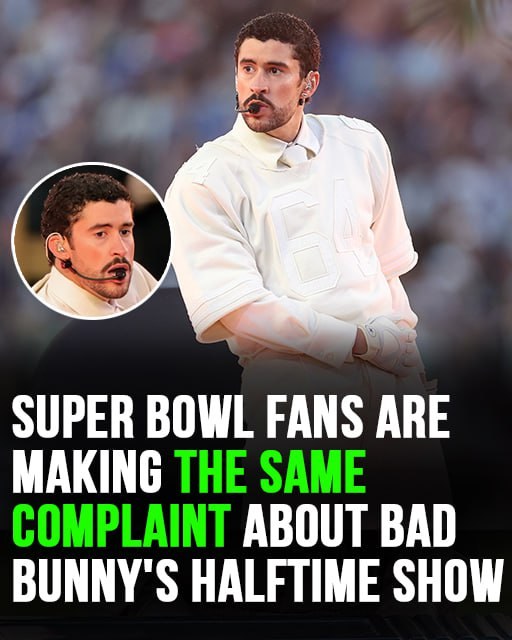
Bad Bunny’s halftime performance at Super Bowl LX delivered exactly what fans had been anticipating for months: a kaleidoscope of color, thunderous volume, kinetic movement, and an unrelenting energy that left the stadium pulsating long after the final note. The performance was bold, unapologetic, and meticulously designed to dominate one of the largest stages in global entertainment. Yet as the lights dimmed and the music faded into echoes, a familiar pattern emerged online. While millions celebrated the spectacle, a vocal subset of viewers immediately zeroed in on a single criticism—and wasted no time broadcasting it across social media platforms.
This year’s Super Bowl, held at Levi’s Stadium in Santa Clara, California, carried more cultural tension than any in recent memory even before the kickoff whistle. From the moment Bad Bunny was officially announced as the halftime headliner, public reactions were sharply divided. Supporters hailed it as long-overdue recognition of one of the most influential artists of his generation, a performer whose global reach and artistic innovation have reshaped modern music. Critics, on the other hand, framed the announcement as yet another example of the NFL straying from what they perceive as “traditional” American entertainment, complaining that the event had drifted too far from its roots.
The backlash had already begun to build long before game day. Conservative activist group Turning Point USA openly criticized the league’s choice, objecting specifically to the prospect of a halftime show performed predominantly in Spanish. The organization went further, staging a competing event branded as the “All-American Halftime Show,” with Kid Rock as the marquee performer. For some of these critics, the issue was never truly about the music or the showmanship; it was about what the performance represented culturally—a broader visibility of Latinx artistry and influence on the nation’s most-watched stage.
None of that diminished Bad Bunny’s momentum or relevance. By any objective measure, he is one of the largest artists on the planet. He sells out stadiums across continents, dominates streaming charts, and has transformed global pop culture without ever altering his language or identity to placate audiences. From a business and cultural perspective, his selection was flawless. If the Super Bowl halftime show is meant to reflect contemporary music trends, then Bad Bunny sits squarely at the center of that landscape, unapologetically representing his artistry to a worldwide audience.
When the show began, he delivered exactly what his fans had hoped for and more. The set was high-octane, visually immersive, and built around movement and spectacle rather than nostalgia or references to past hits. The crowd inside Levi’s Stadium responded instantly, its energy feeding into the performance and creating a feedback loop of excitement. The climax came when Lady Gaga joined him on stage, amplifying the intensity and sending the audience into a near-universal frenzy. From a production standpoint, the show was precise, modern, and unmistakably global in scope.
Yet as the performance unfolded, social media once again lit up with a familiar complaint. Many viewers focused less on the staging, choreography, or guest appearances than on one specific element: the language. Bad Bunny performed predominantly in Spanish—a choice he has never hidden, never apologized for, and never diluted for wider audiences. That decision quickly became the focal point of online criticism. Comments flooded platforms like X, Twitter, and Instagram, with viewers expressing frustration that they couldn’t understand the lyrics.
Some posts were sarcastic, jokingly asking whether a translator would appear on stage mid-performance. Others quipped that English subtitles might be necessary. A smaller number expressed genuine confusion rather than hostility, acknowledging Bad Bunny’s popularity but lamenting that a halftime show performed entirely in Spanish at a major American sporting event felt alienating. Others were more aggressive in tone, calling it one of the worst halftime shows ever and complaining that their children thought the broadcast had accidentally switched to a Spanish-language channel.
Several commenters attempted to soften their criticism while still reinforcing their point. They stressed that they bore “no ill will” toward Bad Bunny, insisting that the problem was purely the language barrier. Across thousands of posts, the underlying sentiment was the same: “I don’t understand the words.”
Supporters of the artist were quick to push back. Many reminded critics that comprehension of lyrics has never been a prerequisite for a successful Super Bowl halftime show. Iconic performances by Prince, Beyoncé, Bruno Mars, and others were memorable not for the words themselves but for the spectacle, musicality, and charisma on display. Others pointed out the obvious demographic fact: Spanish is the second-most spoken language in the United States, and for millions of viewers, this halftime show felt relevant, timely, and overdue—not foreign.
The NFL itself, along with Bad Bunny, opted not to respond—and neither arguably needed to. The league has long been pursuing a strategy of global expansion, and its halftime shows increasingly reflect the cultural and musical influence of international audiences. Viewed through that lens, the online criticism underscored exactly why the league’s selection of Bad Bunny was culturally significant.
Ultimately, the controversy revealed more about expectation than performance. For some fans, the Super Bowl remains a symbol of a narrowly defined American identity, and anything that challenges that image is met with resistance—even when it mirrors the nation’s current demographics and the evolution of musical taste. Bad Bunny did not adjust his sound, his language, or his identity to fit the stage. Instead, he brought the stage into his world, asserting his culture and artistry unapologetically. For supporters, that confidence was the core of the experience. For critics, it was the point of contention.
By the end of the night, complaints had not overshadowed the performance. Clips circulated widely online, streaming numbers spiked, and the halftime show dominated discussion long after the final whistle. Whether audiences loved it or hated it, they were talking about it—and in the realm of Super Bowl halftime shows, conversation itself is often the clearest measure of success.
Super Bowl LX will be remembered not only for the game itself but also for a halftime show that reignited a familiar cultural question: who gets to feel represented on America’s largest stage, and who decides what belongs there? In an era of rapidly changing demographics and globalized culture, the event illustrated that music, identity, and representation are intertwined—and that controversy can sometimes highlight the very progress that divides opinion.