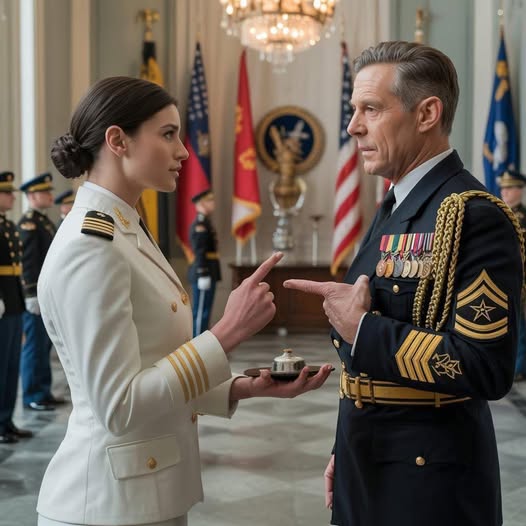
He died almost unnoticed, and we let him slip away as if his life were a minor footnote in a larger story we didn’t care to read. We mistook his distance for indifference, his quiet for emptiness, and his absence for irrelevance. Only after the funeral, when the echoes of mourners’ footsteps faded and the last hymn hung in the air, did the first crack in our understanding appear: a ring, a single, seemingly insignificant question, and a general who went pale the instant he saw it. Files didn’t match. Records were incomplete, some even erased. Our “boring” grandfather—the one who had baked cookies for us, mended leaky faucets, and quietly listened when we thought no one cared—had been someone far more extraordinary, someone whose life had been hidden in plain sight.
We had buried him like an ordinary man, the sort whose life can be summed up in a two-line obituary and a modest potluck after the service. Only later did the truth emerge: he had been trained to erase himself, to swallow every story, every achievement, every mission that might reveal where he’d been, what he’d done, or who hadn’t returned. The ring we had all overlooked for decades—simple, scuffed, unremarkable to an untrained eye—was a key. Not just a piece of jewelry, but a symbol, carried by men whose work ended in silence, whose victories were invisible, whose losses were unacknowledged. It was proof that his life had been extraordinary, that the quiet man we thought we knew had been moving through dangerous worlds we could not imagine.
When the general arrived, unannounced, stiff-backed, and carrying the weight of secrets decades old, the room itself seemed to shift. His voice, taut with restraint, trembled slightly as he described “men like your grandfather,” only to stop before crossing lines that were still bound by classified protocols. We didn’t receive the full, redacted version of our grandfather’s life—no declassified files, no cinematic retelling—but we were given something subtler and harder to grasp: a portrait of a man who had chosen to love from a distance, who had sacrificed personal recognition, and who had kept war and its horrors out of the kitchen of his family.
Now, that ring sits on my hand. It is no longer just a piece of metal; it is a warning, a talisman, and a reminder. It tells me never again to assume that quiet means empty, that ordinary appearances equate to small deeds, or that a life lived without fanfare carries little cost. Our grandfather’s story teaches that true courage often moves silently, unseen, and that the smallest figure in a room may have carried the heaviest burdens. It is a call to attention, a challenge to look beyond the surface, and a lesson in recognizing the extraordinary lives hiding in the quiet corners of ordinary days.