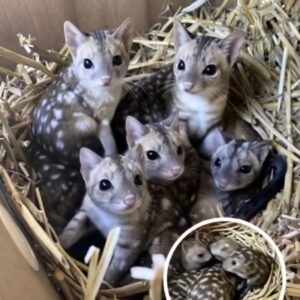
At Mt. Gibson Wildlife Sanctuary in Western Australia, ecologists recently celebrated a momentous and heartwarming milestone: the birth of the first baby western quolls, also known as chuditch, at the sanctuary. This event is not just a success story in wildlife conservation; it represents years of careful planning, dedication, and tireless effort to restore one of Australia’s unique marsupials to its natural habitat. During a routine survey, researchers were overjoyed to discover the tiny, delicate joeys safely nestled in their mothers’ pouches — a tangible sign that the sanctuary’s reintroduction program is working. For the team, it was a moment of pure excitement and emotional significance, a confirmation that their work to rebuild balance in Australia’s fragile ecosystems is beginning to bear fruit.
Western quolls are small, agile marsupials, roughly the size of a domestic cat. They are nocturnal hunters with remarkable agility, feeding on insects, small mammals, birds, and reptiles. By preying on these species, quolls play an essential role in regulating the ecosystem, ensuring no single population dominates and disrupts the natural balance. In this way, quolls act as a vital safeguard for ecological health, keeping the environment in equilibrium and allowing other species to thrive.
Historically, western quolls were found across much of mainland Australia, inhabiting forests, woodlands, and open landscapes. Their numbers, however, have dwindled dramatically over the past century. Habitat destruction caused by agriculture, urban expansion, and deforestation significantly reduced their living spaces. Introduced predators such as foxes and feral cats further threatened their survival, preying on both adults and young. Human activities, including accidental trapping and hunting, added further pressures. Today, western quolls survive in only a fraction of their former range, making every new birth and each successful reintroduction a momentous achievement for conservationists.
The Australian Wildlife Conservancy (AWC) has led the charge in returning quolls to their former habitats. Their approach combines scientific research, careful planning, and hands-on conservation techniques. Each quoll is carefully assessed and monitored, with the sanctuary providing predator-free areas, supplemental food, and environmental enrichment to ensure the animals can thrive. The sanctuary also tracks the quolls’ movements, reproductive behaviors, and interactions to gauge the success of the program. By creating a safe and supportive environment, the AWC is giving the quolls the best possible chance to survive and reproduce.
The discovery of the baby quolls at Mt. Gibson marks a significant milestone. It demonstrates that the animals are not only surviving but also beginning to establish new, self-sustaining populations. Each birth represents a hopeful step toward recovery, a sign that the sanctuary provides the conditions necessary for the species to flourish. These tiny marsupials are the promise of the next generation — a generation that may eventually expand into surrounding areas, restoring the quolls’ presence across more of their historic range.
For the conservation team, observing the joeys tucked safely into their mothers’ pouches was a profoundly moving experience. Each life symbolizes years of effort — from habitat restoration and predator management to fundraising and public awareness campaigns. Every volunteer hour, donation, and moment spent advocating for wildlife contributed to this success. Seeing these young quolls thrive offers both personal and professional fulfillment to the researchers and volunteers who have devoted themselves to the species’ survival.
The ecological importance of these births cannot be overstated. As predators, quolls maintain the balance of smaller animal populations, which prevents overgrazing and the overconsumption of native plants. Their presence benefits the broader ecosystem, supporting biodiversity from insects and reptiles to birds and other mammals. This cascading effect highlights the interconnectedness of all species and shows how the survival of one predator can positively impact an entire habitat.
Beyond the scientific significance, the birth of these young quolls carries a message of hope and inspiration for the wider community. It illustrates that with dedication, knowledge, and collaboration, humans can make a meaningful difference in reversing environmental decline. Public support — whether through volunteering, donations, or raising awareness — directly contributes to moments like this, proving that conservation is a collective effort.
As the joeys continue to grow, explore, and interact with their environment, they serve as living reminders of what is possible when humans act as careful stewards of the natural world. Each day, their presence reinforces the idea that ecosystems can recover and flourish if given the right conditions and support. The sanctuary has become a place of learning, research, and hope, showing that endangered species can once again thrive when protected and nurtured.
In conclusion, the birth of the first baby western quolls at Mt. Gibson Wildlife Sanctuary is a story of triumph, dedication, and ecological restoration. It is a testament to the power of focused conservation efforts, the impact of community involvement, and the resilience of nature itself. These young quolls are more than just a scientific achievement — they are a symbol of the future, a reminder that endangered species can recover, ecosystems can heal, and humans can play a positive role in preserving the natural world for generations to come.