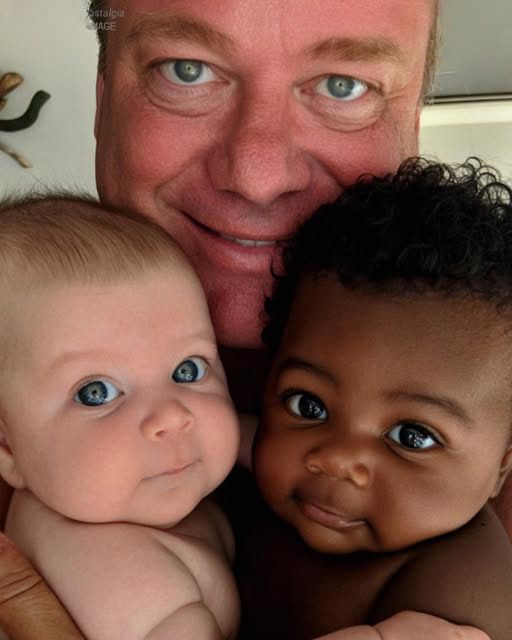
If someone had told me that the day my sons were born would completely change my life—that people would question my marriage and that the truth would challenge everything I thought I knew about family—I probably wouldn’t have taken it seriously.
But the moment my wife asked me not to look at our newborn twins, I knew something wasn’t right.
Anna and I had spent years hoping for a child. After going through multiple miscarriages, we were emotionally exhausted, barely holding onto hope. I tried to stay strong for her, but there were nights I’d find her awake, quietly talking to the baby we hadn’t even met yet.
So when she finally carried a pregnancy to term, it felt like something we had fought hard for. Every moment mattered—every heartbeat, every movement.
Then came the day of the delivery.
Everything happened fast—doctors moving quickly, machines sounding, Anna in pain. Before I could fully understand what was going on, she was taken away.
When I was finally allowed to see her, she was holding our two sons close, shaking.
“Please… don’t look at them yet,” she said.
My heart sank. I didn’t understand why—until I saw them.
One of our boys, Josh, had lighter features like mine.
The other, Raiden, had darker skin and curly hair.
For a moment, I didn’t know what to think.
Anna started crying immediately. “I didn’t cheat. I swear. I love you. I don’t know how to explain this.”
I didn’t have answers—but I chose to trust her.
The hospital ran tests, and the wait felt endless.
When the results came back, the doctor confirmed that I was the biological father of both children.
It didn’t seem possible—but it was real.
Even so, life didn’t simply go back to normal.
People noticed. They stared. They asked questions that crossed every boundary.
Anna struggled the most. The looks, the comments—it slowly wore her down. She became quieter, carrying something heavy inside her.
Years went by. The boys grew, bringing joy and energy into our home—the kind of life we had always dreamed of.
But Anna still wasn’t at peace.
Then one night, after the boys turned three, she finally opened up.
She showed me messages from her family—telling her to stay silent, to let others believe something untrue rather than reveal the reality.
I couldn’t believe it.
Then she told me everything.
Her grandmother had been of mixed race, something her family had hidden for years out of shame. That part of their history had been ignored, never spoken about.
And there was something else.
During her pregnancy, doctors discovered that Anna had a rare condition—she carried two sets of DNA, likely from absorbing a twin early in development.
That meant her genetic makeup held more than one lineage—and it explained our sons.
Raiden wasn’t a mystery.
He was part of a truth her family had tried to hide.
Anna had kept all of this to herself, trying to protect us. But in doing so, she carried a burden that was never hers to carry.
I wasn’t angry at her.
I was angry at the people who made her feel like she had to hide.
So I spoke to her mother.
I didn’t argue—I just made it clear that until they accepted the truth and respected Anna, they wouldn’t be part of our lives.
Not long after, everything came to a turning point at a church gathering.
Someone asked the question we’d heard too many times:
“Which one is yours?”
This time, I didn’t hesitate.
“Both of them,” I said. “They’re my sons. We’re a family.”
The room fell silent.
And for the first time, Anna didn’t shrink back.
Later, she asked me if any of it embarrassed me.
I told her honestly—never.
From that point on, we focused on building a life based on honesty, not silence. When we celebrated the boys, we did it surrounded by people who truly cared about us.
That evening, sitting together in peace, Anna leaned against me and said softly, “Promise me we’ll always be honest with them.”
“I promise,” I told her.
Because sometimes the truth doesn’t tear a family apart.
Sometimes, it’s exactly what brings it together.