The call came in the dead of night, shattering the fragile illusion of normalcy that I had taken for granted.
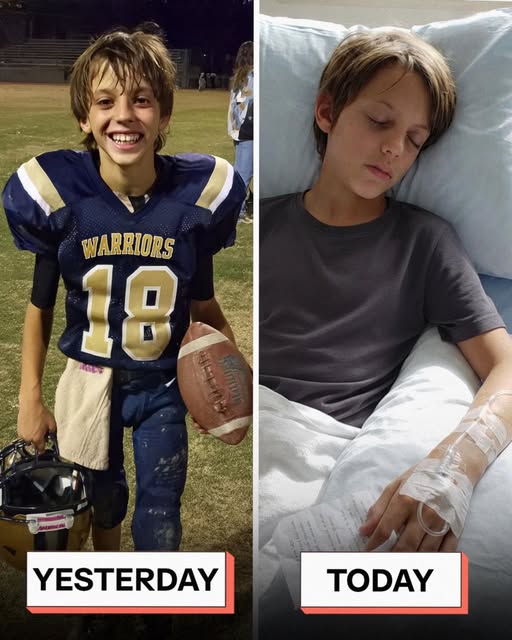
One moment, my thirteen-year-old son, Andrew, was walking out the door with his father for an ordinary stroll, a routine we had followed countless times. The next, he was lying in a hospital bed, surrounded by machines, completely unresponsive, and the world had tilted on its axis.
Some moments in life divide everything into “before” and “after.” That phone call was mine.
Andrew had always been boundless energy, the kind of child who left half-empty water bottles scattered across the house and wore out sneakers faster than I could buy replacements. Before he left that day, I gave him my usual reminder:
“Take your inhaler, just in case.”
He rolled his eyes, smiled quickly, and walked out.
That was the last time I heard his voice.
By the time I arrived at the hospital, everything had shifted. Fluorescent lights burned too bright, the air reeked of antiseptic, and the world had condensed to one point: my son, motionless in a hospital bed.
Brendon, my ex-husband, sat nearby, pale and shaken. He repeated the same words over and over:
“I don’t know what happened. He was fine. One moment he was standing, the next he collapsed.”
I wanted to believe him.
But something felt wrong.
This wasn’t the first time he had ignored Andrew’s health concerns. Past symptoms had been dismissed, appointments skipped despite my insistence, warnings overlooked. And now my son lay in a coma.
The doctor approached, calm yet firm, and her words struck me like lightning.
Andrew had suffered a cardiac event. His heart had briefly stopped, and they had managed to revive him. He was alive—but unconscious—and they didn’t yet know why.
Every hour, every second mattered.
I stood at his bedside, gripping the rail, watching the gentle rise and fall of his chest, whispering words into the quiet room, trying to will him back:
“I’m here, baby. You’re not alone.”
Behind me, Brendon’s sobs felt off—too loud, too deliberate, as if he were convincing himself of something he didn’t want to admit.
I pressed him again.
“Did he say anything? Chest pain? Dizziness? Any warning at all?”
He shook his head too quickly.
“No. Nothing. He was fine.”
But I saw the flicker, the hesitation, the truth he wasn’t speaking aloud.
Later, after visiting hours ended and he had left, the room fell into an almost unbearable silence. Just me, Andrew, and the persistent hum of machines recording every fragile sign of life.
That’s when I noticed his hand.
Clenched. Tight. Something hidden in his fingers.
I gently pried it open and found a small, crumpled piece of paper. His handwriting.
“Mom, open my closet for the answers. BUT DON’T TELL DAD!”
My heart sank.
Why hide something from his father? What could be so important that he had to leave me a secret note in this moment?
“I promise,” I whispered. “I’ll find out.”
I left the hospital that night with the note in my hand, mind spinning with questions I feared to answer.
At home, the quiet was suffocating. I paused outside Andrew’s room before stepping inside, bracing myself.
His closet door was slightly ajar. My chest tightened.
I searched. Slowly at first, then urgently, scanning every shelf, every box. On the top shelf, hidden behind a stack of old comics, I found a shoebox.
Inside, the truth revealed itself.
A cardiology appointment had been scheduled for the coming week—necessary, critical. And there was a note:
“Appointment canceled by parent — Brendon.”
Canceled. Not postponed, not rescheduled.
My hands shook as I read the next note, in Andrew’s handwriting:
“Dad said I don’t need it. Mom is going to freak out.”
I couldn’t breathe.
He had felt something was wrong. He had been scared. And instead of getting help, he had been told to ignore it.
I called Brendon immediately.
“Why did you cancel his appointment?”
He hesitated.
“I didn’t think he needed it. You always overreact.”
Overreact. The word hit me harder than anything else.
“He trusted you,” I said, my voice trembling. “He told you something was wrong.”
“I didn’t want to worry you,” he replied.
I hung up, fury and grief knotted together, and turned to another piece of evidence—the video on my phone I hadn’t seen yet.
It was Andrew, minutes before everything happened. Pale, uneasy.
“Hey, Mom… I don’t feel good. My chest hurts. I feel dizzy. Dad says it’s nothing, but I’m scared.”
In the background, Brendon’s voice:
“Put that away. You’re fine. Stop making a scene.”
My son had reached out. He had been scared. And I hadn’t been there in time.
But from that moment, the guilt transformed into resolve.
I called the hospital, voice steady.
“This is Andrew’s mother. I have information you need to hear.”
By morning, everything changed. The note, the canceled appointment, the video—everything went into his chart. The doctors updated the plan, accounted for every detail.
For the first time since that night, I felt not relief, but hope.
Brendon’s explanations no longer mattered. This wasn’t about blame. It was about Andrew.
“No more decisions without me,” I made clear. He didn’t argue.
Sitting beside Andrew again, I held his hand gently.
“I found your answers,” I whispered.
The machines continued their rhythmic hum—a reminder that he was still fighting. And I was too.
Because when he wakes—and I know he will—he’ll know one thing for certain:
I listened.
And this time, I didn’t miss it.