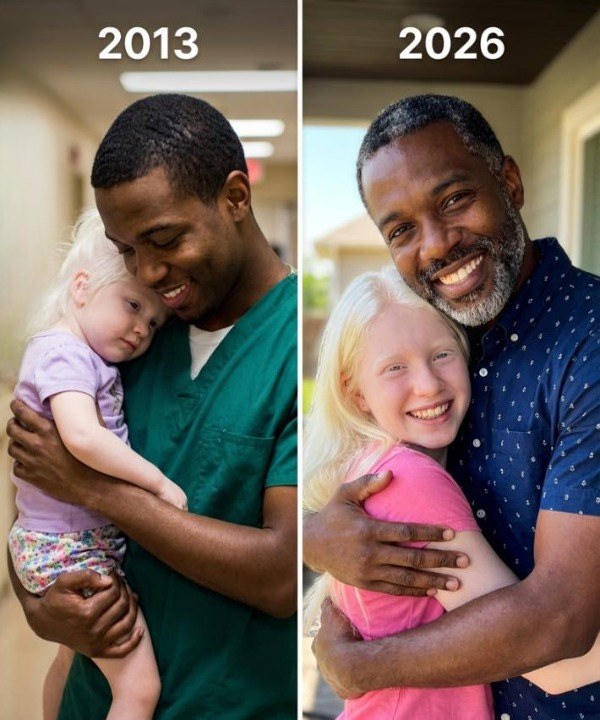
Thirteen years ago, during what should have been just another exhausting shift in the ER, I met a terrified three-year-old girl whose world had collapsed in an instant.
She had just lost her parents. She didn’t understand what was happening, only that everything familiar was gone. The room was filled with noise—machines, voices, footsteps—but she seemed completely alone in it all. When I approached her, she didn’t say a word. She just reached out and grabbed my arm, holding on tightly, as if I were the only thing keeping her from falling apart.
And in that moment, something inside me shifted.
I couldn’t walk away.
What started as a simple act of comfort—sitting beside her, reassuring her, staying a little longer than I was supposed to—quickly became something much deeper. I checked on her the next day. Then the day after that. I told myself it was just part of my job, just making sure she was okay.
But it wasn’t just that.
Days turned into weeks. Weeks turned into months. I found reasons to be there—for paperwork, for updates, for anything that kept me close. And somewhere along the way, I stopped being just the doctor who had helped her.
I became her person.
When the system started talking about placement, foster care, and uncertainty, the idea of her being sent somewhere unfamiliar—somewhere without stability—didn’t sit right with me. Not after everything she had already been through.
So I made a decision that changed both of our lives.
I adopted her.
I named her Avery, and from that moment on, everything in my life began to revolve around her. My priorities shifted without hesitation. Long hospital shifts, early mornings, sleepless nights—it didn’t matter. I would come home exhausted, but the moment she ran to me, everything felt lighter.
Every small moment became meaningful.
Teaching her how to tie her shoes. Helping her with homework. Watching her fall asleep on the couch after insisting she wasn’t tired. Listening to her laugh—really laugh—for the first time after everything she had been through.
Those were the moments that built us.
And slowly, piece by piece, she healed.
Avery grew into someone I couldn’t be more proud of. She became strong in ways most people never have to be. She was kind, thoughtful, and quietly resilient. She carried her past, but it didn’t define her. If anything, it shaped her into someone even more compassionate.
Our bond wasn’t something that needed explanation.
It was just there—solid, unbreakable, real.
She wasn’t just my daughter in name.
She was my daughter in every way that mattered.
For years, it was just the two of us, and honestly, I never felt like anything was missing.
Until Marisa came into my life.
She entered slowly, naturally. We met through mutual connections, and at first, it felt easy. She was intelligent, calm, and had a way of making conversations feel effortless. For the first time in a long while, I allowed myself to imagine a future that included someone else.
Not instead of Avery—but alongside her.
I thought maybe we could build something more. A fuller life. A shared one.
And for a while, it seemed possible.
Marisa was polite, composed, and outwardly supportive. She never openly challenged my relationship with Avery, and I took that as a good sign. I believed she understood what Avery meant to me.
I believed we were on the same page.
But I was wrong.
The shift didn’t happen all at once. It was subtle at first—small comments, slight changes in tone, moments that felt off but were easy to dismiss. I told myself I was overthinking. That everything was fine.
Until the night everything came crashing down.
Marisa arrived unannounced, her expression serious, almost controlled. She didn’t waste time with small talk. Instead, she pulled out her phone and showed me security footage.
According to her, Avery had been going into my office and stealing from my safe.
The accusation hit me harder than I expected. Not because I believed it—but because I didn’t understand it. The idea itself didn’t make sense. Avery had never given me a reason to doubt her.
Still, seeing the footage created a moment of confusion.
A moment of uncertainty.
But only for a second.
Because when I turned to Avery, I didn’t see guilt. I didn’t see fear.
I saw confusion.
Real, genuine confusion. And beneath it—hurt.
She looked like someone who had just been accused of something she couldn’t even comprehend.
That’s when I knew something wasn’t right.
Then I noticed a small detail in the footage.
The hoodie.
It was hers—but something about it felt off. It wasn’t where it should have been. The way it appeared in the video didn’t match reality. It was a tiny inconsistency, but it was enough.
Enough to make me question everything.
So I didn’t react emotionally. I didn’t jump to conclusions.
I checked the footage myself.
Carefully. Thoroughly.
And the more I looked, the clearer it became.
The angles didn’t line up. The timing was manipulated. The setup was deliberate.
This wasn’t a misunderstanding.
It was staged.
Marisa had used Avery’s belongings—her space, her identity—to create doubt. To plant suspicion where none existed. To make it look like Avery had done something wrong.
All to create distance between us.
All to break something she didn’t understand.
When I confronted her, she didn’t deny it for long.
It came down to one thing: resentment.
She couldn’t accept the kind of bond Avery and I shared. She couldn’t understand how something so strong could exist without biology. To her, it didn’t make sense. It didn’t fit into how she saw the world.
And instead of accepting it, she tried to tear it apart.
In that moment, my choice was immediate.
Clear.
There was no hesitation.
I chose my daughter.
I asked Marisa to leave. Calmly. Firmly. No arguments, no second chances, no room for negotiation.
Some things don’t deserve discussion.
Then I turned to Avery.
She was still standing there, quiet, processing everything.
I sat beside her and told her the truth—not just about what had happened, but about us. About what we meant to each other.
I told her she didn’t have to prove anything.
That nothing could break what we had built.
That she was safe.
And more than anything—that she was loved.
Unconditionally.
In the days that followed, I made changes. Not out of fear, but out of responsibility. I strengthened our sense of security—both physically and emotionally. I made sure Avery knew, without a doubt, that our home was a place where she would always be protected.
Where trust wasn’t fragile.
Where love wasn’t conditional.
And what remained after everything settled wasn’t just relief.
It was clarity.
A deeper understanding of what truly matters.
Because family isn’t defined by blood.
It isn’t about biology or shared DNA.
It’s about presence.
It’s about choosing each other, every single day.
It’s about standing beside someone when it matters most—and refusing to walk away, no matter how difficult things get.
And if there’s one thing I know for certain, it’s this:
I didn’t just adopt Avery thirteen years ago.
We chose each other.
And I will keep choosing her—again and again—no matter what.